Stage 1 vs Stage 2 tuning: difference, power and parts

Stage 1 vs Stage 2 tuning – what's the real difference?
Author: ASF Tuning – professional ECU/TCU tuning and dyno centre
If you're researching tuning for your car, you've surely come across the terms Stage 1 and Stage 2. But what do they actually mean? What are the differences in power, investment and safety? And which is the better option for your engine?
Below we give a precise explanation, based on our experience with over 1,000+ maps done every month, work on the latest ECU generations and measurements on a 4×4 dyno ASF Tuning.
What is Stage 1 tuning?
Stage 1 is the most popular and safest level of tuning — ideal for completely stock cars without any mechanical modifications.
What's needed for Stage 1?
- Stock exhaust
- Stock intercooler
- Stock air intake
- Standard fuel (95/98)
- Regular engine maintenance
What's done in Stage 1?
- Optimisation of injection and the fuel map (ECU remap)
- Adjusting turbo boost within safe limits
- Torque optimisation
- Removing factory throttle response limits (where possible)
How big are the gains?
Gains depend on the model, but roughly:
- Turbo petrol engines: +20–45% power
- Turbodiesels: +25–40% power
Stage 1 advantages:
- The best price / result ratio
- Compatible with stock mechanics
- Minimal increase in temperature and load
- The car becomes livelier, faster and smoother
- The map can be returned to stock whenever you like
Stage 1 is ideal for everyday driving and maximum safety.
Want a safe power increase while keeping stock mechanics?
Learn more about Stage 1 chip tuningWhat is Stage 2 tuning?
Stage 2 is a more serious level of tuning for those who want even more power, but are ready for mechanical upgrades and somewhat larger investment.
Modifications needed for Stage 2:
- Sports or free-flowing exhaust / downpipe
- Larger or more efficient intercooler
- Improved intake (performance air intake)
- On many turbo petrol engines – spark plugs of the right heat range
What do you get with Stage 2?
- An even bigger increase in power and torque (often +30–60% compared to stock)
- More stable and higher boost pressure
- Lower intake temperatures thanks to better flow
- Faster turbo spool and better response
- A sportier, more pronounced exhaust sound (especially on turbo petrol engines)
Stage 2 drawbacks:
- An additional budget for mechanical parts is needed
- The car can be noticeably louder
- More frequent and higher-quality maintenance is needed
- In some countries an overly loud exhaust can cause problems at the roadworthiness inspection
Thinking about Stage 2 tuning? First measure your real power on the dyno.
Book a 4×4 dyno measurementStage 1 vs Stage 2 – side by side
| Element | Stage 1 | Stage 2 |
|---|---|---|
| Mechanical modifications | No, all stock | Yes, exhaust, intercooler, intake... |
| Power increase | ⭐⭐ – strong gains | ⭐⭐⭐⭐ – maximum gains |
| Turbo boost | Moderate, within factory limits | Higher, but controlled and safe |
| Temperatures | Slightly above stock values | Higher – that's why better flow and cooling matter |
| Investment in parts | Low | Medium to high |
| Purpose | Everyday driving | Sporty driving / enthusiasts |
| Sound | Mostly stock | Sportier, louder |
Examples from our dyno
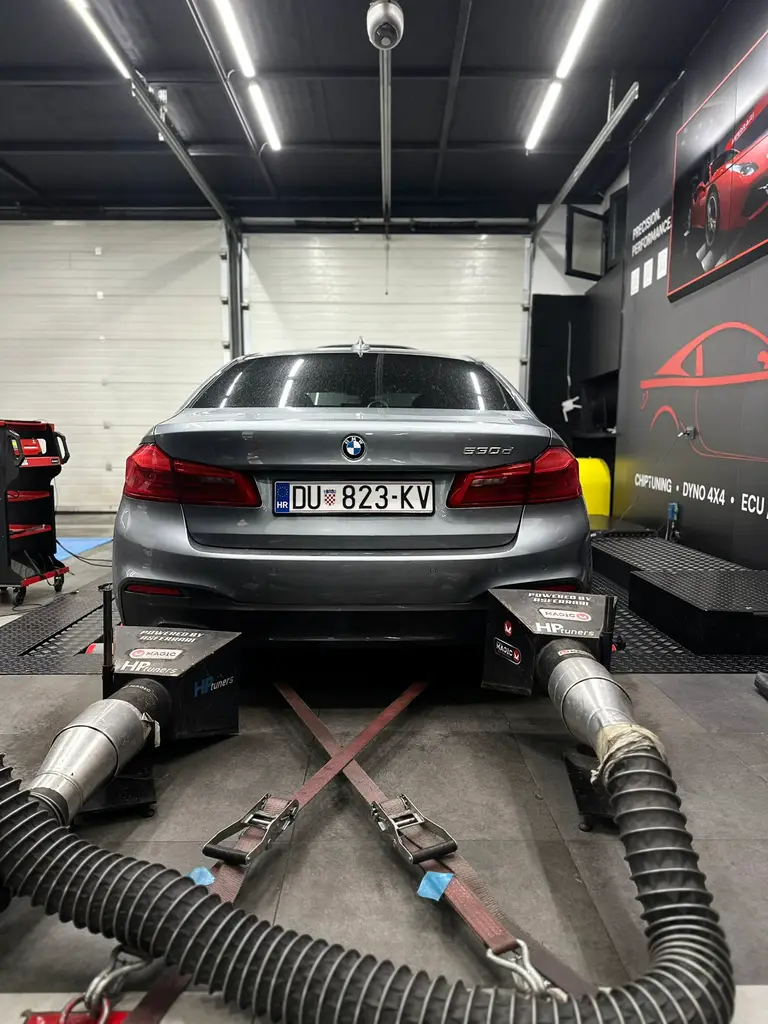
Real results measured on our dyno in Danilovgrad. Click a car to see the full project.
| Car | Level | Stock | After tuning |
|---|---|---|---|
| Audi A6 C8 2.0 TDI | Stage 1 | 204 hp | 232 hp |
| Audi A5 2.0 TDI | Stage 1 | 177 hp | 215 hp |
| BMW 750i (G series) | Stage 1 | 530 hp | 673 hp |
| Mini Countryman 2.0 diesel | Stage 2 | 136 hp / 314 Nm | 205 hp / 430 Nm |
| Audi A4 2.0 TFSI | Stage 2 | 252 hp | 304 hp |
| BMW M235i (F22) 3.0 N55 | Stage 2 | 326 hp / 450 Nm | 400 hp / 540 Nm |
| Audi A6 C7 3.0 TFSI | Stage 2 | 319 hp / 444 Nm | 453 hp / 547 Nm |
| Porsche Panamera 4S 2.9 Twin-Turbo | Stage 2 | 340 HP | 540 HP |
See more projects in our dyno projects, and check the power gain for your car in the power catalogue.
Does Stage 2 shorten engine life?
With properly done tuning and the right mechanical modifications – it doesn't have to.
The danger only arises when:
- a poor or too narrow downpipe is used,
- the car is driven with excessive intake and exhaust temperatures,
- unprofessional, “generic” maps are applied without measurement and logs.
U ASF Tuning the tuning is done with:
- 4×4 dyno measurements
- turbo boost and fuel logs
- AFR and EGT monitoring (where applicable)
- checking fault codes and the engine's health
You can also read more about engine technology and turbo systems on the official websites of Bosch Mobility Solutions, Garrett Motion and EVC Electronic (WinOLS).
How do we know what's ideal for your car?
Before any tuning we do:
- an engine health check and fault diagnostics
- a baseline dyno measurement
- analysis of turbo, pressure and temperature logs
Based on that, we recommend:
- Stage 1 – for stock, well-maintained cars in everyday use
- Stage 2 – for owners who want more, with the right mechanical mods
Not sure whether your car is for Stage 1 or Stage 2?
Send us your vehicle's model, engine and year and you'll get a free recommendation based on our dyno experience.
Send an enquiry to the ASF Tuning teamStage 1 and Stage 2 tuning: frequently asked questions
How much power does Stage 1 add?
It depends on the engine. Turbo petrol engines usually gain 20–45% more power, turbo diesels 25–40%. You can see the exact gain for your car in the power catalogue or after a dyno run.
Is Stage 1 safe for the engine?
Yes, as long as the engine is healthy and regularly serviced. Stage 1 stays within the limits of the stock hardware, and we check every map on the dyno and through logs.
Can the car be returned to the factory map?
Yes. The factory map can be restored whenever you want.
What do I need for Stage 2?
Usually a downpipe or a freer-flowing exhaust, a better intercooler and intake, and on many turbo petrol engines spark plugs with the right heat range. The map is written for the parts fitted to your car.
How much does chip tuning cost?
Chip tuning with us starts at €140. You will get the exact price for your car when you send us an inquiry.
ASF Tuning – professional ECU & TCU tuning, dyno measurements and individual mapping tailored to you.