Tuning training at ASF Motorsport for workshops
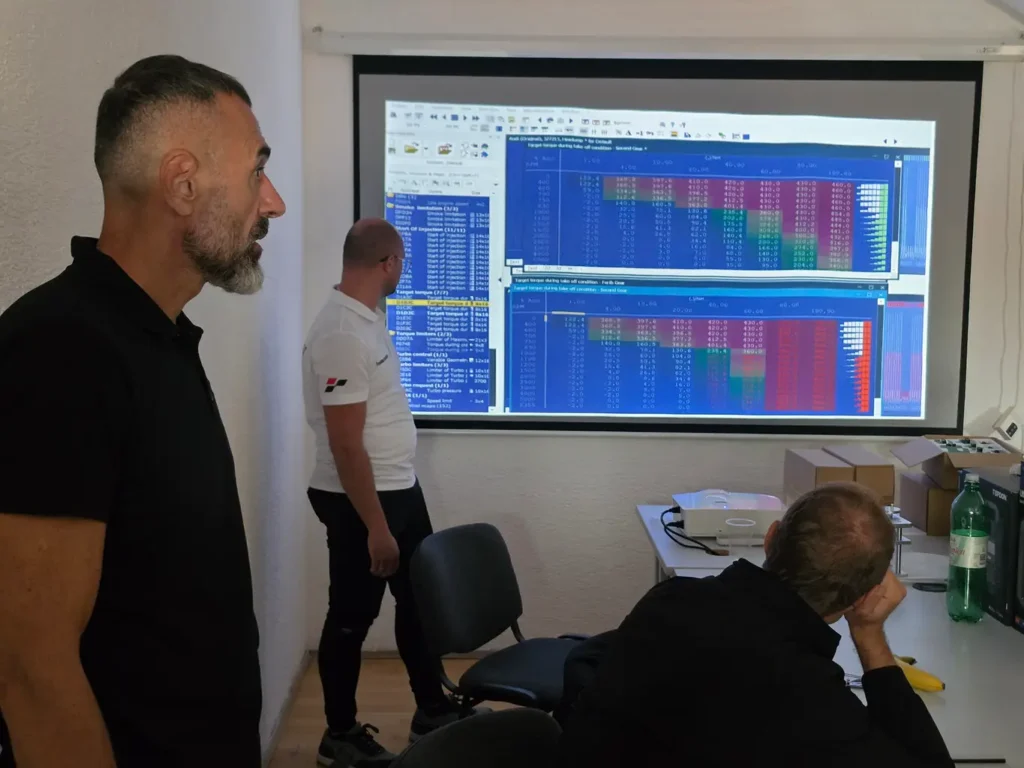
A calibration file on its own isn't tuning knowledge. Without proper diagnostics, an understanding of the control unit's strategy and measurement under load, every change remains an assumption. Tuning training at ASF Motorsport focuses on exactly the difference between simply writing a file and a professional process in which every decision can be explained with data.
For a workshop, tuner or experienced enthusiast this means working methodically: first establish the vehicle's real condition, then set a realistic goal, adapt the calibration to the hardware and finally confirm the result. That's the Where Speed Meets Precision approach – performance isn't about the biggest number on the screen, but about controlled delivery of power, response and reliability.
What tuning training should teach
Good training doesn't start with how much power can be gained. It starts with whether the vehicle is technically ready for calibration. A stock engine, a modified turbo system, a motorcycle with a changed exhaust or a work machine under constant load have different requirements, even though they all use electronic engine management.
The trainee needs to understand the relationship between driver demand, the torque model, injected fuel quantity, air, boost pressure, temperature and protection functions. When these parameters are looked at separately, it's easy to make a change that seems successful in the short term but isn't aligned with the rest of the ECU strategy. Professional calibration requires the system to work as a whole.
In modern vehicles the ECU often doesn't use one map that directly determines power. The control unit compares pedal demand, permitted torque, calculated air mass, gearbox limits and active protections. That's why understanding the logic matters more than randomly raising values in individual tables.
Diagnostics before every change
The first practical step is checking faults, live data and the basic mechanical condition. DTC codes aren't just an obstacle to clear. They can point to a fuel pressure deviation, a faulty sensor, a turbo actuator problem, clutch slip or a limit that will affect the final result.
Training should also cover reading data in real conditions. Intake air temperature, fuel corrections, actual and requested boost, EGT where available, fuel pressure and the behaviour of torque limiters give context to every measurement. One clean dyno run isn't enough if the log shows instability or active protection under prolonged load.
Motorcycles, ATVs and UTVs need extra attention to the drivetrain, cooling and how they're used. A vehicle doing short sprints doesn't load the system the same way as one driven uphill, under load or in high ambient temperatures. The calibration must always follow the vehicle's real purpose.
Working on the dyno: measurement, not spectacle
A dyno is a tool for repeatable measurement and controlled conditions, not just a device for posting peak power. During tuner training it's especially important to understand why a baseline measurement is done before changes and why the same parameters are checked after every relevant correction.
An AWD chassis dyno allows all-wheel-drive vehicles to be tested in a controlled environment. On vehicles with advanced drive and stability systems this matters, because the wrong procedure can give unreliable results or trigger protection strategies. Proper ventilation, temperature stabilisation, correct strapping of the vehicle and choice of measurement mode are just as important.
The result isn't read only through the peak value. The torque curve, the power delivery range, repeatability across several runs and behaviour as temperature rises often say more than one high number. With TCU calibration, shift quality, response to torque demand and alignment between the ECU and gearbox strategies are also observed.
Why baseline data is crucial
Without a baseline measurement it's impossible to judge a change objectively. Two vehicles of the same model can differ because of fuel, mileage, maintenance, previous modifications or the control unit's software version. Baseline data protects both the tuner and the vehicle owner from conclusions based on feel.
In practice, power and torque are compared, but so are the logs before and after calibration. If a performance gain comes with excessive temperature, a fuel pressure deviation or limiters kicking in, the job isn't finished. The right response isn't to ignore the data, but to find the cause and adjust the solution.
ECU and TCU calibration as a linked system
The ECU controls the engine, while on automatic gearboxes the TCU controls shift logic, torque limits, clutch pressure and other functions depending on the gearbox design. When the engine's available torque increases, the TCU strategy can become just as important as the ECU calibration.
Tuning training must therefore explain when TCU adjustment is justified and when it isn't. On some vehicles the stock TCU calibration can limit engine demand or change gearbox behaviour in a way that doesn't suit the new torque curve. On others, the priority is to keep the stock logic and work within its limits. There is no universal setting for every platform.
Special focus should be on torque limits and the coordination of requests between modules. If the ECU calculates one permitted torque and the gearbox expects another, the result can be power reduction, inconsistent response or unnecessary load on the drivetrain. Precise calibration doesn't bypass the problem – it aligns the strategies where this is technically possible and justified.
Safety limits aren't an obstacle to performance
Protection functions in stock software exist for a reason. Some are conservative because of the wide range of markets and operating conditions, while others directly protect the engine, turbo, fuel system or transmission. Training must teach how to tell these two categories apart instead of treating every limiter as an obstacle to be removed.
Temperature protections, knock monitoring on petrol engines, fuel pressure monitoring and boost deviation control are part of safe operation. How they're interpreted depends on the engine, fuel, hardware and load profile. The calibrator's goal is to keep control of the system, not to hide the signal that it's running outside its intended range.
This applies especially to commercial vehicles and agricultural and industrial equipment. There, usable torque at working revs is often more important than peak power, and machine downtime can cost more than any performance gain. The calibration must respect the duty cycle, load and service intervals of the specific machine.
From a file to a documented process
A professional tuner keeps records of the original software read, hardware identification, calibration version, changes and measurements. This allows a return to the previous state, easier diagnostics and clear communication with the vehicle owner. Data organisation may not be the most exciting part of tuning, but it's part of a serious workshop.
It's equally important to know the limits of your own experience. Some platforms, unknown modifications or complex faults require further analysis before any change. Good training builds the habit of stopping the work when the data isn't clear enough, instead of making a decision under the pressure of expectations.
For workshops that want to build a long-term reputation, this discipline is key. The vehicle owner should get an explanation of what was checked, what was changed and how the result was confirmed. Transparency doesn't diminish expertise – it demonstrates it.
The most useful outcome of tuner training isn't editing the first map faster, but a better way of thinking about every one after it. When diagnostics, measurement and calibration are done in the same order, performance remains the goal and precision becomes the working standard.