A guide to jet ski calibration without guesswork
A jet ski with a powerful engine on paper doesn't necessarily perform as convincingly on the water. Intake temperature, fuel quality, supercharger condition, passenger load and water conditions all change how the engine takes in air and fuel. That's why this jet ski calibration guide doesn't start with a promise of power, but with checking the craft's real condition and a clear goal: response, safer power delivery, stability under load or adapting to parts already fitted.
On modern PWC models, ECU calibration is precise work within limits set by the engine, cooling, fuel and drivetrain. A good map doesn't chase the highest number at any cost. It keeps temperature controlled, combustion correct and throttle response predictable across the whole rev range.
What is actually calibrated on a jet ski?
The ECU controls a series of parameters that together determine how the engine behaves. These can include torque request via the electronic throttle, injected fuel quantity, ignition timing, rev limits, boost control on supercharged engines and protection strategies linked to temperature and knock. On some platforms the access and editing options differ, so the same method can't automatically be carried over from one manufacturer or model year to another.
The biggest difference between a car and a personal watercraft is load. A car on the road often passes through changing operating modes. A jet ski can run at high load for a long time, as the pump pushes water and the engine faces a continuous demand for power. Cooling depends on water flow and how the craft is used, which is why an aggressive setting that looks good briefly can be a poor choice for longer rides.
On supercharged engines, the relationship between boost, intake air temperature, fuel and ignition is also monitored. On naturally aspirated engines the focus is more often on response precision, fuel, limits and matching to the intake or exhaust. On two-stroke models the approach is different and needs particular attention to lubrication, exhaust temperature and the engine's mechanical condition.
The jet ski calibration guide starts with diagnostics
No ECU map fixes a worn supercharger, a slipping impeller, a damaged wear ring, a weak battery or a fuel delivery problem. On the contrary, calibration can make an existing fault more obvious because the engine reaches high-load conditions faster and stays there longer.
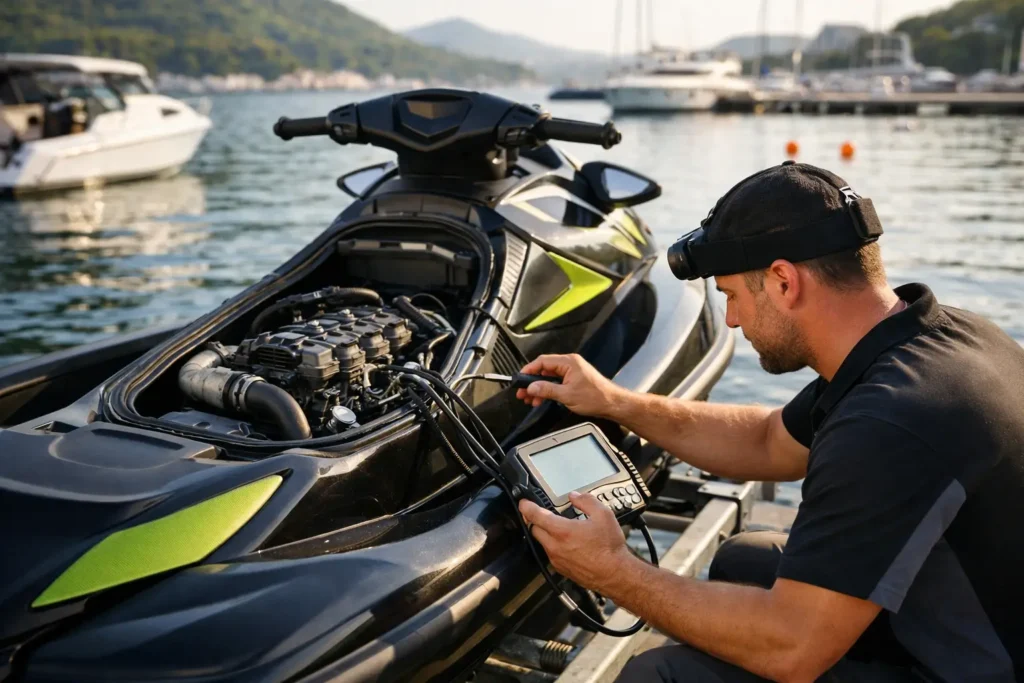
Before changing the software, faults must be read, the service history checked and the basic sensor values reviewed. Engine temperature, intake temperature where available, charging voltage, fuel pressure, throttle position and logged protective interventions deserve particular attention. If the ECU is already reducing power because of overheating or irregularities, the cause is fixed first, not the symptom.
The mechanical inspection should also cover parts that directly affect engine load:
- the condition of the impeller, wear ring and pump housing
- the intake grate, any damage and deposits
- cooling hoses, filters and fuel supply
- spark plugs, oil on models where relevant, and battery condition
This isn't a formality. An impeller with damaged edges or excessive clearance can change engine speed and the craft's behaviour so much that the problem is wrongly blamed on the ECU map. The calibrator must know whether the engine reaches the expected revs because the map asks for it or because the drivetrain isn't transferring power as it should.
A baseline measurement gives every change meaning
Before calibration, the stock condition should be recorded. That includes a diagnostic log of riding under load, throttle response, maximum operating parameters and the craft's behaviour with different amounts of fuel and passengers. Where possible, the measurement is repeated in similar conditions to separate a real change from the effect of waves, wind or water temperature.
Dyno testing can be valuable for controlled comparison, but a personal watercraft must ultimately be confirmed in the environment it works in – on the water. On a dyno it's easier to follow repeatability and the engine's response to a map change. On the water, behaviour under real pump load, cooling flow and hull resistance is confirmed. The most responsible process uses both sources of data when the platform and conditions allow.
ASF Motorsport approaches calibration precisely through measurement, diagnostics and log review, because a number without context doesn't say enough about engine health. Where Speed Meets Precision means performance must stay measurable, repeatable and technically justified.
Fuel determines how safe a map is
The calibration must match the fuel the owner can actually use regularly. A map tuned for higher-octane fuel must not be run on fuel with lower knock resistance. That isn't a small difference in the feel of power – in an engine under heavy load it can mean a greater tendency to knock and protection strategies kicking in, and in bad circumstances mechanical risk.
That's why a simple question is answered before the work: which fuel will be available throughout the season? If the jet ski is used when travelling, at marinas or at different locations, a more conservative calibration suited to reliably available fuel is often smarter than a setting that depends on a rarely available specification.
The same principle applies to additional parts. An intake, exhaust, intercooler, supercharger pulley change or different impeller aren't separate modifications. Each can change flow, temperature, pressure or load. The ECU map must know what configuration the engine is really running in. Copying a file from another craft, even when the models look identical, skips that key step.
What responsible validation on the water looks like
After a change, the result isn't judged only by the feeling at the first full throttle. Logs and the craft's behaviour need to be monitored in controlled, safe conditions, with enough space and respect for navigation rules. Temperatures, any protective interventions, rev stability and consistency of response after several repetitions are checked.
If the impeller, the altitude at which the craft is used, the fuel or a key intake or exhaust part changes, the previous validation is no longer complete. A completely new map isn't always needed, but a new check is. A jet ski is a system in which a drivetrain change is very quickly reflected in engine load.
It's important to distinguish good response from uncontrolled response. Overly sharp initial electronic throttle response can seem attractive on a short test ride, but it makes precise power metering harder in waves, out of turns or with a passenger. For recreational riding, progressive power delivery is often best. For specific sport use the priorities may differ, but even then the map must stay readable and predictable.
When calibration should be postponed
There are situations where the best advice is not to change the ECU until the basics are sorted. That applies if the engine has active faults, an unknown service history, signs of overheating, unstable fuel pressure, a charging problem or unclear pump behaviour. Also, a craft that has been laid up for a long time deserves a thorough inspection before more demanding riding and any increase in load.
Postponing isn't a lost opportunity for performance. It protects the investment. A properly serviced jet ski with the stock calibration will give more safety and enjoyment than a modified craft running on the edge because of an unresolved mechanical problem.
The real value of calibration isn't just how quickly the jet ski reaches maximum revs. The value is that the owner understands what was changed, which fuel and configuration the map applies to and which parameters to monitor through the season. When measurement, mechanics and software are aligned, every ride has more confidence and less guesswork.