TCU optimisation or gearbox service: which to choose?
When an automatic gearbox starts shifting late, jerking when pulling away or holding high revs unnecessarily, the question isn't just whether to do TCU optimisation or a gearbox service. The real question is: is the cause in the calibration, the adaptations, the hydraulics or worn mechanical components? The wrong answer can bring only a short-term improvement, while precise diagnostics save time, money and the gearbox itself.
TCU optimisation and servicing aren't opposing jobs. They solve different problems, and on a mechanically healthy vehicle they can complement each other well. In the ASF Motorsport approach, every software change starts by checking the vehicle's real condition, because Where Speed Meets Precision means performance never comes before technical soundness.
What does the TCU really control?
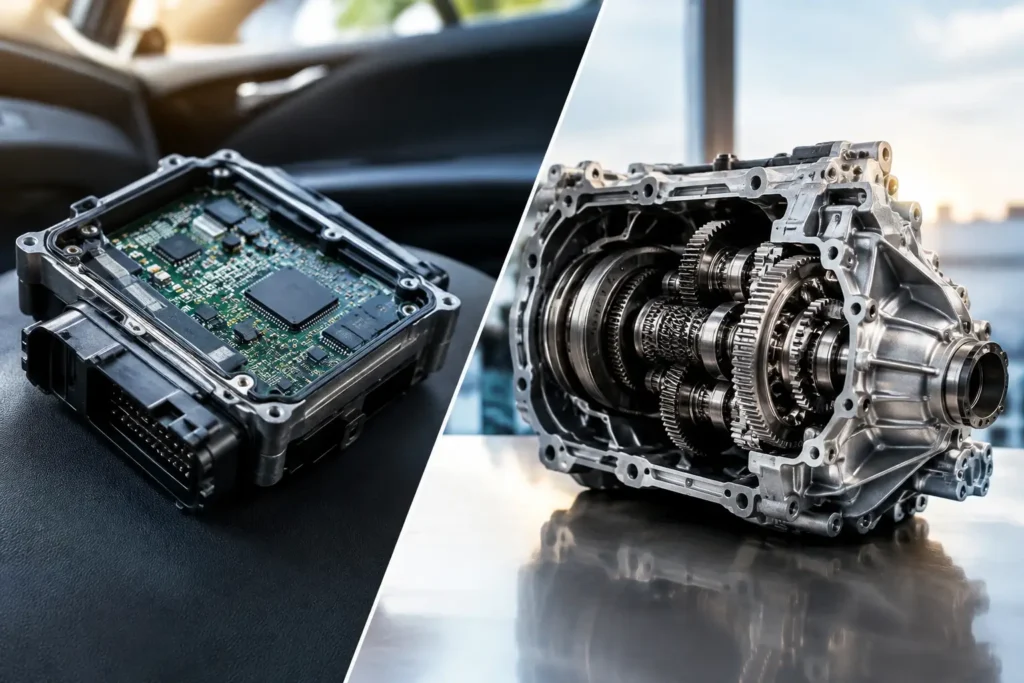
The TCU, or transmission control unit, manages the operating logic of the automatic gearbox. Depending on the gearbox design, it determines shift timing, hydraulic system pressure, torque converter lock-up behaviour, response to accelerator position and protective torque limits.
On dual-clutch gearboxes, the TCU controls clutch operation and pre-selection of the next gear. On conventional torque-converter automatics it controls valves, pressures and converter lock-up. On automated manual gearboxes, the algorithms that control the actuators and clutch are especially sensitive.
The stock calibration has to suit a wide range of fuels, climates, driving styles, manufacturing tolerances and the manufacturer's long-term requirements. That's why it's often set up conservatively. That doesn't mean it's bad, just that it isn't necessarily optimised for the specific vehicle, its ECU remap or the way the owner uses the car.
When does TCU optimisation make sense?
TCU optimisation is justified when the gearbox is technically sound but its behaviour doesn't use the full potential of the drivetrain. This is often the case after a moderate ECU optimisation, when the engine produces more torque than the stock gearbox logic expects or allows in certain modes.
A well-made TCU calibration can adjust torque limits, speed up gear changes in the right modes, improve response to driver demand and control clutch or hydraulic pressures more precisely. In some applications, the automatic upshift logic in manual mode, kickdown behaviour and launch strategy can also be changed.
The goal isn't for every shift to be harsh and maximally aggressive. Excessive pressure, an unsuitable shift strategy or removing protective limits without understanding the hardware can increase load on the clutch, plates, valves and flywheel. Quality optimisation needs a balance between faster response, torque capacity and long-term reliability.
A TCU remap is especially useful when the vehicle upshifts too early at full load, limits power through torque intervention or responds slowly to a manual shift request. Still, it should first be confirmed that these symptoms aren't caused by clutch slip, a sensor fault or an oil pressure problem.
Signs that a gearbox service is the priority
Software can't fix worn plates, a dirty valve body, a bad solenoid or a damaged bearing. If the gearbox has a physical problem, TCU optimisation can only make it more visible, because the system will work under different load and execute commands faster.
A service or more detailed mechanical check takes priority when there are constant shift shocks, slipping under load, delayed engagement of D or R, vibration when the converter locks up, a gearbox warning on the dashboard or a switch to limp mode. Metal particles in the oil, a burnt oil smell and recurring pressure-related faults are also not calibration issues.
It's important to distinguish a routine service from a repair. A routine service usually includes the specified oil, a filter where fitted, seals and correctly setting the oil level at a given temperature. A repair can mean work on the mechatronics, valve body, clutch, torque converter or internal gearbox components. The exact procedure depends on the transmission type and the manufacturer's recommendation.
The claim that gearbox oil is “lifetime” often creates false expectations. Operating temperature, city driving, towing, frequent short trips and increased torque all change the load on the oil. The service interval should be considered according to the manufacturer's specification, the vehicle's real use and the condition found on inspection.
TCU optimisation or gearbox service: how to decide?
The safest decision isn't made based on feel after one drive. It starts with reading faults from the ECU and TCU, reviewing available measured values and a test drive in the conditions where the problem appears. On modern vehicles, data on oil temperature, clutch adaptation values, requested and actual pressure, input and output speed ratio and logged slip are useful.
If there are no active or stored faults, the oil is in good condition, adaptations are within the permitted range and shifts are consistent, the vehicle is a good candidate for TCU optimisation. If diagnostics show deviations, the cause is fixed first. After a proper service or repair, an adaptation can be performed and behaviour checked before any calibration change.
For vehicles used for towing, commercial transport or frequent climbs, the decision is further shaped by thermal load. The owner may not need sharper shifts, but a more stable strategy under load and carefully defined torque limits. For sportier road driving the priority may be faster response in manual mode, but without unnecessarily sacrificing everyday comfort.
Why must the ECU and TCU work as a system?
The engine and gearbox don't work separately. When the ECU requests a certain torque, the TCU assesses whether the gearbox can safely transmit it in the given gear and temperature state. During a shift, the units exchange information so that torque is briefly adjusted and the shift is carried out in a controlled way.
That's why an ECU remap without a suitable TCU strategy sometimes doesn't deliver the expected response. The gearbox may limit torque, shift earlier than the driver expects or keep protection strategies set for stock power. On the other hand, a TCU calibration without checking the ECU file can produce inconsistent behaviour.
A good result needs a known goal: should the vehicle respond better in in-gear acceleration, use power more efficiently on track, handle load more safely when towing or simply run more smoothly? The calibration is then based on the vehicle's real parameters, not a universal file applied without checks.
A dyno test and a test drive give context
A dyno isn't a substitute for gearbox diagnostics, but it gives important context. Measuring torque and power shows how the engine delivers load across the rev range. This helps align ECU and TCU strategy, especially on vehicles where torque limits are key to transmission behaviour.
Still, part of the assessment always stays on the road, in controlled and safe conditions. Cold start, warm gearbox, light load, hard acceleration, deceleration and shifts in different driving modes need to be checked. Only then can you judge whether the change is truly precise, predictable and suited to the vehicle's purpose.
The best work isn't the one you feel most on the first acceleration, but the one that makes the gearbox consistent in everyday use and at full load. If the transmission is healthy, TCU optimisation can give noticeably better control over performance. If it isn't, a gearbox service is the investment that comes first – because precision starts with mechanics that work properly.