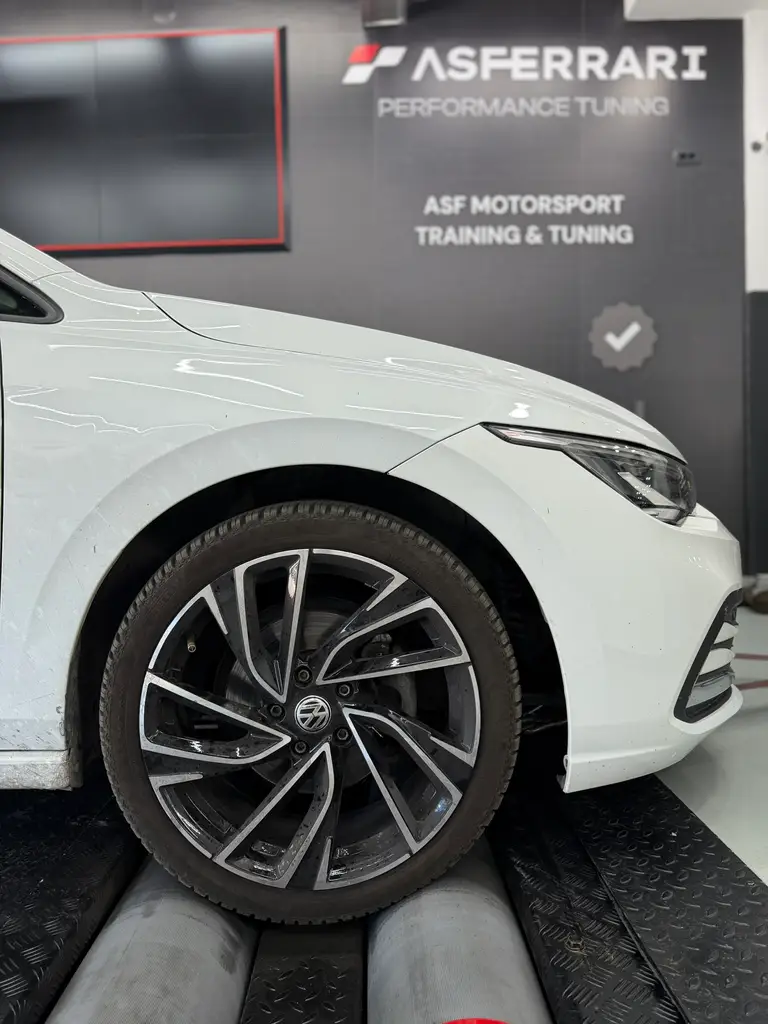
Performance car tuning for sharper response

A stock car is a compromise that has to work across different markets, fuels, temperatures and driving styles. Performance car tuning has a different task: to adapt the way the engine and drivetrain deliver their available potential to the specific vehicle, its purpose and real technical conditions. When done properly, the result isn't just a bigger number on paper. The driver feels cleaner throttle response, stronger in-gear acceleration and more predictable drivetrain behaviour.
It isn't a process of simply “adding power”. Professional calibration starts with understanding the factory engine management strategy, reading the vehicle's condition and measuring under load. Only then can the ECU and, where applicable, TCU calibration be adjusted for a clear technical reason.
What does performance car tuning actually change?
The ECU controls a large number of parameters: injection quantity and timing, boost pressure on turbo engines, ignition on petrol engines, torque control, temperature and protection functions. The factory map isn't a bad map. It's designed for a wide range of conditions, including fuel quality, climate extremes, service intervals and different vehicle configurations.
The goal of calibration is to optimise the relationship between these parameters without leaving reasonable operating limits. On a healthy turbodiesel this often means more decisive mid-range torque and easier in-gear acceleration. On a turbo petrol engine the focus may be on more precise control of boost, fuel delivery and ignition. Naturally aspirated engines usually offer less room for peak power gains, but can gain more linear response and better throttle reaction.
That's why two identical model badges don't necessarily give identical results. Different software versions, mileage, the condition of the turbo, fuel system, intake, exhaust and clutch or gearbox directly affect the safe room for optimisation.
Measurement before the change is part of calibration
A dyno test isn't decoration for the final chart. It gives a reference point before the work and allows changes to be assessed under controlled load. On an AWD chassis dyno, all-wheel-drive vehicles can be tested without ignoring how the drivetrain distributes power. For motorcycles, hub dyno measurement removes the effect of tyre slip on the rollers and gives very repeatable results at the rear wheel.
Still, the horsepower figure on its own doesn't say enough. The torque curve, power stability over several runs, intake air temperature, boost behaviour and the corrections the ECU applies are often more important than a single peak result. A vehicle that gains a few percent of power but delivers it smoothly and consistently can be faster and more pleasant in real driving than one with an aggressive peak in the curve.
Diagnostics should be done before any remapping. Active and stored faults, deviations between actual and requested boost, injection problems, excessive temperatures or clutch slip aren't details that software can fix. Calibration doesn't repair a mechanical fault. On the contrary, extra load can expose a problem that was previously borderline.
Why torque often matters more than peak power
In everyday driving, the driver doesn't use maximum revs most of the time. That's why the way a vehicle builds torque between, for example, 2,000 and 4,500 rpm is often decisive for how performance feels. A well-tuned map can reduce sluggishness when pulling away, make overtaking safer through quicker response and reduce the need for frequent gear changes.
But more torque isn't always better. The manual gearbox, dual-mass flywheel, clutch, differential, driveshafts and tyres have their own limits. On high-mileage vehicles, sensible, progressive torque delivery can be a better choice than the most aggressive setting. A quality calibration respects the whole drivetrain, not just the engine's potential.
TCU calibration and the engine must work together
On automatic gearboxes, ECU tuning without understanding the TCU strategy can leave part of the potential unused. The TCU determines clutch pressure, shift speed, torque limits and how the gearbox responds to driver demand. If the engine produces different torque after ECU optimisation, the gearbox needs a calibration that can correctly accept and transmit it.
Well-aligned ECU and TCU operation doesn't have to mean harsh shifts. On a vehicle used every day, the priority may be faster but still smooth gear changes. On a vehicle used on track, the requirements are different: holding the selected gear, more decisive shifts and consistent response may take priority. The vehicle's purpose determines the approach.
Transparency is especially important here. Some gearboxes have significant headroom, while others are more sensitive to increased torque, oil temperature or existing wear. Before the work, the gearbox's service history, oil condition where applicable and the factory limits of the specific unit should be assessed.
Not every part of the vehicle is ready for the same level of changes
Performance car tuning works best when treated as a system. The engine needs adequate airflow, fuel of the right quality and stable cooling. The drivetrain must be able to transmit the torque, and the brakes and suspension must match the vehicle's ability to accelerate harder and repeat those loads.
Hardware modifications therefore also change the requirements for the software. A larger intercooler can improve intake temperature stability under repeated load, but on its own it doesn't guarantee extra power without proper calibration. A modified intake or exhaust can change flow and response, but their real value must be confirmed by measurement, not assumption. With every modification, the engine's functional protections should be kept and the regulations for road-going vehicles respected.
The same applies to fuel. A map tuned for fuel of a certain quality requires consistency at the pump. If the vehicle travels through areas where that fuel isn't always available, a more conservative calibration may be the smarter decision. Precision means adapting the map to the owner's reality, not designing an ideal scenario that rarely exists.
What a professional procedure looks like
A reliable result starts with a conversation about the vehicle and the goal. Is the owner looking for stronger in-gear acceleration, better response when towing a trailer, a smoother automatic gearbox or preparation for modified hardware? Then come reading the original software, complete diagnostics and, when needed, a baseline dyno measurement.
After the custom file is built, the vehicle is tested and the relevant parameters are monitored. The calibration is corrected as needed according to the real behaviour of the engine and drivetrain, not a universal template. The final measurement confirms the change and gives the owner clear proof of what was done.
ASF Motorsport builds this approach on the principle of Where Speed Meets Precision: performance must be measurable, and every decision in the map must have a technical justification. That's equally important for a sports car, a motorcycle, a work pickup or a vehicle that covers high mileage every day.
The best modification isn't the one you'll describe most loudly, but the one the vehicle consistently shows every time you press the throttle. Start with a healthy vehicle, set a real goal and let diagnostics and measurement set the limits. Then performance stays exciting, but also under control.