Fleet optimisation without compromise

A vehicle off the road because of a fault, excessive fuel consumption or unpredictable drivetrain behaviour doesn't just cost money in the workshop. It interrupts deliveries, shifts driver schedules and puts pressure on the rest of the fleet. That's why fleet optimisation isn't a hunt for the most horsepower, but a precise process that balances power, torque, fuel consumption, reliability and the way the vehicle really works every day.
For light commercial vehicles, trucks, agricultural machines and industrial engines, the goal is often clearer response under load, more stable torque in the useful range and fewer unnecessary gear changes. However, the solution should never be a generic file applied to every vehicle of the same model. Engine condition, mileage, transmission, route, load and service history decide what is technically justified.
What fleet optimisation really means
Good optimisation starts with measurement, not a software change. The engine control unit uses a large number of maps for injection, turbo boost, torque limits, intake temperature and protection functions. The TCU, the automatic gearbox control unit, at the same time determines shift logic, torque limits and response to driver demand.
When these strategies aren't well matched to the real duty cycle, the vehicle can feel sluggish pulling away under load, downshift too often or hold high revs unnecessarily long. Professional calibration doesn't remove factory protections or bypass environmental systems on vehicles used on public roads. It works carefully within the safe limits of the hardware and checks whether the specific vehicle can support the planned change.
For a fleet manager this means success isn't measured by one acceleration. More relevant indicators are fuel consumption per work cycle, time off the road, regeneration frequency where applicable, temperature stability and the vehicle's ability to do the job consistently.
Diagnostics first, then calibration
Increased fuel consumption isn't always a calibration problem. A dirty mass airflow sensor, a pressure sensor deviation, an intake leak, a faulty thermostat, a worn turbo or a gearbox problem can cause symptoms that a software change can't fix. On the contrary, extra load on a vehicle with an existing fault can make the problem more expensive.
That's why initial diagnostics must include reading fault codes, reviewing available operating parameters and assessing the engine's real load. Values such as requested and actual boost, injection corrections, coolant and intake air temperatures, and transmission behaviour say much more than the driver's subjective impression.
For vehicles working under higher load it's useful to compare data before and after the work in the same conditions. Route, payload, driving style and outside temperature all affect the result. Without that context, a claim of reduced fuel consumption can easily be misread.
Why dyno measurement is valuable
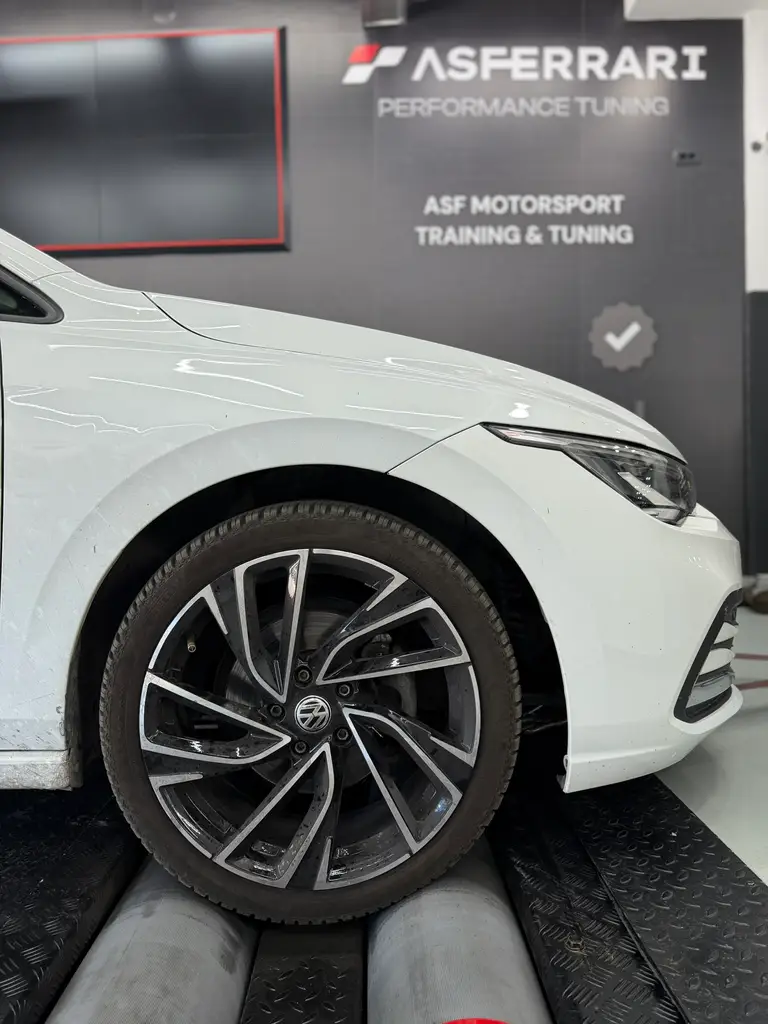
A dyno test isn't decoration added to tuning. It provides a controlled environment for checking power and torque delivery across the rev range. It's especially important for vehicles expected to work under load, because it reveals irregularities that can be missed on a short test drive.
Measurement also shows the shape of the curve, not just the peak value. For a work vehicle, even torque in the mid-range is often more useful than a sudden peak that stresses the clutch, gearbox or driveshafts. On an AWD chassis dyno, the vehicle's behaviour can be analysed in conditions closer to how power is really put down.
ASF Motorsport approaches every project through diagnostics, parameter checks and calibration with a clear technical reason. That's the Where Speed Meets Precision principle – performance with measure, purpose and a verifiable result.
ECU and TCU must work as a whole
On modern automatic vehicles the engine and gearbox can't be looked at separately. The ECU calculates available torque, while the TCU uses that figure to set clutch pressure, shift timing and transmission protection. If the engine calibration is changed without understanding the gearbox's limits, the result can be uneven driving, slipping or more frequent activation of protective modes.
A properly aligned TCU calibration can improve shift logic, response to load and use of useful torque. Still, it isn't automatically recommended for every vehicle. A gearbox with an unclear service history, existing shift shocks or high oil temperature first needs inspection and a service assessment.
The same goes for vehicles with a manual gearbox. Extra torque must stay within limits the clutch and flywheel can handle long term. A technically good result isn't one that looks impressive on paper, but one the driver can use every working day without compromising reliability.
Where fleets most often lose money
Fuel cost is visible on the bill, but it isn't the only loss. Inefficient vehicle allocation, excessive idling, late fault detection and differing driving styles often have just as big an impact. Optimisation makes sense when it's seen as part of operational discipline, not as an isolated engine intervention.
The most useful data to track includes consumption by route and load, idle time, the number of unplanned stops and deviations in drivetrain temperatures or faults. When this data is reviewed regularly, it's easier to tell a problem with one vehicle from a problem with the whole fleet.
The driver also remains a key part of the result. Calibration can give better response and more useful torque, but it can't make up for rough handling, ignoring dashboard warnings or irregular maintenance. Clear procedures for reporting symptoms and timely servicing protect both the vehicle and the work schedule.
When optimisation isn't the right first step
There are situations where it's better to wait. A vehicle already showing active faults, smoke, unusual oil consumption, changes in turbo sound or transmission problems shouldn't be calibrated before the cause is fixed. An equally careful approach is needed for fleets whose vehicles have completely different uses – city delivery, long-haul and trailer work don't necessarily need the same setup.
Before deciding, the priority should be defined. If the goal is lower fuel consumption on long routes, the calibration is shaped differently than when the vehicle regularly tows loads uphill. If responsiveness in city delivery matters, frequent stops, temperatures and transmission logic must be taken into account. One map for everything usually isn't the most precise solution.
A good fleet doesn't need the most aggressive calibration. It needs vehicles whose behaviour you know, measure and maintain. When diagnostics, dyno checks, and ECU and TCU strategy are linked to the vehicles' real tasks, optimisation becomes a data-driven decision – and that's the most reliable route to a more available fleet.