Which vehicles benefit from remapping?

A stock engine isn't necessarily set up for the best possible behaviour in every condition. With one calibration, the manufacturer has to cover different markets, fuel qualities, climate zones, regulations, component tolerances and driving styles. That's why the real question of which vehicles benefit from remapping is less about the make and more about the vehicle's condition, purpose and the potential of its drivetrain.
A quality remap isn't copying a universal file or chasing big numbers on paper. It's a controlled change of ECU parameters, and TCU parameters where needed, based on diagnostics, measurement and the vehicle's real use. When hardware, fuel and calibration are aligned, the result can be stronger response, more useful torque and safer behaviour under load. Where Speed Meets Precision isn't just a slogan – it's the principle by which every change must be verified.
Which vehicles benefit most from remapping?
Modern turbo petrol and turbo diesel engines usually have the most room for meaningful improvement. On them, the ECU controls boost pressure, fuel quantity, torque limits, ignition or injection and a range of protection strategies. The stock map often leaves some headroom, so careful tuning can give a more usable power and torque range without compromising factory protections.
Naturally aspirated engines can also benefit, but expectations must be realistic. Without a turbo there isn't the same room for increasing cylinder filling, so the gain is more often felt as more precise throttle response, optimised torque delivery, adaptation after intake or exhaust changes and better matching to the fuel actually used. On such an engine a good calibration can change the driving character, but it can't replace mechanical potential that isn't there.
Vehicles with an automatic gearbox often require TCU calibrationto be considered alongside the ECU. If the engine produces more torque, the gearbox must correctly manage clutch pressures, torque limits, shift points and kickdown strategy. A well-tuned TCU can make the transmission more decisive and predictable, while mismatched engine and transmission software can limit the result or put unnecessary load on components.
Turbo petrol engines: response and a wider useful range
Turbo petrol cars, especially those with direct injection, are common candidates for individual calibration. The potential doesn't come only from higher turbo boost. The right approach looks at intake air temperature, ignition corrections, fuel quality, cooling system capacity and the real fuel delivery under load.
For the owner, how the vehicle accelerates from mid revs is often more important than peak power at the very top. More even torque and quicker response can be useful when overtaking, driving uphill or exiting a corner on a closed track. Still, a car already showing knock corrections, ignition problems or excessive temperatures isn't ready for a remap until the underlying fault is fixed.
Turbo diesels: torque for everyday work
On turbo diesel vehicles, a well-executed remap usually brings a noticeable change in the mid-range. That's why owners of passenger cars, vans and work vehicles often look for optimisation. More, and better distributed, torque can reduce the need for frequent gear changes, make driving with a load easier and improve flexibility.
However, a diesel mustn't be calibrated just by adding more fuel. Exhaust gas temperature, turbo operation, smoke, the condition of the injectors, intake and exhaust aftertreatment system must be monitored. Legal emissions systems on road vehicles must remain functional. A calibration that ignores thermal limits isn't professional optimisation, regardless of the measurement result.
Passenger cars aren't the only candidates
Remapping has clear value beyond conventional cars too. The application sets the calibration priority: for a sports vehicle it may be consistent response, and for a work machine available torque at low revs and stability under prolonged load.
Motorcycles, ATVs and UTVs
Motorcycles can respond significantly to correct fuel and ignition tuning, especially after changing the exhaust, intake or other components that change airflow. The stock map is often a compromise for homologation and a wide range of conditions. On a motorcycle, a small change in throttle response can be felt more strongly than in a car, because of the lower weight-to-power ratio and the rider's more direct connection to the engine.
With ATVs and UTVs, very different operating modes matter. Slow off-road driving, high temperatures, towing and dust create loads that aren't always visible in a short road drive. The calibration must keep protecting the engine and the CVT or transmission components, not just improve response in a short burst of full throttle.
Jet skis and boats
PWCs and marine engines work under continuous load, often at high temperatures and with changing cooling conditions. That makes them good candidates for precise optimisation, but also a category where irresponsible calibration is especially risky. An engine that seems fine on land or in a short test can behave differently after a longer period of work on the water.
That's why with these applications the focus is on safe operating parameters, fuel quality, temperature and the craft's real purpose. The owner of a recreational jet ski and a team using a craft in more demanding conditions won't necessarily get the same map.
Light commercial vehicles, trucks and machinery
A van that carries tools and goods every day doesn't need the same calibration as an empty passenger vehicle. With light commercial vehicles, the goal may be smoother pulling with a load and less need for aggressive use of the throttle. For fleets, repeatability matters: the vehicle must work reliably over many kilometres, with different drivers and changing loads.
Trucks, tractors, agricultural and industrial machines can benefit when optimisation is aimed at the duty cycle. Torque at certain revs, response to load and limit logic are often more relevant than peak power. Before any change, you need to know the condition of the turbo, fuel system, cooling, transmission and diagnostic logs under load.
When remapping isn't the right first step
A remap isn't a service substitute for worn parts. If the vehicle has sensor faults, a blocked intake, a boost leak, a weak high-pressure fuel system, clutch slip, a faulty automatic gearbox or a cooling problem, the cause is fixed first. Adding torque to an already stressed system can only speed up a failure.
It's equally important to talk openly about purpose. A vehicle that regularly tows a trailer, works at high altitude or uses fuel of varying quality needs a more conservative strategy than a weekend car that's carefully maintained and driven in controlled conditions. The best map isn't necessarily the most aggressive, but the one that suits the real vehicle and its owner.
Why diagnostics and measurement are decisive
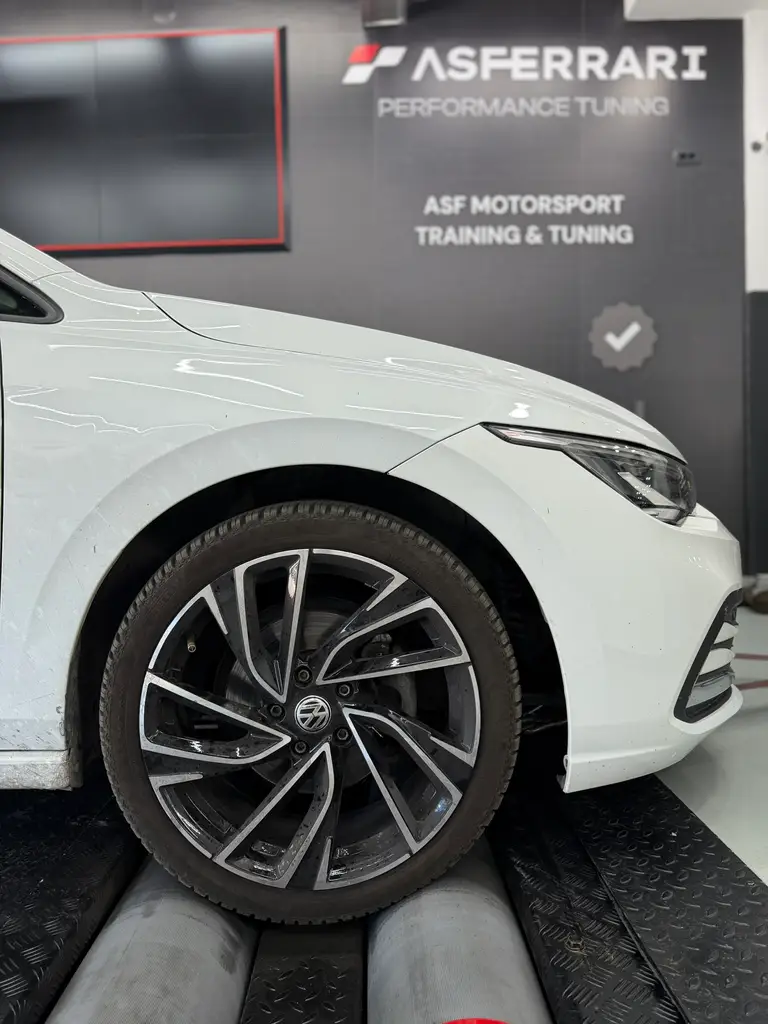
Before calibration, the basic operating parameters should be checked and faults read. After that, through a data log or a dyno test the actual pressures, temperatures, corrections, fuel and torque behaviour can be monitored. A dyno isn't just a tool for measuring peak power. It allows repeatable work under load and shows whether the vehicle delivers its result consistently, without unwanted deviations.
ASF Motorsport approaches every project through diagnostics, controlled calibration and verification of results. Especially with AWD vehicles, motorcycles and work applications, the right measuring equipment helps ensure decisions aren't based on assumptions.
The vehicle that gains most from remapping isn't always the one with the greatest stock potential. It's the one that's technically healthy, properly maintained and calibrated for the way it's really used. When data, mechanics and software are on the same side, the driver gets not just more performance, but clearer confidence in what the vehicle is doing.