How to test injectors under load properly
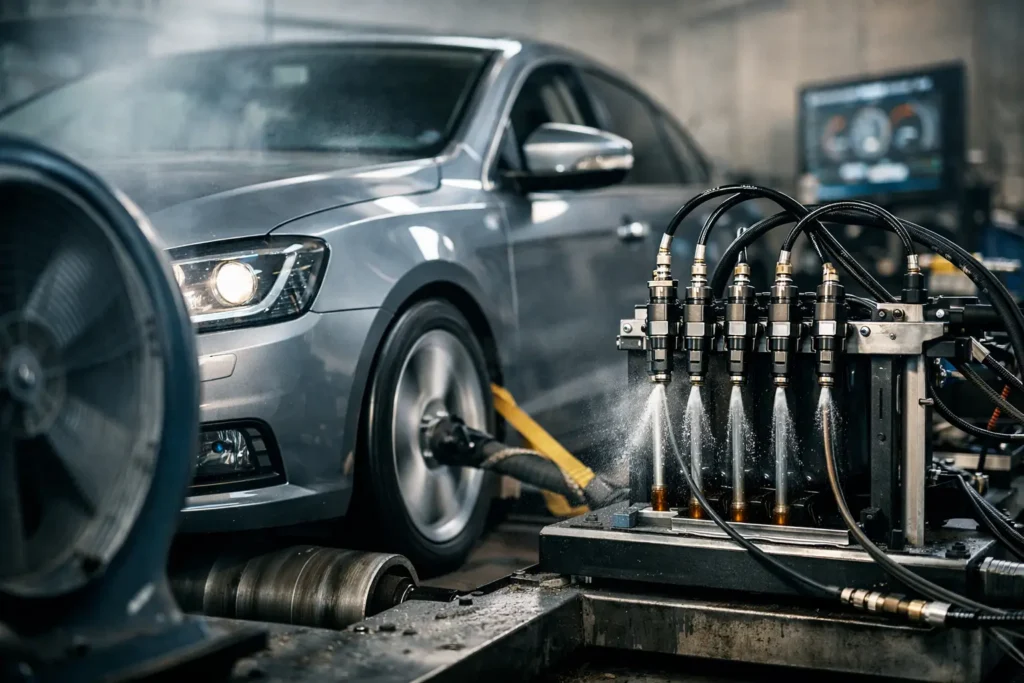
An engine that idles smoothly can lose power at full throttle, start jerking or log a fuel pressure fault. That's exactly why testing injectors under load doesn't start with removing the injectors, but with understanding the whole fuel system while the engine is really demanding flow. A static test and idle readings often don't reveal a fault that only appears at higher torque, higher revs or on a long climb.
For a reliable result you need to monitor requested and actual fuel pressure, injection time, cylinder corrections, fuel temperature and engine behaviour during controlled load. On modern petrol and diesel engines the injector is only one part of the chain. The low-pressure pump, high-pressure pump, regulator, filter, wiring and ECU strategy can all produce symptoms very similar to a faulty injector.
Why injectors should be tested under load
At idle the engine needs only a small amount of fuel. Even an injector that's partly clogged, atomises poorly or responds slowly can still keep the engine running acceptably. When the driver asks for acceleration, the ECU increases injection time and the fuel system must maintain pressure and flow without delay. That's when deviations show that stay hidden in the workshop without load.
On common-rail diesels a typical problem can be excessive fuel return through one injector. At idle the engine may still run fine, but under load rail pressure doesn't follow the target. On direct-injection petrol engines, misfires, a lean mixture or power limiting can occur when the high-pressure side can't supply enough fuel. On port-injection engines, uneven flow, a poor spray and differences between cylinders are more common.
Not every loss of power should be blamed on the injectors. A clogged fuel filter, a weak in-tank pump, a vacuum problem, a faulty coil, an incorrect pressure sensor reading or an intake restriction can give almost the same feeling on the road. Good diagnostics therefore look for the cause, not the part that's easiest to blame.
How to test injectors under load through diagnostics
The safest approach is measurement on a dyno or a controlled test drive with suitable diagnostic equipment. A dyno has the advantage of allowing repeatable loads at the same speed and revs, without guessing how much load the engine is really under. It's especially useful for vehicles that only show the problem in a certain gear or after several consecutive accelerations.
Before the test the engine must reach operating temperature. A cold engine uses different fuel corrections, and fuel viscosity and pump operation aren't the same as after warming up. The fuel level, filter condition, battery and any active faults should also be checked. A test with an almost empty tank can create a fuel supply problem that has nothing to do with the injectors.
During the load, the parameters the ECU offers for the specific engine are logged. Most often these are:
- requested and actual fuel pressure on the low- and high-pressure side
- injection time, injection quantity and per-cylinder corrections
- lambda value or air-fuel ratio on petrol engines
- misfires, exhaust gas temperature where available, and fuel temperature
- accelerator position, engine load, revs and torque request
A number on its own isn't a diagnosis. In some ECU systems per-cylinder corrections are expressed in milligrams per stroke, in others in time or as a relative value. The acceptable range depends on the engine, software strategy, temperature and operating mode. The pattern matters more: does one cylinder constantly deviate, does the deviation grow with load and is there a fuel pressure drop or misfire at the same time?
On a petrol engine, a wideband lambda sensor provides key confirmation. If the ECU asks for a richer mixture at full load for protection and power, but the actual mixture stays leaner than requested, the fuel system's capacity and individual injectors should be checked. It isn't right to simply extend injection time through the calibration straight away. First it must be proven that the mechanical system can meet the demand.
On a diesel, the relationship between target and actual rail pressure is monitored. A short transient lag can be normal on a sudden throttle change, but a constant difference at high load isn't. If the ECU requests pressure and actual pressure drops, the cause can be injector return, insufficient supply to the high-pressure pump, the volume control valve or the pump itself. Only further tests narrow it down.
Fuel return test on diesel injectors
The fuel return test is very useful, but it isn't a complete substitute for dynamic measurement. It measures the amount of fuel each injector returns to the return line in a given time. One injector with noticeably higher return than the others can reduce available rail pressure, especially during demanding work.
The test should be done according to the factory procedure for that engine. Differences between cylinders matter more than the absolute amount, and the result can depend on temperature and test duration. An injector can have normal return and still atomise fuel poorly or have an electrical problem at longer pulses. That's why a return test confirms one possible fault, but doesn't declare the whole system healthy.
An electrical test doesn't tell you everything
Measuring coil resistance and checking connectors and wiring make sense when there are open circuits, short circuits or injector control fault codes. However, an electrically sound injector doesn't necessarily have correct flow. Mechanical wear, deposits on the tip and a changed spray pattern can't be seen with a multimeter.
For a detailed check, a removed injector is tested on a specialised bench. There, flow, sealing, spray pattern and response in various simulated modes can be assessed. It's the most direct way to check the component itself, but it requires removal and coding or adaptation after refitting, depending on the system. That's why a diagnostic log under load first helps justify that work.
What distinguishes an injector fault from a fuel supply problem
If all cylinders show a similar symptom and fuel pressure drops overall, attention should first go to the pump, filter, regulation or supply. When one cylinder has a more pronounced correction, repeated misfires or an uneven contribution to power, the suspicion of an individual injector becomes stronger.
Still, there are exceptions. On petrol engines a faulty spark plug or coil can cause a misfire that the ECU then tries to compensate for with a fuel correction. On a diesel, a compression problem can look like an injection problem. That's why a professional assessment includes a basic mechanical check, and if needed swapping component positions only where the factory procedure allows it.
A good test isn't based on one full acceleration. The measurement should be repeated, the cooler and fully warmed-up states compared and behaviour after prolonged load checked. Heat often changes the picture: fuel warms up, electrical components increase their resistance, and a pump may only show weakness when it's really loaded.
Dyno measurement before any calibration
For vehicles coming in for ECU or TCU optimisation, the condition of the fuel system isn't a side issue. Calibration can manage torque, pressure and injection more precisely, but it can't fix a worn injector or a pump with no spare capacity. If the baseline log shows that actual pressure doesn't follow the request, the hardware cause is fixed first.
In the ASF Motorsport approach, the dyno and diagnostics serve as a measuring tool, not a means for assumptions. A repeatable test reveals whether the engine maintains stable fuel values across the whole rev and load range. That's the difference between a correction that seems good on a short drive and a calibration based on real data – Where Speed Meets Precision.
If your engine loses power under load, don't wait for the symptom to turn into a bigger failure. A log with properly chosen parameters often gives a clearer answer than replacing parts blindly, and protects the fuel system for the next demanding kilometre.