A guide to boat ECU tuning without guesswork
On a boat, every calibration change is felt under a load a car rarely sees: the propeller constantly “pulls”, the engine runs at steady high revs for long periods, and water, fuel and intake temperatures can change quickly. That's why this guide to boat ECU tuning doesn't start with a promise of power, but with the question of whether the engine, drive and existing calibration can use that power safely and repeatably.
What boat ECU tuning really changes
The ECU controls key engine parameters: fuel injection quantity and timing, turbo boost on turbo engines, torque limits, throttle control, ignition on petrol engines and a range of protection strategies. On modern outboard, inboard and PWC engines these maps aren't separate from each other. Changing turbo boost, for example, requires precise alignment of fuel, exhaust gas temperature protection and torque limits.
Well-executed ECU tuning doesn't mean simply raising a few values. The goal is to optimise response and available torque in the rev range the boat actually uses, without leaving reasonable thermal and mechanical limits. The result depends on the engine, turbo or supercharger, fuel, cooling, intake, exhaust, propeller and the boat's total load.
On naturally aspirated petrol engines the room for gains is often smaller than on turbo diesels or turbo petrol engines. Still, more precise throttle response and better-adapted maps can be as valuable as the peak figure on the spec sheet. On turbo engines the potential is usually greater, but the demands on cooling and parameter monitoring are more serious.
Why the environment on the water is different
A car under acceleration goes through load, changes gear and often has only short periods at full throttle. A boat with a correctly chosen propeller can run close to maximum load for a long time. That means the calibration must keep control not only during a short acceleration, but also during prolonged operation under load.
The propeller is a key part of the equation here. Too much pitch or diameter can “choke” the engine and stop it reaching its designed wide-open-throttle range. Too small a propeller can allow excessive revs. ECU tuning can't correct the wrong propeller, a slipping hub, a damaged cavitation plate or a boat that's significantly heavier than when it was originally set up.
Performance is also affected by the condition of the hull bottom, load distribution, amount of fuel, altitude, and air and water temperature. Two identical engines won't necessarily behave the same on different boats. That's why serious calibration always starts with the real condition of the specific system, not universal assumptions.
Diagnostics before every change
Before reading and changing ECU software, faults, sensor operating values and the basic mechanical condition need to be checked. If the engine already has a problem with fuel pressure, temperatures, boost, spark plugs, injectors or air supply, tuning can only make the existing fault more visible and more expensive.
Cooling systems need special attention. A blocked water intake, a worn pump impeller, deposits in the passages or a faulty thermostat change the engine's thermal headroom. On turbocharged engines, actual and requested boost need to be checked, along with deviations that could point to a leak, an actuator problem or turbo wear.
It's also worth checking the fuel quality that's realistically available to the owner. A calibration adapted to higher-octane fuel doesn't have the same safety margin if the boat is regularly filled with fuel of inconsistent quality. A professional approach plans for real use, not ideal conditions that only exist on paper.
What responsible ECU calibration looks like
A good procedure starts with identifying the hardware and original software. Then the stock calibration, its limiting maps and protection functions are analysed. No two ECUs should be treated as completely identical just because they have a similar engine designation. The software version, market specification and factory hardware can change the approach.
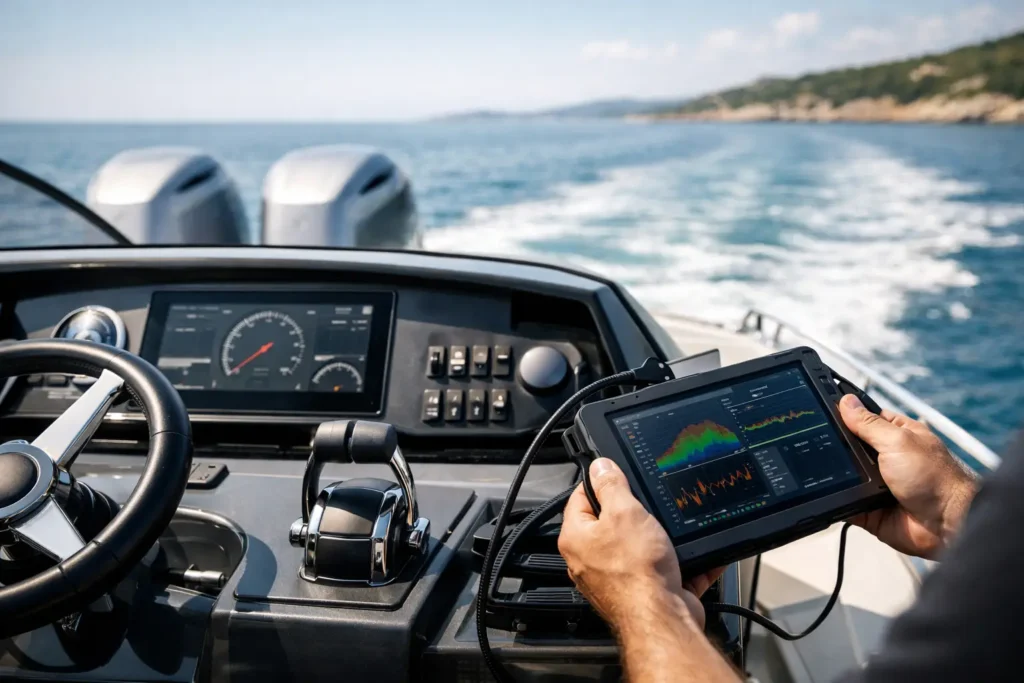
After the change, the system's behaviour needs to be confirmed through diagnostic logs and, when conditions allow, controlled measurements under load. On a boat, wide-open-throttle revs, actual boost on turbo engines, cooling system temperature, fuel corrections and any activation of protective modes are especially relevant.
Tuning isn't good if the engine briefly shows better response and then goes into power limiting because of temperature or running irregularities. Stable power delivery matters more than an aggressive map that only looks good on one short run. That's exactly where the difference between a generic file and a calibration based on technical checks shows.
Power, torque and the real benefit
Owners often ask about peak power, but with boats it's more useful to talk about the whole operating range. More and more evenly available torque can help a boat get onto the plane more easily, respond better at mid revs or hold speed with a heavier load. However, the benefit is assessed together with the propeller and the drive's ability to handle that torque.
Fuel consumption also has no universal answer. If optimisation lets the desired cruising speed be held with less throttle and lower load, consumption in that mode can be better. If the extra power is constantly used for higher speed, overall consumption will naturally rise. Calibration improves the efficiency of engine management, but it doesn't abolish the physics of water resistance.
On multi-engine boats, the calibrations must be matched. Different response, differently developed torque or uneven revs can make handling harder and create unnecessary load on the drive system. The condition of both engines must be assessed before any work.
When ECU tuning makes no sense
If the boat doesn't reach the specified wide-open-throttle rev range, the reason must be found first. The problem may be the propeller, hull, fuel, cooling, a dirty intake, compression or the drive. Adding power without a diagnosis often moves the symptom, but doesn't solve the cause.
The same goes for engines without a clear service history or with active faults. Service first, then measurement and checks, and only then calibration. An owner looking for maximum performance for short runs has a different profile from one who spends hours on the water with family or uses the boat professionally. Neither purpose is wrong, but they don't need the same map or the same compromise.
Choosing an expert partner for boat tuning
The right service will first ask questions about the engine, boat, propeller, purpose and available fuel. It should explain what's being changed, which data it monitors and where the project's limits are. Avoid an approach that promises an identical result for every engine or asks for no checks before the work.
ASF Motorsport approaches ECU calibration through diagnostics, parameter monitoring and adaptation to the real purpose of the vehicle or boat. That's the Where Speed Meets Precision philosophy: performance only has value when it's backed by measurement, technical understanding and risk control.
Before the first full run after calibration, check the basic operating parameters, watch the engine's behaviour and don't ignore warnings or changes in temperature and revs. There's no room for guesswork on the water – a well-prepared boat gives more enjoyment precisely because the skipper knows what's happening under the engine cover.