Engine and ATV tuning: power under control
An ATV that hesitates on the throttle out of a bend, a UTV that's slow to recover revs under load or a quad on big tyres that has lost its liveliness – these are situations where engine and ATV tuning has real technical value. The goal isn't to chase a number on paper. The goal is for the engine to respond more precisely, use its torque more effectively and stay reliable in the conditions the vehicle is really used in.
With ATVs and UTVs, performance isn't judged by peak power alone. Vehicle weight, transmission type, tyre size, altitude, temperature and constant load changes directly affect how it feels to ride. That's why a quality ECU calibration must be adapted to the complete package, not based on a universal file.
What engine and ATV tuning really changes
The engine's electronic control unit controls fuel injection, ignition timing, the electronic throttle, torque limiters and, on certain engines, the intake system or turbo. The factory calibration has to cover a wide range of markets, fuel qualities, climate zones and user habits. That compromise is understandable, but it often leaves room for more precise tuning when the vehicle's real configuration is known.
A well-executed remap is usually felt as more linear throttle response and torque available earlier. On naturally aspirated ATV engines the changes are usually moderate, but they can significantly improve control in slow technical riding, pulling out of mud or riding with a load. On turbo UTV platforms the potential is often greater, but so are the demands on fuel, cooling and the transmission.
It's important to distinguish better response from aggressive response. An oversensitive throttle map can feel fast on a short test ride, but make it harder to meter power precisely on a slippery surface. For a work UTV, a controlled and predictable torque request is preferable. For a sport ATV the response can be more direct, but it still has to stay usable when the ground is uneven.
Why an ATV needs a different approach from a car
ATV and UTV engines rarely work in stable conditions. The vehicle climbs, descends, tows a trailer, goes through water, travels at low speed with little airflow and often works under more load than the rider realises. That's why the calibration mustn't focus only on full throttle and maximum revs.
Particular attention should be paid to the mid-rev zones, throttle transitions and the engine's protection strategies. That's exactly where an ATV is used most. A map that only gives a good result at full load isn't a complete solution if it causes jerks, overheating or uneven running at part throttle.
The CVT transmission changes the picture further. When engine power is increased or its distribution across the revs changes, belt and clutch behaviour becomes even more important. ECU tuning doesn't fix a mechanically worn belt, an incorrectly set clutch or a CVT housing cooling problem. On the contrary, extra torque can make existing weaknesses more obvious.
Bigger tyres and accessories aren't a minor detail
Bigger off-road tyres, a winch, a cab, skid plates, a roof, extra cargo and passengers change the load on the drivetrain. An ATV or UTV can then feel more sluggish, especially when pulling away and on climbs. Tuning can help through torque distribution and throttle response, but it can't cancel out the physics of a larger wheel diameter and mass.
In such cases, the complete package should be checked first: belt condition, gear ratios, intake, exhaust, cooling and service condition. Only after that does ECU calibration make sense as a precise step, not as an attempt to hide a mechanical problem with software.
Diagnostics before every software change
A professional process starts with reading faults and reviewing the available operating data. Coolant temperature, intake air temperature, charging voltage, pressure sensor values, fuel corrections and any active protections give a clear picture of the vehicle's condition before calibration.
If the engine has an ignition, fuel pressure, intake leak or overheating problem, tuning isn't the first step. Such vehicles need the fault fixed before any optimisation. The same goes for vehicles with unknown modifications, especially when the exhaust or intake has been changed without properly checking the mixture and temperatures.
On newer platforms, diagnostics are also important because of the control unit's software versions. Not all ECU systems are the same, and how a file is read, written and validated depends on the specific electronics. A safe procedure includes identifying the original software, properly checking the file and communication without power interruptions.
The role of dyno measurement
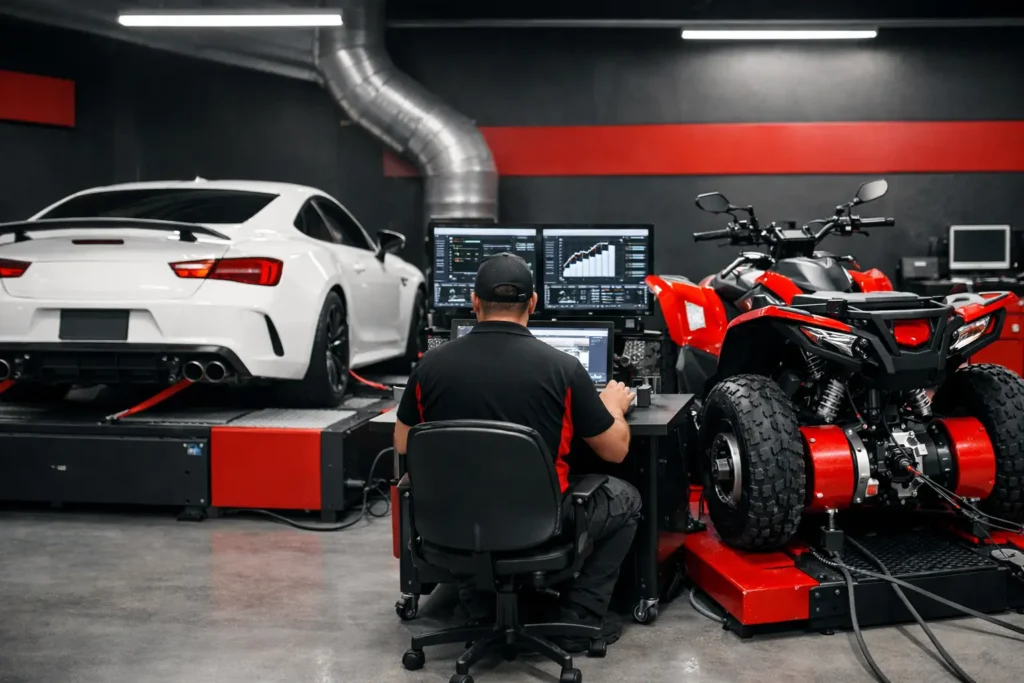
A dyno gives more than a peak number. It shows the power and torque curves, the engine's behaviour through the revs and the difference before and after calibration in controlled conditions. With ATVs and UTVs this is especially useful, because the change often lies in the mid-range, where the vehicle is ridden most.
Measurement also helps spot anomalies. An unexpected power drop can point to belt slip, a fuel supply problem, excessive intake temperature or a factory protection kicking in. Without data, a rider can easily conclude the problem is the map, even though the cause may be entirely mechanical.
ASF Motorsport approaches calibration through diagnostics, hardware checks and measurable results. That order is key: the software should be adapted to a healthy vehicle and its real purpose, not a result promised before the system's condition is understood.
How to set the calibration goal
Before tuning, you need to define clearly where and how the ATV works. Sport riding on open terrain, slow technical riding through forest, work on a property and towing all call for different priorities. There's no one map that's ideal for every use.
For a recreational ATV, the best result is often a smoother throttle and a fuller mid-range, without unnecessarily pushing high revs. For a work UTV, the priority may be usable torque at lower speeds and stable power delivery under load. Turbo platforms may need a more conservative approach if the vehicle is used for long periods in high temperatures or fully loaded.
Fuel quality must be part of the conversation. A calibration based on fuel that isn't always available isn't a good solution for a vehicle regularly used far from a service centre. It's equally important to openly declare all modifications, from the intake and exhaust to changed tyres and CVT components.
Reliability is part of performance
More power has no value if the engine constantly triggers protections, the transmission overheats the belt or the rider can no longer finely control the throttle. Reliable tuning keeps reasonable engine operating limits and respects the capabilities of the factory hardware. That isn't a slower approach – it's an approach that lets the vehicle be used longer and more safely.
After calibration, the vehicle's behaviour should be monitored in real conditions: cold start, operating temperature, response at small throttle openings, behaviour under load and any fault messages. For vehicles working in dust, water or wide temperature swings, regular servicing of the intake, cooling and CVT system remains as important as the quality of the software.
Proper engine and ATV tuning doesn't change the vehicle's character blindly. It matches it to how it's ridden, the equipment it carries and the terrain it tackles. When data, mechanics and calibration are aligned, the result isn't just faster response – it's a vehicle that gives the rider more control exactly where it's needed most. Where Speed Meets Precision.