Truck tuning for more power under load
A truck that responds slowly when joining the motorway, loses rhythm on a climb or changes gear too often under load doesn't necessarily have a mechanical fault. Often the problem is how the factory ECU calibration manages torque, injection and turbo boost in real working conditions. Professional truck tuning isn't a search for the maximum horsepower figure, but precise tuning of the drive system for the work the vehicle really does.
On commercial vehicles, every bit of extra, properly available torque has concrete value. It can make moving with a load easier for the driver, reduce the need for frequent gear changes and allow speed to be held more safely on a gradient. For a fleet owner it can mean more consistent vehicle operation and better use of the engine. But only if the calibration is done after serious diagnostics, with an understanding of the load, gearbox and condition of the whole drivetrain.
What truck tuning actually changes
The ECU manages the engine through a large number of maps and protection strategies. They determine fuel quantity, boost, injection timing, torque limiters, throttle response and how the engine communicates with an automatic or automated gearbox. The factory calibration has to suit a wide range of markets, fuel qualities, climates, permitted configurations and vehicle uses.
That doesn't mean the factory software is bad. On the contrary, it's designed conservatively to cover many scenarios. However, a truck that regularly runs regional routes fully loaded doesn't have the same needs as a vehicle for light city distribution. An individually developed calibration can better match torque delivery to the specific duty cycle, without aggressive interventions that would put unnecessary load on the engine or transmission.
The most important change isn't peak power on paper. For a work vehicle the torque curve matters more: where torque arrives, how progressive it is and how it's held through the useful rev range. An overly sharp torque surge at low revs can feel impressive on a short drive, but it isn't necessarily good for the clutch, propshaft, differential or gearbox. A quality map builds power in a controlled way.
Torque must follow the transmission
On a truck, the engine should never be looked at separately from the gearbox. The ECU and the TCU, the transmission control unit, continuously exchange data on requested and permitted torque. If the engine's character changes while the gearbox logic stays mismatched, the result can be hesitant gear changes, unnecessarily holding a lower gear or power being limited by protection functions.
TCU calibration, when technically justified and available for the specific platform, can adapt the shift strategy to the engine's new torque. The goal isn't for the gearbox to shift harder or later at any cost. The goal is to keep the engine in the range where it makes power efficiently, while preserving the transmission's thermal and mechanical limits.
With manual gearboxes the assessment is different, but just as important. The condition of the clutch, dual-mass flywheel, propshaft and differential must be taken into account before any change. A truck with an already worn clutch won't gain reliability from more torque. Tuning isn't a substitute for maintenance.
Not every truck is a candidate for the same approach
The working purpose decides how the calibration is set. A tipper that spends most of its time on climbs and short runs needs a different torque distribution from a tractor unit covering long motorway stretches. A refrigerated truck has extra load and a specific operating mode, while a delivery vehicle often does short runs, many stops and lower speeds.
That's why a universal file isn't a serious answer for professional use. A good calibration starts with questions: what's the payload, what's the route, how many kilometres does the vehicle cover, what gearbox does it have and what condition are the key components in? Only then can a safe and sensible direction for optimisation be set.
Diagnostics before power
Before remapping, you need to check whether the engine is already reporting faults or running outside expected parameters. A turbo boost fault, a fuel pressure deviation, an EGR problem, a blocked intake or a sensor irregularity can significantly change the calibration result. Software can't fix a worn turbo, a leaking intercooler hose or a faulty injector.
A quality process includes reading faults, analysing available live data and assessing actual values under load. Requested and achieved boost, fuel pressure, temperatures, injection corrections and torque limiters are particularly monitored. On certain vehicles, TCU data and the condition of the exhaust aftertreatment system are also relevant.
Emissions systems aren't an obstacle to bypass, but part of the vehicle's technical whole. Professional calibration must keep the systems required for public road use working properly. If diagnostics show a fault, the right procedure is to fix the cause, not hide the consequence in the software.
Dyno measurement gives data, not assumptions
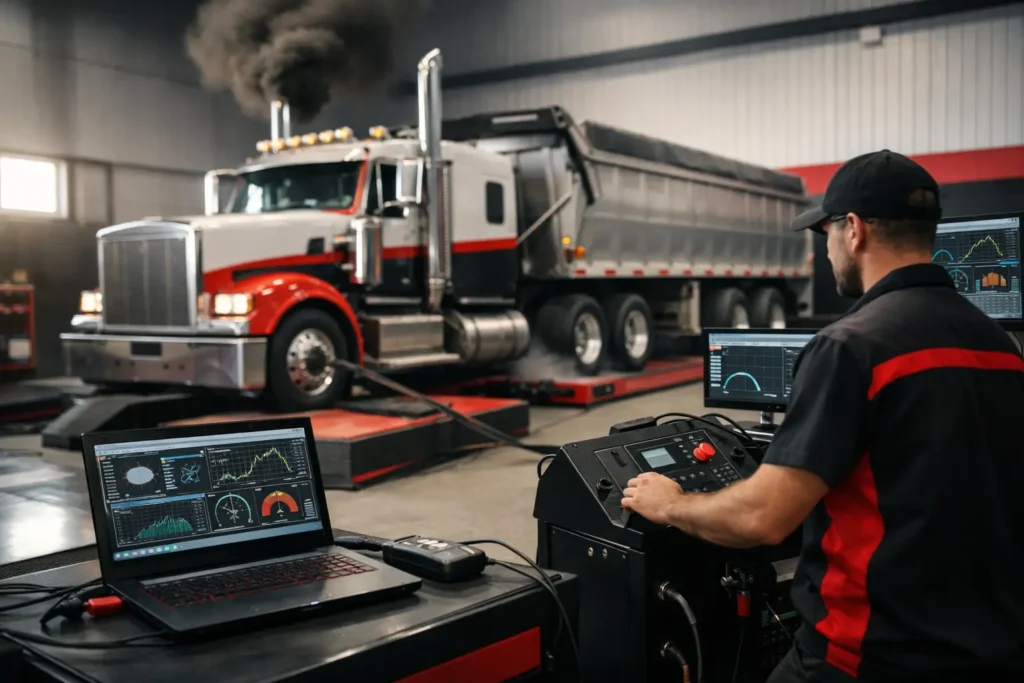
Dyno measurement isn't just a tool for showing peak power. It allows controlled observation of the vehicle's behaviour under load and comparison of its condition before and after calibration. The power and torque curves show whether delivery has become more linear, whether the engine runs out of breath too early and where protection strategies limit performance.
For trucks, it's especially useful to analyse behaviour in the rev range actually used on the road. A vehicle rarely runs only at maximum revs. That's why a good result isn't just a higher peak, but better response and available torque in the working range.
ASF Motorsport approaches calibration as an engineering process: reading the original software, checking the vehicle, adapting the maps and validating the result. That's the approach that follows the Where Speed Meets Precision philosophy – performance only has value when it's measurable, controlled and suited to the vehicle's purpose.
Can tuning reduce fuel consumption?
It can, but it isn't an automatic result and shouldn't be promised without context. If optimised torque delivery lets the driver shift up earlier and use full throttle less often, consumption can be better in certain conditions. On long routes with steady load, that effect can be more pronounced than in city distribution with frequent stops.
On the other hand, a driver who constantly uses the available power after tuning may use more fuel. Aerodynamic drag, payload, tyre pressure, filter condition, driving style and route terrain often have as big an effect as the ECU calibration itself. That's why the honest answer is always: it depends on how the vehicle is used.
When tuning makes no sense
Truck tuning should be postponed when the vehicle has active faults, a transmission problem, overheating, incorrect boost values or visible symptoms of mechanical wear. The same applies to vehicles whose working purpose is about to change, because a calibration for regional transport isn't necessarily optimal for heavy construction work.
The best time for optimisation is when the truck is technically sound, properly serviced and clearly defined in its role. Then tuning becomes a tool for better power delivery, not an attempt to hide problems the vehicle already has.
A truck earns money while it's working, not while it's in the workshop. That's why every software change should have a clear goal: more stable response under load, a more useful torque range and behaviour the driver can feel without compromising the long-term reliability of the drivetrain.