Transmission tuning benefits for better power transfer
On a vehicle that's already strong at full throttle, the next limit often isn't the engine but how the gearbox uses the available torque. The term transmission tuning benefits covers more than faster gear changes: it's about precisely aligning the TCU calibration with the engine's character, the vehicle's load and the driving style. When done properly, a car, motorcycle or work machine doesn't just feel faster – it feels more decisive, predictable and better controlled.
The TCU, or gearbox control unit, makes decisions the driver feels with every acceleration. It determines when the gearbox changes gear, how quickly it carries out the shift, how it manages torque converter lock-up on automatics and how it limits torque during a shift. The stock calibration has to cover a wide range of fuels, climates, driving habits, service conditions and legal markets. That's why it often leaves room for a more precise configuration when the vehicle is technically sound and the project goal is clearly known.
What TCU calibration really changes
The most visible change on many automatic and dual-clutch gearboxes is the shift strategy. The stock map may upshift early for smoothness and economy, even when the driver asks for more decisive acceleration. A tailored calibration can hold a lower gear longer in modes where the engine makes more useful torque, without unnecessarily hunting between two gears.
That doesn't mean the goal is always to raise the shift point as high as possible. On diesel engines, commercial vehicles and work machines, the useful rev range is often different from a sporty petrol engine. A good TCU map follows the torque curve, gear ratios, oil temperature and the vehicle's real purpose. For a vehicle that tows, for example, the more logical shift may be one that reduces gear hunting on a climb, not one that just feels more aggressive.
On dual-clutch gearboxes or electronically controlled automatics, calibration can also optimise shift time. More precise control of clutch pressure, engine torque interventions and the activation sequence allows a more decisive shift without harsh behaviour that brings no real advantage. The limit is always the mechanical design of the specific gearbox. A faster shift isn't good if it creates an unnecessary jolt, slip or thermal load.
The most important transmission tuning benefits on the road
The first benefit is better response to driver demand. When the accelerator is linked more quickly to the right gear, the feeling of delay before acceleration is reduced. This is especially noticeable when overtaking, exiting a slower corner on a track or with a loaded vehicle that has to keep pace on a gradient.
The second benefit is consistency. A stock gearbox sometimes responds differently to a similar throttle position because it tries to judge the driver's intent through conservative filters. Calibration can more clearly separate calm driving from a demand for full performance. The result isn't necessarily a permanently firmer gearbox, but more predictable behaviour: at light load it stays refined, and on a decisive request it responds without an unclear pause.
The third benefit is better use of the engine after an ECU remap. If the engine has a modified torque curve, the stock TCU strategy may trigger limits, request torque reduction or change gear in a way that doesn't follow the new power delivery. Aligned ECU and TCU calibration doesn't mean removing all protections. On the contrary, the goal is for communication between the units to stay logical and for protection strategies to work within limits that suit the drivetrain's real capabilities.
On certain automatic gearboxes, an extra benefit can be adapting torque converter lock-up behaviour. Earlier or more stable lock-up in the right conditions can reduce losses and the feeling of slip. Still, that decision depends on the gearbox design, temperature and working load. There's no universal setting that's best for every car.
Performance isn't the same as aggressiveness
Many drivers judge TCU tuning only by how hard the shift kicks. That's the wrong criterion. A sharp transition can give an impression of performance, but calibration quality is better seen through repeatability, the right gear being chosen and stability under load.
For a road car, the best map is often one that keeps everyday smoothness but recognises a demand for acceleration faster. For a vehicle used on track, the priority may be a consistent manual mode, more control over automatic shifting and precise control at high loads. For a van, truck or agricultural machine, fewer unnecessary shifts, better response under load and a more stable operating temperature may matter more.
CVT gearboxes need special attention. Their operating feel, torque transfer limits and ratio strategy differ from conventional automatics and DCT designs. The same goes for automated manual gearboxes, motorcycles with electronically controlled shifting and various marine drives. That's why TCU calibration mustn't be treated as a universal file applied the same way to every platform.
Diagnostics before changing the map
Tuning doesn't fix worn clutches, faulty mechatronics, contaminated oil, solenoid problems or a sensor fault. If the gearbox is already slipping, jolting, overheating or reporting faults, the cause should be found first. Increasing the demands on a component that's already at its limit can only speed up a failure.
A professional process starts with reading diagnostic data and checking the service history. Then the gearbox temperature, adaptation values where available, behaviour at part and full load and the vehicle's real configuration are assessed. On vehicles with a modified intake, exhaust, turbo or ECU map, the TCU calibration must take the whole package into account, not just the model name.
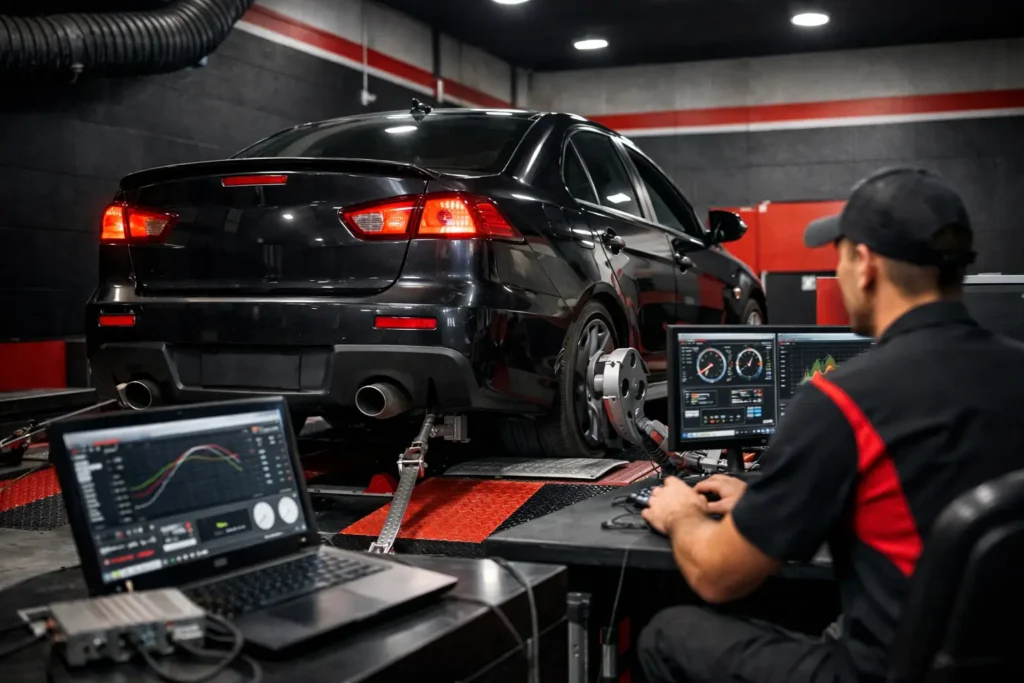
Dyno testing gives controlled data on wheel power and torque, but it doesn't replace checking gearbox behaviour in real conditions. Shifts under load, downhill runs, thermal mode and response at different throttle positions are often confirmed through a combination of measurement, data logs and a carefully carried-out test drive. That combination of measurement and calibration is exactly what separates technical work from generic tuning.
Where the difference is felt most
On powerful turbo petrol and turbo diesel vehicles, TCU tuning is often important because stock torque limiters may be set for the factory specification. On vehicles that tow a trailer or work under constant load, the benefit is more often seen in calmer gear selection and less need for the driver to correct the gearbox manually. On sports cars and motorcycles with suitable electronics, the emphasis may be on consistent shifts when maximum acceleration is demanded.
ASF Motorsport approaches these projects through a technical check of the vehicle, analysis of the existing calibration and measurement where it gives a relevant answer. The Where Speed Meets Precision philosophy has a practical meaning here: performance is only worth something when it's delivered in a controlled, repeatable way and in line with the hardware.
When TCU tuning may not be the right first step
If the vehicle is completely stock, runs fine and the owner only wants subtly better response, the benefit may be smaller than on a vehicle with an already modified ECU map or a specific purpose. If maximum economy is the priority, expectations need to be defined separately, because faster response and holding a lower gear longer on a strong request aren't the same as optimising consumption in every mode.
Also, some gearboxes have limited access or calibration options, while with others the available options depend on the software and hardware version. Sometimes the honest answer is that servicing, adaptation or fixing a fault is more important than tuning. That isn't a missed chance for performance, but the right order of work.
The best result doesn't come from the most aggressive setting, but from a calibration that suits the vehicle and the way you really use it. When the engine and gearbox work as one system, every acceleration gets a clearer purpose – and the driver gets precision they can feel and use.