What is torque management tuning in an engine?
When a driver suddenly opens the throttle, the engine shouldn't always deliver all its available torque immediately. On modern vehicles that can mean tyre spin, a shock to the gearbox, excessive clutch load or an uneven gear change. That's exactly why it's important to understand what torque management tuning is: precise calibration of the strategies the ECU and TCU use to decide how much torque the drivetrain may deliver at a given moment.
Torque management isn't just a power limiter. It's a control system that aligns the engine, turbo, automatic or DSG gearbox, clutch, driveshafts and traction system. A quality calibration doesn't remove protections blindly. It checks where the factory limits are conservative, where they're really needed and how the vehicle responds under load.
What is torque management tuning?
Torque management tuning is the adjustment of the maps and logic that control the engine's actual and requested torque. The ECU constantly compares the driver's request via the accelerator with numerous limits: intake and coolant temperature, engine speed, gear, boost pressure, combustion quality, gearbox protection status and stability system requests.
If one of those limits says less torque is allowed, the ECU intervenes. It can do this by reducing fuel quantity, correcting ignition timing on petrol engines, regulating turbo boost, closing the electronic throttle or a combination of methods. On diesel engines, torque management is closely linked to injection quantity, fuel pressure, boost and smoke control.
On vehicles with an automatic gearbox, the TCU often asks the ECU for a brief torque reduction during a gear change. That brief cut allows controlled unloading of the clutch packs or clutches. Without proper coordination, the shift can be slow, harsh or damaging to the transmission in the long run.
Why manufacturers limit torque
The factory calibration has to work across a very wide range of conditions. The manufacturer takes into account fuel of varying quality, extreme temperatures, different driving styles, prolonged load, component tolerances and several versions of the same engine. The same engine can be fitted to a vehicle with a manual gearbox, a conventional automatic, a DCT or all-wheel drive, and each unit has a different load limit.
That's why torque often isn't limited only by the capacity of the engine itself. It may be limited in first or second gear for traction, at low revs to protect the turbo and dual-mass flywheel, or during gear changes to protect the gearbox. On commercial vehicles and work machines the strategy may protect the differential, propshaft or attached equipment, or reduce thermal load during long work under load.
That doesn't mean every factory limit should stay unchanged. It means every change must have a technical justification.
The ECU and TCU must speak the same language
One of the most common problems with poor-quality modifications is a mismatch between the torque calculated in the ECU and the torque the TCU expects. Modern control systems don't use torque just as a number on paper. That value affects gearbox clutch pressure, shift strategy, traction control, torque reduction requests and diagnostic checks.
If the ECU reports too little torque while the engine actually produces much more, the TCU may apply insufficient pressure to the clutches. The result can be slip, irregular gear changes or faults being triggered. If the reported torque is too high or the limits are wrongly aligned, the vehicle may close the throttle unnecessarily, reduce power or refuse the driver's request.
That's why ECU remap and TCU calibration on certain platforms form a linked whole. Not every vehicle is a candidate for TCU tuning, and not every torque increase requires a TCU software change. The decision depends on the gearbox type, actual torque, vehicle condition, purpose and factory safety limits.
Gear changes without an unnecessary jolt
Good torque management calibration doesn't necessarily mean the shortest possible torque interruption. The goal is for the shift to stay quick, predictable and mechanically controlled. Removing torque reduction too aggressively can send a sharp shock through the drivetrain. Too much reduction, on the other hand, creates a feeling of delay and interrupted acceleration.
On a well-tuned vehicle the transition between gears feels decisive, without unnecessary slip and without the harshness that's often wrongly presented as a sign of performance. Speed and precision must work together.
How tuning is carried out in practice
A professional process starts with diagnostics, not with editing a file. You need to check whether there are active or stored faults, what the engine corrections are, whether the boost system reaches the requested values and how the fuel and temperature systems behave. On automatic gearboxes it's important to assess shift quality, adaptations and any signs of slip.
After that, the original calibration is analysed. A tuner doesn't look for one map called torque limit and raise it at random. On a modern ECU, torque is often part of a model that includes driver demand, limits by speed and gear, component protection, smoke control, thermal limits and communication with other modules.
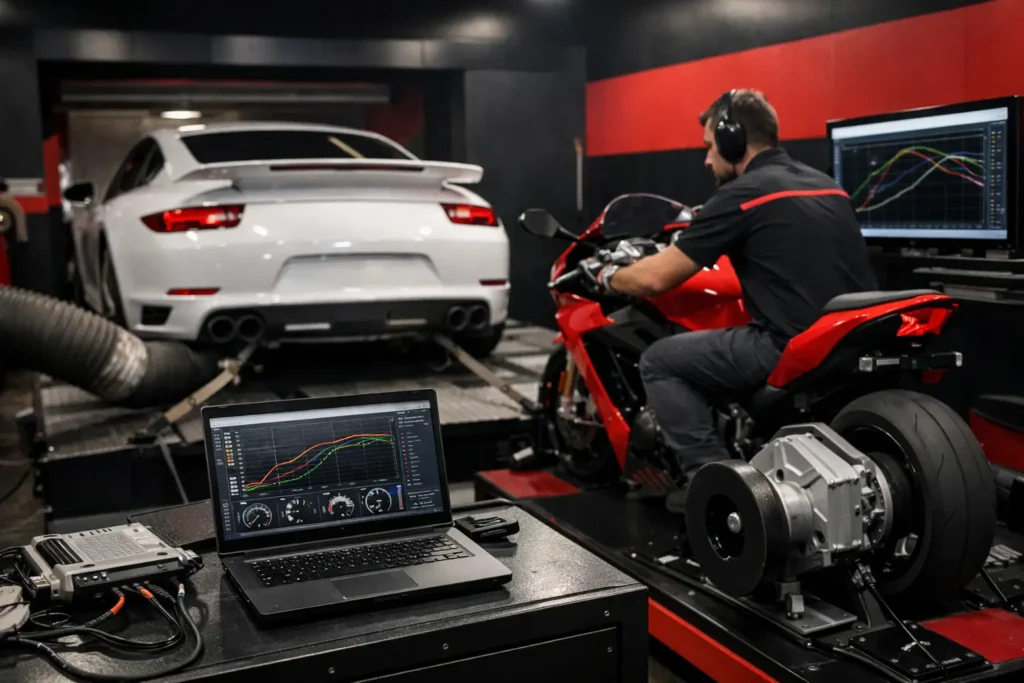
Dyno measurement provides a controlled environment for checking results. However, peak power alone isn't enough. The shape of the torque curve, boost stability, intake temperature, fuel system behaviour and transmission response are just as important. Testing in real conditions with careful data logging further confirms that the strategies behave as planned.
ASF Motorsport approaches these projects through diagnostics, measurement and calibration that respects the vehicle's real configuration. That's the Where Speed Meets Precision working principle: performance must be measurable, repeatable and in line with the mechanics.
What the driver can feel after a proper calibration
The most visible change isn't always peak power. On vehicles with well-tuned torque management, drivers often first notice more linear throttle response and stronger but controlled in-gear acceleration. An automatic gearbox can choose a gear more clearly and shift without hesitation, provided the ECU and TCU strategies are properly aligned.
On turbo engines, the way torque arrives is especially important. A sudden peak at very low revs can stress the clutch, gearbox and drive components more than a more even torque build-up through the useful range. That's why a bigger number isn't the goal in itself. For a road car, a work truck or an ATV working under load, usable and thermally sustainable response is often worth more than a short-lived peak.
Differences between manual, automatic and DCT gearboxes
On a manual gearbox, torque management mainly concerns protecting the engine, clutch and drivetrain. If torque is raised beyond the stock clutch's capacity, slip can appear even when the engine runs perfectly. Calibration then can't replace a mechanically insufficient component.
Conventional automatic gearboxes use a torque converter and clutch packs, so they need accurate torque information for correct line pressure and shifts. DCT and DSG gearboxes have two clutches and very precise control logic. With them, every change in the torque model must be carefully assessed, because an aggressive setting can affect clutch temperature and wear.
On motorcycles, PWCs and other specific platforms the logic can be different, but the principle stays the same: torque must be adapted to the transmission, traction and type of use. That's why universal solutions rarely give the best result.
What torque management tuning isn't
It isn't deleting all limiters and protections. That approach may give a feeling of a bigger kick in the short term, but it increases the risk of overload and often undermines consistency. It also isn't a substitute for regular servicing, good gearbox oil, a healthy clutch, sound spark plugs, a clean intake or a fixed turbo problem.
Nor is it the same as simply increasing power. Power is a function of torque and revs, but torque control determines how and when that energy is transferred through the whole drivetrain. That's why two vehicles with similar peak power can feel completely different on the road and put different loads on the transmission.
The real value of torque management tuning shows when the vehicle accelerates decisively, gear changes stay controlled and the calibration respects component limits. It's careful balancing, not removing limits – and that's exactly where precision becomes real performance.