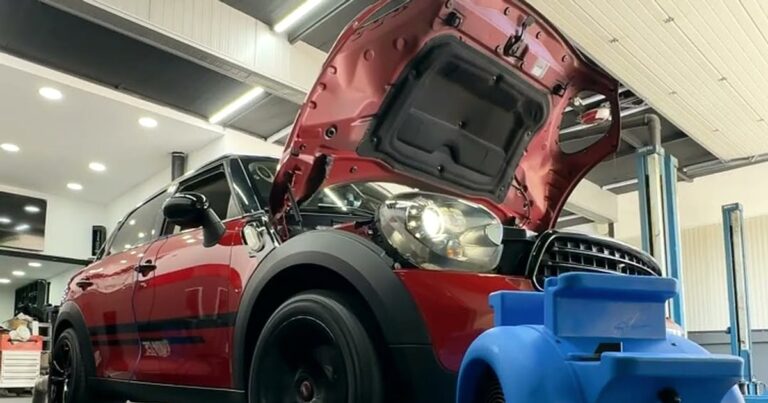
Engine tuning risks you shouldn't ignore
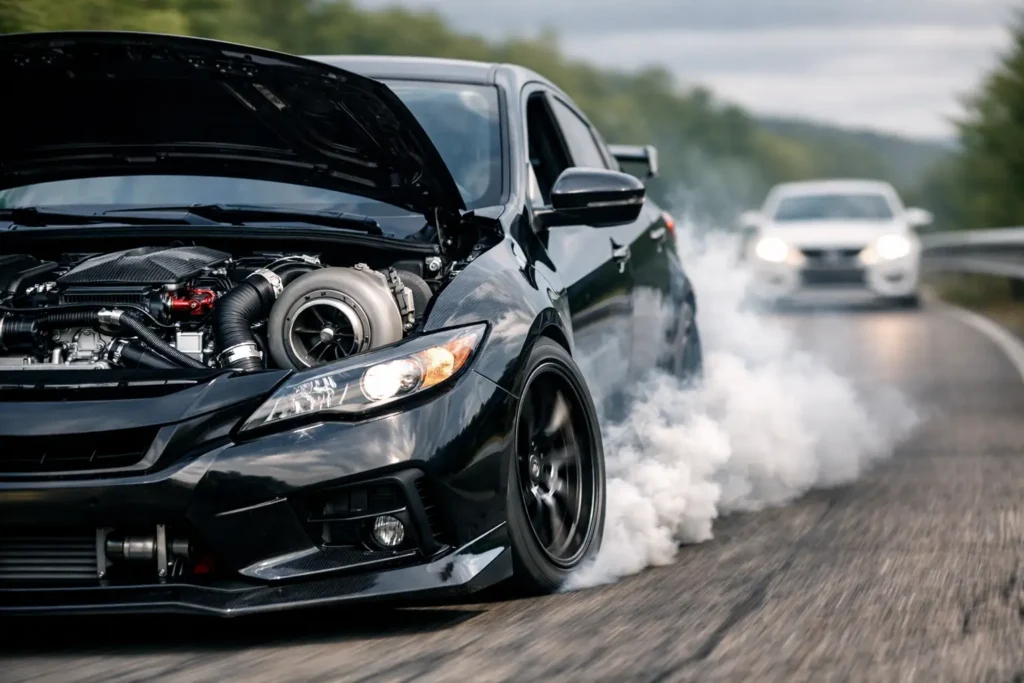
More power isn't automatically more risk. Engine tuning risks arise when calibration is done without knowing the vehicle's real condition, without measurement and without respecting the drivetrain's limits. A well-executed ECU or TCU tune isn't just changing a few values in the software. It's a controlled engineering process in which the engine, turbo, fuel system, cooling, gearbox and electronics must work as a whole.
The owner often sees only the result: stronger in-gear acceleration, better throttle response or more torque at lower revs. The calibrator must also see what comes before the result: boost pressure, intake and exhaust gas temperature, injection corrections, clutch condition, gearbox limits and any faults the vehicle already has. That's exactly the difference between a file that promises a number and a calibration with technical logic.
Engine tuning risks start before the remap
The biggest oversight is assuming every vehicle is ready for more performance just because it drives normally. An engine can start fine and still have deviations that turn into a serious problem under load. A clogged fuel filter, a worn pump, a weak injector, an intake leak, a tired turbo or an inefficient intercooler often don't cause dramatic symptoms in everyday driving. After load is increased, however, their limits become visible.
That's why a professional procedure starts with diagnostics. Faults are read, but it doesn't stop there. Live parameters need to be analysed, requested and achieved pressure values compared, fuel system behaviour checked and temperatures monitored in conditions similar to real load. If the basic mechanics and electronics aren't healthy, tuning doesn't fix the existing fault. Most often it just speeds it up.
On older vehicles the service history is especially important. A car with properly maintained oil, spark plugs, filters and cooling system isn't approached the same way as a vehicle with unknown maintenance intervals. The same goes for motorcycles, boats, work machines and commercial vehicles. The engine's purpose determines how long it works under load, and therefore how conservative the calibration should be.
Power, torque and component limits
Tuning is often described in terms of peak power, but torque is frequently more decisive for durability. High torque at very low revs can put heavy load on the clutch, dual-mass flywheel, torque converter, clutch packs, differential and driveshafts. On turbo engines it can give an impressive feeling of thrust, but that feeling on its own isn't proof of a quality calibration.
Good tuning builds torque in a way that suits the vehicle. Sometimes it's smarter to soften peak torque low in the rev range and keep stable power delivery across a wider range. The vehicle can then be faster, smoother and easier to control, with less load on the transmission. This is especially important on automatic and dual-clutch gearboxes, where the ECU and TCU must have aligned torque requests.
TCU calibration isn't a pointless add-on
When the engine ECU asks for more torque than the gearbox expects or allows, the consequences can be uneven gear changes, limp modes or accelerated clutch wear. TCU tuning, when technically justified, can adjust torque management, clutch pressures, shift strategy and the limits relevant to the new configuration.
That doesn't mean every automatic gearbox needs a remap. The need depends on the specific model, hardware, oil condition, type of use and the vehicle's goal. First it must be confirmed that the transmission is mechanically healthy and that the software change brings a measurable benefit without leaving reasonable operating limits.
Temperature is a silent indicator of risk
More power usually means more energy, and more energy means more heat the system has to control. Intake air temperature affects air density and knock resistance on petrol engines. Exhaust gas temperature is important for the turbo, valves, catalytic components and materials in the exhaust system. On diesels, thermal load depends on fuel quantity, air, injection timing and the duration of the load.
Risk isn't assessed by one short acceleration. A vehicle that gives a good result for a few seconds can behave quite differently after several consecutive loads, in high outside temperatures, on a climb or fully loaded. With boats and work machines this scenario is even more pronounced, because the engine can work under heavy load for a long time without any period of relief.
That's why a quality calibration doesn't chase the maximum value at any cost. It takes into account the capacity of the factory cooling, the fuel quality realistically available, the operating temperature and how the owner will use the vehicle. For an everyday car, a fleet vehicle or a tractor, long-term stability is often worth more than an aggressive peak on the chart.
Dyno testing gives data, but it isn't a substitute for expertise
Dyno testing is a useful tool because it allows repeatable load and precise measurement of power and torque. On an AWD chassis dyno you can follow how the vehicle develops performance across the rev range, compare the condition before and after a change and spot deviations that road driving can hide. For motorcycles, a dedicated hub dyno removes the effect of rear wheel slip and allows very precise measurements at the drive.
Still, the dyno number isn't the whole story. The result depends on corrections, temperature, the type of dyno, drivetrain losses and the measurement methodology. That's why a chart should be read as an engineering record, not as a marketing trophy. The shape of the torque curve, power stability across repeated measurements and the data collected during the test are especially valuable.
ASF Motorsport approaches dyno testing in exactly this way: measurement serves to confirm calibration decisions, not to justify a pre-set number. Where speed meets precision, the result must be repeatable and technically explainable.
A bad file can hide a problem instead of solving it
Generic files, unchecked changes and copied calibrations carry a particular risk. Two vehicles of the same model can have a different software version, different hardware, different component condition and different adaptations. A file that worked acceptably on one vehicle isn't necessarily safe on another.
You can usually recognise a risky approach by the lack of initial diagnostics, no questions about fuel and maintenance, no check of the result after the change and no explanation of what was changed. A professional calibrator doesn't have to reveal every value inside the map, but they should clearly explain the calibration goal, the vehicle's limits and what the owner should monitor after the work.
Vehicles that already have hardware modifications need special attention. A larger turbo, different intake, modified exhaust system, upgraded intercooler or fuel system change the operating conditions. Such a configuration needs a tailored calibration and verification, not the assumption that a standard remap will suit everything.
How the owner can reduce risk
Before tuning, the purpose should be defined realistically. Is the goal safer overtaking, better trailer towing, motorcycle response, more stable operation under load or maximum performance for a closed track? The same engine can get a different calibration depending on the answer.
After tuning, maintenance becomes even more important. Use fuel of the recommended quality, stick to shorter oil change intervals when the vehicle is often under load, don't ignore new noises or warning lights and let the engine reach operating temperature before heavier load. On turbo engines and vehicles that tow, the condition of the cooling and intake systems deserves regular checks.
The best protection against risk isn't fear of tuning, but the right order: a healthy vehicle, a clear purpose, a calibration adapted to the hardware and verification under load. When performance is built on data instead of assumptions, the driver gets more than a more powerful vehicle – they get confidence in the way it delivers that power.