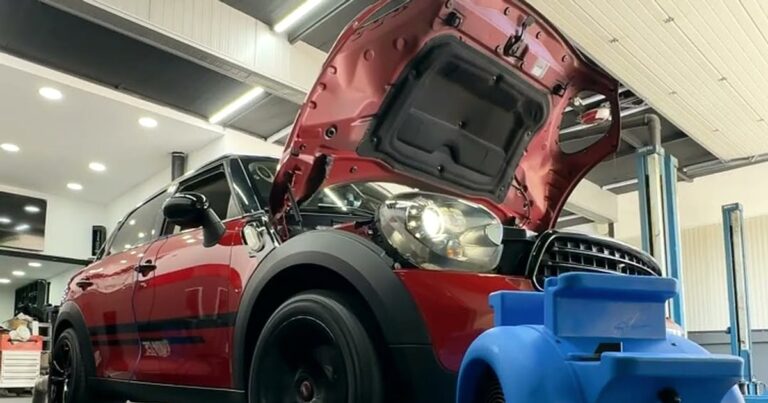
Dyno service in Danilovgrad: a review in practice

A dyno test isn't just the moment a power figure appears on the screen. A good review of a dyno service in Danilovgrad should answer a much more important question: was that number obtained in controlled conditions, with proper vehicle preparation and enough data for the owner to really understand the condition of their engine?
For a driver planning ECU or TCU calibration, checking the result of modifications already made or simply wanting confirmation of the vehicle's technical condition, a dyno is a measuring tool. Its value isn't in a sensational figure, but in a precise before-and-after comparison, analysis of the power and torque curves and finding problems that may not be immediately felt on the road.
What a quality dyno service really measures
A chassis dyno, or roller dyno, measures the power that reaches the wheels. That's why the result depends on the complete drivetrain, not just the engine's claimed power. Losses through the gearbox, differentials, propshaft, tyres and transmission are part of the vehicle's real picture.
This is especially useful when assessing a car's real performance. The factory power figure is measured on the engine under defined laboratory conditions, while the dyno shows how the vehicle delivers power through its own transmission and drive. That's why directly comparing one car with another, measured on different units or in different conditions, rarely makes complete sense.
The most valuable comparison is of the same vehicle on the same dyno, at a similar temperature, with the same fuel and the same methodology. Then it's clear whether a change to the calibration, intake, exhaust or transmission really brought a measurable result.
Dyno service in Danilovgrad review: the criteria that matter
When assessing a dyno service, the equipment matters, but on its own it isn't enough. The operator's way of working, diagnostics before load and willingness to explain the result without exaggeration are just as important.
AWD capability and proper vehicle securing
All-wheel-drive vehicles need a dyno that can safely and correctly simulate the operation of the front and rear axles. With AWD systems it isn't acceptable to improvise by measuring only one axle if the vehicle's design and the manufacturer's recommendations don't allow it. Differences in roller speeds, how couplings work and electronic drive control can affect the result, as well as test safety.
Properly strapping down the vehicle also isn't a detail that can be skipped. The vehicle must be stable under load, the tyres correctly positioned on the rollers, and ventilation directed so that the radiators, intake and engine bay get airflow close to real driving. Poor ventilation can raise intake air temperature and reduce power, especially on turbo engines after several consecutive runs.
Diagnostics before full load
A responsible dyno test doesn't start at full throttle. First you need to check for active or stored faults, the values of key sensors and whether the engine reaches operating temperature without deviations. On petrol engines, ignition correction, fuel pressure, intake temperature and mixture, among other things, are monitored. On diesel engines, requested and actual boost, fuel pressure, injection quantity, exhaust gas temperature where available and the engine protection system matter.
If the data shows a problem, the most professional move isn't to carry on at any cost. The dyno then becomes a diagnostic tool: it can help reveal clutch slip, a fuel pressure drop, an intake leak, a turbo restriction or a protective intervention by the control unit. This saves the owner time and prevents the wrong conclusion that the vehicle is simply “weak”.
Repeatability is stronger than one high result
One run can look excellent, but without repeatability there's no serious confirmation. A quality service usually does several measurements when the vehicle's condition allows, to check whether the curves stay stable and whether temperature affects power delivery.
A difference between two runs isn't always a sign of a problem. On vehicles that are warming up, automatic gearboxes that adapt their shift strategy or engines with pronounced thermal limits, small deviations are expected. What matters is that the operator recognises the reason and explains it clearly, instead of picking only the highest number for the report.
How to read a dyno chart without false expectations
A power and torque chart says more than the peak value at the top. A vehicle that gets a moderate increase in peak power but a stronger, flatter torque curve in the mid-range will often feel noticeably better in everyday driving. It responds faster in in-gear acceleration, needs fewer gear changes and holds pace under load more easily.
On the other hand, a sudden torque spike at low revs isn't automatically desirable. With manual gearboxes, clutches, dual-mass flywheels and some automatic transmissions, overly aggressive torque delivery can increase mechanical load. That's why a good ECU and TCU calibration doesn't just chase the peak number. It shapes power delivery according to the capabilities of the engine, turbo, fuel system and gearbox.
Attention should also be paid to the shape of the curve. Interruptions, pronounced dips or unusual oscillations can indicate traction control intervention, a change in boost, a fuel problem, clutch slip or the automatic gearbox's strategy. Not every irregularity is a fault, but each one deserves an explanation.
Why a dyno test is useful before and after calibration
Before an ECU remap, the baseline measurement gives a reference point. It confirms that the vehicle is running as it should and shows the real starting point. This is especially important on used vehicles, where previous work, unknown maintenance quality or existing modifications can change how the engine behaves.
After calibration, a repeat measurement checks not only the increase in power and torque but also the quality of delivery. The goal isn't to produce an aggressive chart for a photo. The goal is stable, controlled and usable performance, while monitoring parameters the engine and drivetrain can handle long term.
With TCU calibration, the dyno can help assess gearbox behaviour under load. Shift speed, torque limits, kickdown logic and the way engine torque is transferred through the transmission all affect the final driving feel. The ECU and TCU shouldn't be viewed as separate units when they work in the same drive system.
Motorcycles, ATVs and work machines need a different approach
Not every dyno test is the same. Motorcycles require different mounting, different airflow and careful temperature monitoring, and a hub dyno removes the effect of the rear tyre and roller contact. With ATVs and UTVs, the CVT transmission, cooling and the vehicle's specific purpose – recreational riding, work in the field or towing – need extra attention.
With light vans, trucks, agricultural and industrial machinery, a usable torque curve is often more important than peak power. A vehicle that pulls more steadily under load and responds correctly in its working rev range can have a real operational advantage, but every intervention must be adapted to the real load and mechanical condition.
ASF Motorsport in Danilovgrad uses an AWD chassis dyno for vehicles and a dedicated motorcycle hub dyno for precise motorcycle measurement. In both cases the focus should stay the same: controlled conditions, reading technical data and a result that makes sense for the specific vehicle, not just for posting on social media.
What to ask for in the report after testing
After measurement, the owner should get a chart and a clear explanation of the basic test conditions. It's useful to know which gear the vehicle was measured in, the approximate temperature, whether a correction factor was used and whether there were any limitations during the run. If before-and-after measurements were done, both charts should be shown in a way that allows a fair comparison.
A good operator won't hide deviations either. If the vehicle shows a drop in performance due to heat, fuel limits or a transmission problem, that's valuable information. Precision doesn't mean every result will be ideal. It means the result will be understandable, repeatable and technically honest.
A proper dyno service doesn't sell a number. It gives a basis for a decision – whether the vehicle is ready for calibration, whether there are problems to fix and how performance can be improved without guesswork. That's where Speed Meets Precision takes on real meaning: power isn't assumed, but measured, interpreted and applied responsibly.