Can ECU tuning pass an emissions test?
The question “can ECU tuning pass emissions” has no honest answer that fits into a simple yes or no. An emissions test doesn't assess power or the fact that the ECU has been mapped. It measures actual combustion, the operation of the exhaust aftertreatment system, diagnostic readings and, depending on the regulations, the visual condition of the emissions equipment. A well-executed calibration can pass an emissions test. A badly done map or an engine with an existing fault often won't.
For ASF Motorsport, where speed meets precision, that's the basic principle of calibration: extra performance has no value if it's achieved at the cost of uncontrolled combustion, constant faults or faulty emissions equipment.
Can ECU tuning pass an emissions test?
Yes, it can – provided the calibration is adapted to the vehicle's real mechanics, its fuel and the regulations that apply in the market where it's used. ECU tuning on its own isn't automatically the cause of failing a roadworthiness inspection. The problem arises when software changes are used to hide faults, when fuel and turbo boost requests are changed too aggressively or when key exhaust system components are already worn.
On modern vehicles, the ECU controls much more than fuel quantity and boost. It coordinates injection, ignition on petrol engines, EGR strategy, exhaust temperature, DPF regeneration, SCR system operation and AdBlue dosing where fitted, as well as fault monitoring. Any serious calibration change must understand that complete system.
That's why identical software doesn't give an identical result on two vehicles of the same model. One may have a clean intake, a healthy catalytic converter and sound injectors. The other may have a blocked DPF, a differential pressure sensor that reads incorrectly or a turbo that doesn't follow the requested boost. The map only reveals a difference that already existed.
What's checked in an emissions test
The exact procedure depends on the country, the vehicle's year, the fuel type and local regulations. Older diesels are often assessed by smoke opacity, while on petrol vehicles CO, HC, lambda value and engine operation in a prescribed mode may be monitored. Newer vehicles may be subject to an OBD check, which reads diagnostic codes, monitor status and emissions-related faults.
On diesels, the most common reasons for a poor result are too many particulates, an incorrect air-fuel ratio and problems with the DPF, EGR or SCR system. Black smoke under load isn't proof of a “strong” diesel. It's a signal that combustion, air supply, injection or exhaust control isn't working as it should.
On petrol engines the catalytic converter plays a key role. If the engine runs too rich, misfires, uses oil or has faulty lambda sensors, CO and HC emissions can rise regardless of whether the vehicle is stock or tuned. On direct-injection engines, the condition of the spark plugs, coils and intake deposits can also affect the result.
OBD status isn't a detail
An engine light that's on before the inspection is an obvious problem, but a light that's off isn't always proof everything is fine. Diagnostics should check active, stored and intermittent faults, as well as the readiness of the relevant monitors. If the vehicle hasn't completed the required self-checks after faults were cleared or the battery disconnected, on some tests that can be a reason for further checks or a fail.
Professional calibration shouldn't switch off diagnostic logic just to keep the dashboard free of warnings. That doesn't solve the mechanical or electrical cause, and it can create a bigger problem during regular maintenance and legal inspection.
How tuning affects the emissions result
ECU tuning can affect emissions directly and indirectly. The direct effect comes through changes to injection, torque limiters, air requests, turbo boost and exhaust gas temperature. Indirectly, more torque can reveal weaknesses in the clutch, intake hoses, turbo, fuel system or exhaust aftertreatment that the stock map didn't load as much.
A conservative map adapted to the vehicle looks for balance. On a turbodiesel this means fuel isn't increased without enough air and smoke control. On turbo petrol engines it means not forcing parameters that cause knock, excessive temperatures or constant ignition corrections. The goal isn't the biggest number on paper, but stable operation across the whole load range.
Fuel type changes the picture further. Lower-quality fuel, a contaminated fuel filter or the wrong octane rating on a petrol engine can change how the engine responds to the calibration. The same goes for vehicles that often tow loads, work at high altitude or spend a lot of time in city traffic. A calibration for an everyday car isn't the same as one for a work machine, truck or boat.
Before tuning: diagnostics are mandatory
The safest route to reliable performance and clean emissions starts before the software is changed. Faults need to be read, real parameters checked on the road or under load and the basic service items inspected. On turbocharged vehicles, actual and requested boost, airflow, injection corrections, temperatures and fuel system behaviour are especially important.
On a diesel, the DPF load, the frequency and success of regenerations, differential pressure sensor values and EGR and SCR system operation where fitted should be assessed. On a petrol engine, mixture corrections, lambda sensors, misfires, spark plug condition and catalytic converter efficiency are checked. This inspection isn't about finding a reason to refuse tuning, but about first bringing the vehicle into a technically healthy state.
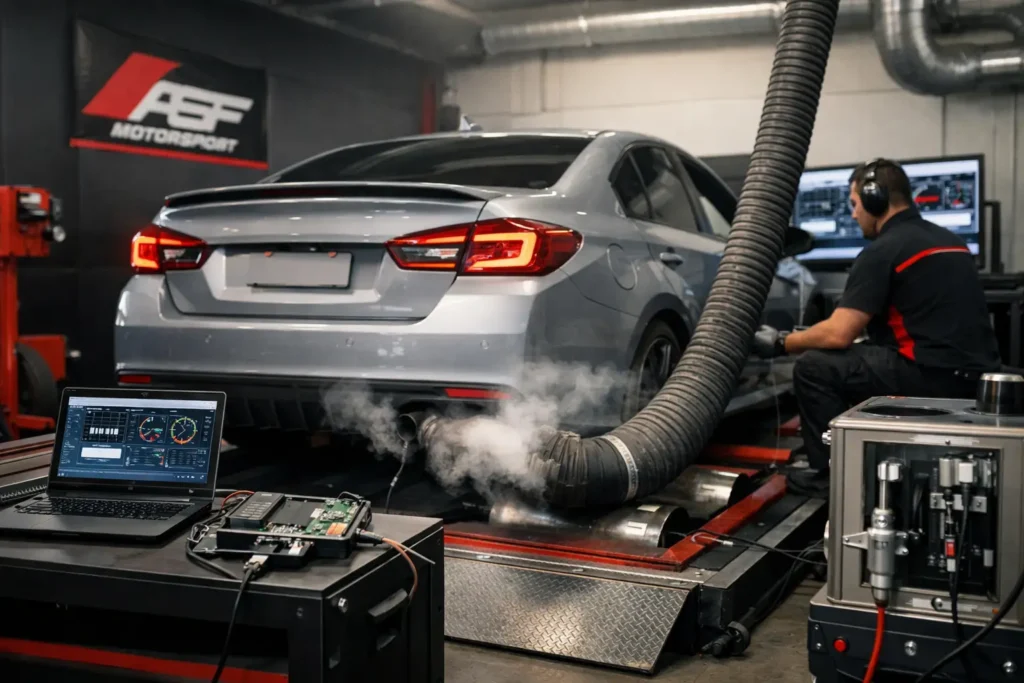
A dyno test can add value because it shows the vehicle's behaviour under controlled load. It doesn't replace road validation or an official emissions test, but it can reveal unstable boost, a fuel drop at higher revs or unusual power limiting. Data matters more than assumptions.
How to prepare a tuned vehicle for a roadworthiness inspection
There's no safe trick that can replace maintenance. If the inspection date is close, it's most sensible to check that there are no active faults, that the engine has reached operating temperature and that the vehicle isn't in the middle of a DPF regeneration problem. Regular servicing of the oil, air and fuel filters, as well as quality fuel, has a real effect on how the engine runs.
Don't try to hide faults by clearing codes just before the test. That can reset the OBD monitors while the underlying cause remains. If the light keeps coming back, if you feel a loss of power, if the vehicle smokes or regenerations happen unusually often, sort out the diagnostics and mechanics first.
Emissions equipment must stay functional
The DPF, catalytic converter, EGR, SCR and associated sensors aren't irrelevant add-ons to performance. They're part of the vehicle's homologated system and crucial for exhaust gas quality. Removing, disabling or hiding these systems in software on road vehicles isn't a responsible or legal way to prepare for an emissions test.
For vehicles used only in specific competition or closed working environments the rules may differ, but that doesn't change the obligations for vehicles registered for public roads. The owner should always check local requirements, because inspection procedures and permitted modifications differ.
When it's better to postpone tuning
If the vehicle already shows emissions-related faults, unstable idle, excessive oil consumption, smoke under load or fuel system problems, tuning should wait. Adding load to an engine that isn't healthy brings neither precision nor long-term benefit. First the cause is established, then the repair is confirmed by measurement and diagnostics, and only then is calibration considered.
The same goes for owners who expect one universal map to solve everything. A quality result depends on the ECU version, the vehicle's hardware, service history, how it's used and what goal is realistic for the specific platform. A transparent tuner will explain the limits before the work, not only after a problem appears.
A well-calibrated vehicle can be stronger, smoother and able to pass the required emissions check. The road to that result isn't a shortcut through diagnostics, but a combination of a healthy engine, functioning emissions equipment, measurement and calibration done with an understanding of the whole system.