How to test power on a dyno accurately
Dyno measurement isn't just checking the horsepower figure. When you know how to test power on a dyno, you get measurable insight into the real condition of the engine, transmission and power delivery across the whole rev range. That's the basis for quality diagnostics, checking ECU or TCU calibration and comparing results before and after a technical change.
A good dyno test starts long before the vehicle gets on the rollers. The result depends on vehicle preparation, the type of dyno, ambient conditions, how the vehicle is strapped down, the selected gear and how the data is processed. That's why one peak number without context mustn't be seen as a complete picture of performance.
What does a dyno really measure?
A chassis dyno measures the force the driven wheels transfer to the rollers. From that measurement, the system calculates power and torque at the wheels. That's not the same as the factory's claimed crankshaft power, because between the engine and wheels there are losses in the gearbox, differentials, propshaft, bearings and tyres.
That's why it's most useful to compare results obtained on the same dyno, in similar conditions and with the same methodology. If a vehicle is tested before and after remapping, the same equipment and procedure give far more valuable information than comparing two charts from different workshops.
With AWD vehicles it's especially important to use proper all-wheel-drive equipment. Incorrect testing can trigger the vehicle's protection systems, produce inconsistent data or put unnecessary load on the drivetrain. Motorcycles, on the other hand, are tested on a dedicated hub dyno or other equipment suited to their design and power transfer.
Preparing the vehicle before measuring power
Technically correct measurement starts with a basic inspection. The engine must reach operating temperature, but mustn't be overheated. Oil and coolant levels should be correct, with no active faults affecting engine operation, turbo boost or throttle position. On turbo engines we especially check whether the intake system, vacuum lines and boost pipes hold pressure.
Tyres must be in good condition and correctly inflated. Too little pressure increases deformation on the rollers and can affect measurement repeatability, while excessively high pressure changes the contact and tyre behaviour. The goal isn't to find a universal pressure value, but to ensure stable and safe conditions for the specific vehicle.
Fuel is another often overlooked factor. The ECU calibration may be designed for fuel of a certain octane rating, and the engine's adaptations depend on fuel quality and knock detection. Testing a vehicle with fuel that doesn't match the calibration can reduce power, change ignition timing or lead to protective interventions. On diesel vehicles, the fuel system condition, DPF regeneration and exhaust gas temperature can also change the result.
Before the test, unnecessary consumers should be switched off, unless they're needed for the vehicle to run. The air conditioning is usually switched off, while cooling fans must run to simulate the airflow the vehicle gets on the road. Without enough cooling, intake air temperature rises and the ECU may reduce power to protect the engine.
How to test power on a dyno step by step
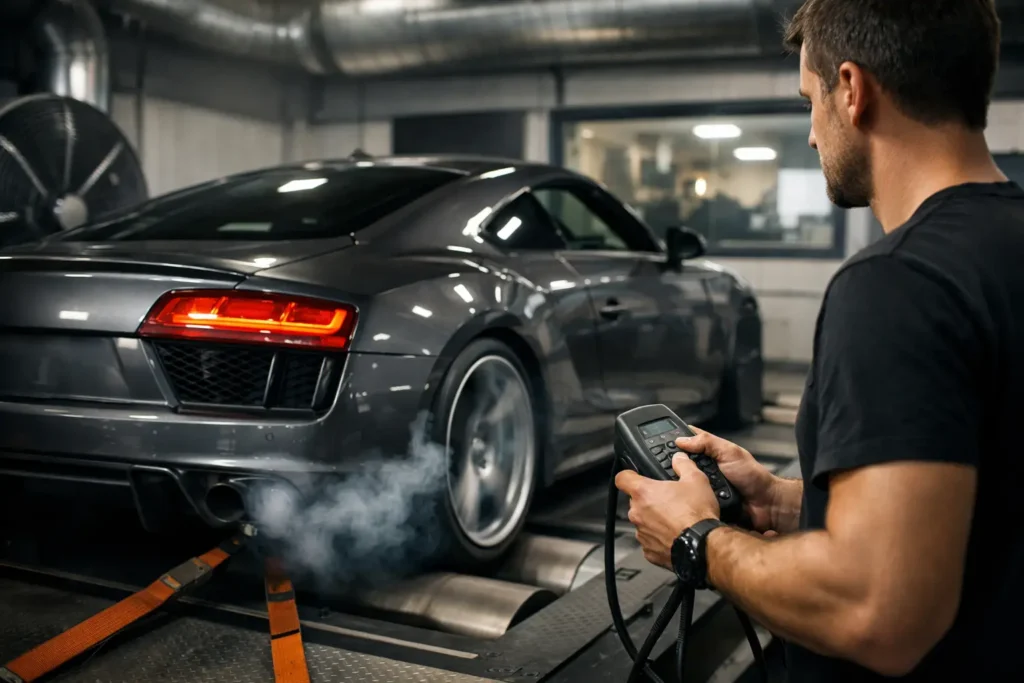
The vehicle is first correctly positioned on the dyno and firmly strapped down with certified straps. The strapping must limit vehicle movement, but mustn't load the suspension unnaturally. Then the fans are positioned, the diagnostic equipment connected and, if needed, probes fitted to monitor lambda, exhaust gas temperature, boost or other critical parameters.
After a short stabilisation, the right gear is selected. Usually the gear with a ratio close to 1:1 is used, but that depends on the gearbox and the characteristics of the specific vehicle. With automatic and DCT gearboxes it's sometimes necessary to use manual mode, disable kickdown or select a dyno mode if the manufacturer supports it. The goal is to prevent unwanted gear changes during the measurement.
The measurement is carried out at controlled full load through a predetermined rev range. The operator monitors live data: air-fuel ratio on petrol engines, boost pressure, intake temperature, ignition corrections, exhaust temperature and any faults. If the parameters show a deviation, the test is stopped. Power is never more important than protecting the engine and drivetrain.
One run isn't enough for a serious conclusion. Several repeatable measurements are needed, with enough time for temperatures to stabilise. If each following run shows a significant power drop, the cause may be heat soak, insufficient airflow, gearbox protection, clutch slip or a calibration limit. That's exactly where the dyno becomes a diagnostic tool, not just a printer for the peak value.
How to read a power and torque chart
The chart should be read as a curve, not as a single point. Peak power shows the top, but the shape of the curve shows how the vehicle accelerates in real driving. Broad, stable torque delivery often gives a more convincing feeling of performance than a short, aggressive peak that quickly disappears.
On turbo engines, attention should be paid to when boost builds, the rise in torque and power behaviour at higher revs. A sudden drop can point to an airflow limit, excessive intake temperature, an exhaust restriction, a fuel pressure drop or ECU protection intervening. On naturally aspirated engines the curve is usually more linear, so unexpected breaks and oscillations more easily point to an ignition, intake or fuel problem.
On vehicles with an automatic gearbox, the chart can also reveal TCU calibration behaviour. Torque limiting, torque reduction during gear changes and clutch protection logic affect the real result. That's why the ECU and TCU shouldn't be looked at separately when the goal is aligned, repeatable power delivery.
Correction for atmospheric conditions can help when comparing tests done on different days, but it isn't a substitute for a transparent methodology. Air temperature, barometric pressure and humidity change air density, and therefore the engine's potential. The correction factor should be clearly shown and used consistently, without trying to flatter the result.
The most common mistakes that change the result
The biggest mistake is expecting every dyno to show the same number. Differences in roller design, calibration, software, how speed is read and corrections can create a difference that shouldn't automatically be interpreted as a fault or a power gain. The trend on the same equipment is more relevant than an isolated number.
Another common mistake is testing a vehicle straight after aggressive driving, without time for temperatures to stabilise. Also, tyre or clutch slip can look like an irregular power curve, when in reality the problem isn't in the engine. That's why the vehicle's mechanical basis is checked before every calibration change.
The choice of driving mode shouldn't be ignored either. Sport, normal, individual mode, traction control off or partly active and the position of active exhaust flaps can change the vehicle's behaviour. A professional test documents these conditions so the result is repeatable.
The dyno test as a basis for precise calibration
A dyno has the greatest value when combined with diagnostics and analysis of ECU and TCU logs. The chart alone shows the consequence, while the data reveals the cause. If power doesn't follow the expected curve, pressures, temperatures, ignition corrections, torque requests and component limits are analysed.
U ASF Motorsport approach dyno measurement is a controlled process: the starting condition is recorded, relevant parameters are monitored, and every calibration change is checked through repeatable measurements. That's the meaning of the Where Speed Meets Precision philosophy – performance isn't judged by guesswork, but confirmed with data.
If you're planning a test, come with a technically sound vehicle, the right fuel and a clear goal: diagnostics, checking the stock condition, validating a modification or optimising the calibration. Then the number on the chart becomes just the start of a useful conversation about how your vehicle really delivers its power.