How launch control tuning works in practice
Dropping the clutch at too high revs doesn't automatically mean a faster start. Most often it means wheelspin, loss of stability or an unnecessary shock to the drivetrain. That's why the question of how launch control tuning worksis above all a question of precise torque control in the first few metres – the moment when the engine, tyres, clutch, gearbox and surface have to work as one system.
Launch control isn't a universal rev map that can be thoughtlessly applied to every vehicle. A properly calibrated system takes into account the drive configuration, gearbox type, turbo characteristics, available grip and how the factory ECU or TCU manages torque. The goal isn't to create an effect, but a repeatable, controlled start in the conditions the vehicle is prepared for.
How launch control tuning works
At its core, launch control sets a target engine speed while the vehicle is stationary and the driver activates defined conditions, such as a pressed clutch, brake or a specific driving mode. Instead of the engine freely hitting the limiter, the ECU holds the revs around a pre-calibrated value.
However, holding the revs is only the visible part of the process. The ECU achieves it by controlling one or more parameters: electronic throttle position, ignition timing, fuel injection quantity, boost on turbo engines and torque limiters. Which approach is used depends on the platform and the factory engine management strategy.
On a modern turbo vehicle, the calibration can help keep the turbo in its useful response range before moving off. That doesn't mean every aggressive anti-lag approach is suitable for a road car. Excessive exhaust gas temperature and load on the turbo, catalytic converter and exhaust system must stay within realistic limits. Precise calibration always looks for a balance between response and long-term mechanical safety.
On a naturally aspirated engine the focus is usually more on holding revs steadily and metering torque than on building boost. On motorcycles, ATVs, UTVs and boats the logic can be completely different, because the transmission, weight, surface or propeller load significantly change behaviour when moving off.
Revs aren't the only important value
A common mistake is to see launch control as a question of one number: 3,000, 4,000 or 5,000 rpm. The right number doesn't exist without context. A start at the same revs can be excellent on a prepared surface and completely ineffective on cold tarmac or with tyres that don't have enough grip.
If the revs are too low, the engine may drop out of its useful torque range and the turbo may respond more slowly after the clutch is released. If they're too high, the tyres can lose contact with the surface, the clutch can take on excess heat and the drivetrain can get an unnecessarily sharp shock. On all-wheel-drive vehicles the limit is often different from front- or rear-wheel drive, but AWD isn't automatic protection against transmission overload either.
That's why the target value is set for the specific vehicle. Weight, tyres, gear ratios, clutch condition, differentials, mid-range power and the surface directly affect the result. Sometimes a more moderate start is objectively faster, because the vehicle reaches stable acceleration sooner without unnecessary wheelspin.
Torque management after moving off
The quality of a launch control calibration doesn't end the moment the driver releases the clutch or brake. The ECU must transition properly from launch mode to the normal acceleration strategy. That transition determines whether power delivery will be progressive or abrupt.
On vehicles with an automatic or dual-clutch gearbox, the TCU often plays as important a role as the ECU. The gearbox monitors clutch temperature, permitted input torque, clutch pressure and protection strategies. An ECU calibration that ignores TCU limits can lead to interventions, inconsistent starts or faults. That's why on certain platforms engine and transmission calibration are assessed together.
Factory launch control systems already have defined protections. When refining them professionally, these protections shouldn't be removed blindly; instead, it's important to understand why they exist and where their real limits are. A vehicle that makes a good start once and then reduces power because of temperature or clutch protection isn't a consistently tuned vehicle.
The difference between a launch limiter and an anti-lag function
A launch limiter limits revs at a standstill. Anti-lag is a broader concept whose aim is to maintain turbo response by changing combustion and the management of exhaust energy. These functions can work together, but they aren't the same.
In certain sport and special applications, anti-lag can have a justified role. On a road vehicle, however, aggressive settings can significantly increase thermal load. Exhaust noises and popping aren't a measure of calibration quality. The real value lies in stable response, controlled temperature and repeatable vehicle behaviour.
The same goes for so-called flat shift or no-lift shift. That function can keep the throttle open during a gear change and briefly manage torque for a faster continuation of acceleration. Its compatibility depends on the gearbox, clutch and how the ECU supports the gear change. It shouldn't be treated as a universal add-on for every manual car.
Why diagnostics and measurement change the result
Before any launch control calibration, the vehicle's basic health needs to be checked. Misfires, a worn clutch, fuel problems, inconsistent boost, poor sensor data or overheating aren't solved by changing a limiter. Launch control can only show more clearly a weakness that already existed.
Diagnostics give the initial picture, while driving logs and measurements show how the vehicle responds under load. Actual and requested torque, revs, throttle position, boost, ignition corrections, temperatures and traction control interventions are monitored. On automatic gearboxes it's also useful to monitor clutch-related data and torque limits.
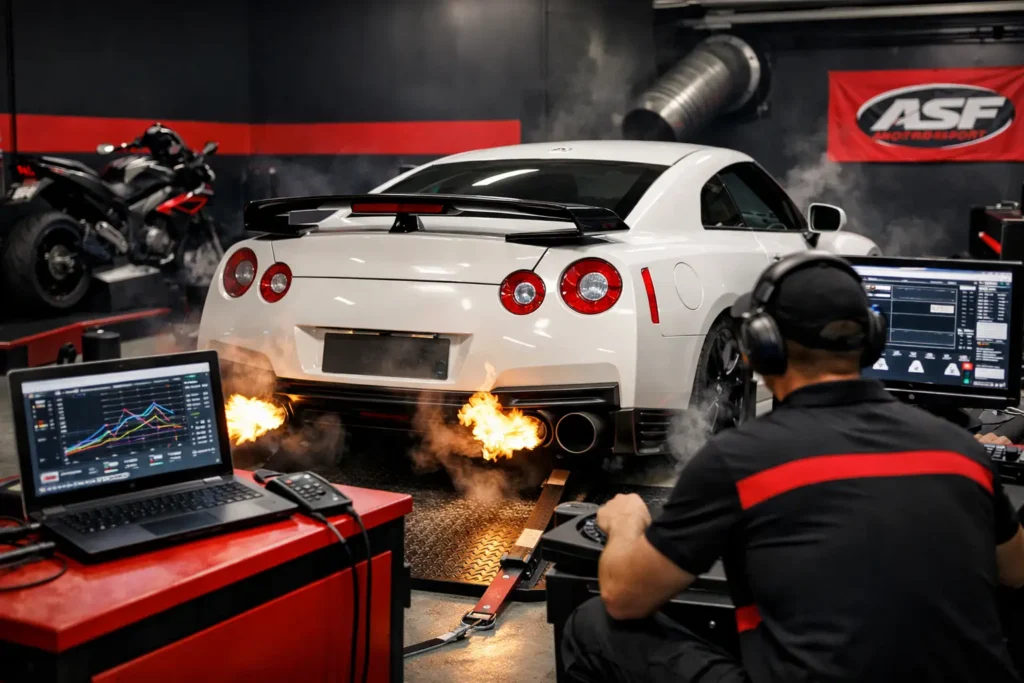
A dyno is a valuable tool for checking power delivery and engine behaviour in controlled conditions, but it can't fully simulate the grip of a real surface. A vehicle's launch depends on tyre-surface contact, weight transfer and driver technique. That's why the calibration isn't judged only by the power chart, but by the complete behaviour of the system.
ASF Motorsport approaches such functions through diagnostics, measurement and adaptation to the vehicle's specific configuration. That's the Where Speed Meets Precision principle: performance has value when it's delivered in a controlled, measurable way and within the capabilities of the mechanics.
When launch control isn't the right answer
A vehicle used every day on city tyres, with a standard clutch and driven in changing road conditions often doesn't need an aggressive launch strategy. In that case better throttle response, properly mapped torque and a healthy transmission can bring more benefit than a high launch limit.
Also, the function should only be used at a suitable, closed and safe location. Fast starts increase the load on drive components, and a public road offers neither predictable conditions nor space to control risk. Regular maintenance, quality tyres and a properly warmed-up vehicle remain more important than any software option.
The best-tuned launch control doesn't try to hide the vehicle's shortcomings. It gives the driver a controlled tool that respects the limits of the engine, transmission and surface – exactly where precision decides how much performance is really usable.