How to map ignition with safe power reserves
An ignition map isn't a table where you randomly add a few degrees of advance to make the engine feel stronger. When people ask how to map ignition, the real question is: how do you get the highest stable torque without knock, overheating and unnecessary mechanical load? The answer requires measurement, proper diagnostics and an understanding of how the whole engine works.
In a petrol engine, spark timing directly affects cylinder pressure. If the mixture ignites too early, peak pressure builds while the piston is still moving towards top dead centre. The result can be knock and higher load on the pistons, bearings and cylinder head. If the spark fires too late, combustion continues as the piston is already moving down, so the engine loses torque, exhaust gas temperature rises and part of the energy goes into the exhaust instead of the crankshaft.
That's why good ignition calibration isn't a hunt for the most aggressive value. It's a controlled process of finding the optimal point for the specific engine, fuel, air temperature, load and vehicle configuration. This is exactly where speed meets precision.
What the ignition map actually controls
Ignition timing is usually expressed in degrees before top dead centre of the crankshaft. The ECU doesn't use one fixed value for the whole operating range. Instead, base timing is laid out in cells by engine speed and load, which the ECU can calculate from intake pressure, airflow, throttle position or requested torque.
At light load the engine usually needs more advance because the mixture is leaner and burns more slowly. At full load, especially on a turbo engine, cylinder pressure and temperature rise, so a bigger margin against knock is needed. That's why the same timing value can't be right for both light cruising and full acceleration.
Modern ECU systems also apply corrections. Intake air temperature, coolant temperature, fuel quality, camshaft position, lambda value, boost pressure and component protection can all change the final ignition angle. The base table is just the starting point. The actual value the engine gets is the result of several linked strategies.
It's important to distinguish petrol and diesel engines. A conventional diesel has no spark plugs to ignite the mixture, so ignition isn't mapped in this sense. On a diesel, injection timing and duration, fuel pressure and the related torque strategies are optimised. The term ignition map therefore applies mainly to spark-ignition engines, including petrol cars, motorcycles, ATVs, UTVs and boats.
How to map ignition: the process before changing the table
Before any calibration change, the engine must be in good technical condition. Spark plugs, coils, fuel delivery, the intake system, intercooler, pressure sensors and knock sensors directly affect the result. A weak coil or the wrong spark plug can sometimes look like a map problem, and changing the ignition then only hides the fault.
The first step is reading fault codes and reviewing the available data on the road or on the dyno. The calibrator monitors actual ignition angle, per-cylinder knock corrections where the ECU supports them, lambda, boost pressure, intake temperature, coolant temperature, fuel pressure and delivered torque. Without that data it's impossible to say with certainty whether the engine is responding to the timing change or is being limited by another system.
Next comes a baseline measurement in repeatable conditions. A dyno is especially useful because it lets a change be tested at a defined load and engine speed. On the road, conditions often vary: gradient, wind, temperature, gear changes and the way the throttle is applied all affect the results. Dyno testing doesn't replace a final check in real driving, but it gives a controlled basis for decisions.
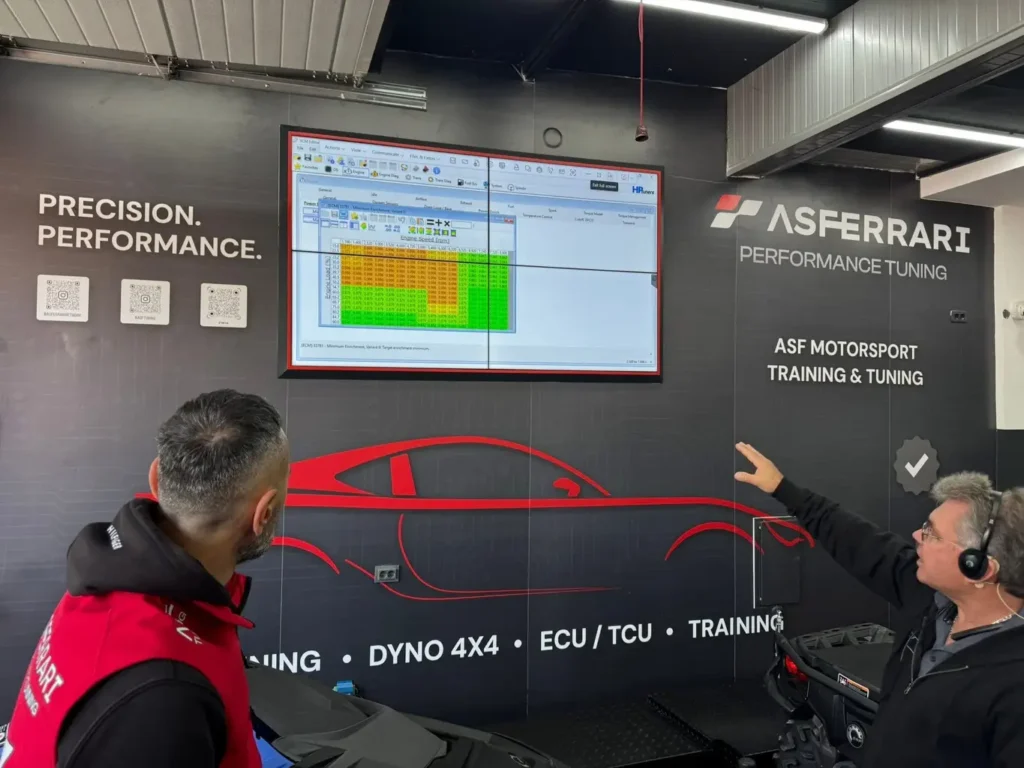
The ASF Motorsport approach is based on exactly this kind of before-and-after measurement. Power without repeatability doesn't tell you enough, and stability under load often tells you far more than a peak figure from a single run.
Torque, knock and the limit of useful advance
The goal isn't always to add advance. For every combination of engine, fuel and load there's a point where extra degrees no longer bring a measurable torque gain. In professional practice this zone is linked to the MBT approach – the spark timing for best torque. However, an engine at full load often can't run at that point because knock, temperature or a safety margin limits it.
On a naturally aspirated engine the limit may depend on compression ratio, combustion chamber shape, intake temperature and fuel quality. On a turbo engine the situation is more sensitive. Higher boost increases charge density and cylinder pressure, so the ignition map must be matched to boost, lambda targets and the engine's thermal state. Raising boost without proper ignition control is not a complete calibration.
Knock sensors provide an important layer of protection, but they must not be an excuse for an over-aggressive base map. The ECU can pull timing when it detects unwanted vibration, but constant, large corrections mean the base calibration or operating conditions aren't set up well. The goal is stable running with reasonable corrections, not an engine that constantly has to save itself from the table.
Fuel differences must also be taken into account. A map set up for higher-octane fuel can't automatically be considered safe for fuel with lower knock resistance. Regional fuel availability, the season and the actual quality at the pump matter in practice. For a vehicle whose operating conditions change every day, a more conservative margin is often a better choice than a minimal gain at ideal temperature.
Why temperature changes everything
Intake air at 15°C and air at 40°C don't behave the same. Warmer air increases the tendency to knock, especially on turbocharged engines with higher specific load. A good calibration therefore includes ignition corrections for intake temperature, as well as sensible protections based on coolant temperature, oil temperature where available, and exhaust gas temperature through the appropriate ECU models.
Pulling timing too aggressively can make the vehicle sluggish as soon as the temperature rises. Pulling too little can stress the engine exactly when its margin is smallest. The right solution depends on intercooler efficiency, intake design, vehicle load, purpose and how the vehicle is used. A car built for short sprints and a vehicle that tows heavy loads for long periods don't have the same thermal demands.
Mistakes that create a bad ignition map
The most common mistake is copying values from another vehicle. Two engines of the same model can differ in turbo condition, spark plugs, combustion chamber deposits, fuel quality or actual airflow. A file can be a starting reference for an expert, but it's never a substitute for checking the specific vehicle.
The second mistake is judging the result only by how it feels to the driver. Quicker throttle response can come from a change in torque request, boost pressure or throttle position, not necessarily from optimal timing. That's why logs and torque measurement matter. They separate impressions from facts.
The third mistake is ignoring transient conditions. A map can look good at full throttle on the dyno but have a problem when the driver suddenly opens the throttle at mid revs. Cylinder filling, temperature and torque demand then change quickly. The calibration must also be checked at part load, under acceleration and during gear changes.
A calibration that stays stable
A good ignition map doesn't try to beat physics. It respects the engine's mechanical limits, fuel quality and real operating conditions. It's matched to the fuel, boost pressure, lambda targets, variable cam timing and torque strategies in the ECU or TCU where they're linked.
When ignition is calibrated methodically, the result isn't just a number on a chart. The engine runs more predictably, power delivery is even, and protection strategies make sense instead of constantly intervening. The best map is one that keeps the vehicle's character even when outside temperature, load or fuel quality aren't perfect.
If you want to understand how your engine responds to changes, start with measurement and technical condition, not with aggressive values in a table. Precision in ignition isn't a limit on performance – it's what makes performance last.