Choosing an ECU flasher: Flex, AutoTuner, KESS, Dimsport, FLASH Fox
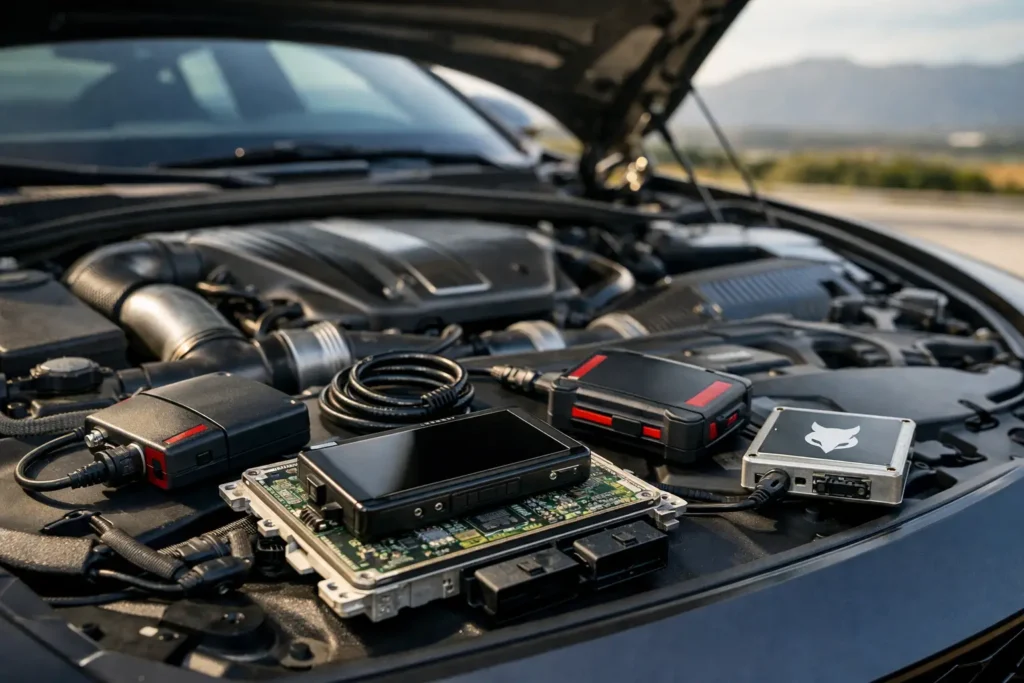
An ECU flasher isn't just a device for writing a modified file. It determines how the workshop reads the original software, which protocols it uses to access ECUs and TCUs, how safely it works on new controllers and what support it has when a vehicle doesn't respond as expected. That's why choosing between the Flex, AutoTuner, KESS, Dimsport and FLASH Fox ECU flashers shouldn't come down to which tool has the longest list of supported vehicles.
For professional work, the actual types of vehicle in the workshop, the method of accessing control units, the quality of technical support and the data protection procedure matter more. A good flasher is part of a controlled process – from diagnostics and a stable power supply, through reading and checking the file, to validating the vehicle after writing.
Choosing an ECU flasher starts with the work you do
A workshop doing most of its work on diesel and petrol passenger cars doesn't have the same needs as one focused on motorcycles, agricultural machines, trucks or boats. The same goes for a workshop that mostly does standard OBD reads and one that regularly opens ECUs for bench or boot access.
Before choosing a tool, take a realistic look at your own vehicle base. Which makes and ECU generations come up most often? How often do TCUs come in? Does the work include newer protected controllers, modules accessible only on the bench or industrial engines where documentation and strategy identification are especially important?
A supported vehicle on a list isn't always the same as a supported specific ECU, hardware version and software revision. That's why the exact ECU number, software version, read method and voltage requirements are checked before every job. That's basic discipline, not slowing the process down.
Flex, AutoTuner, KESS, Dimsport and FLASH Fox: what to assess
These tools differ in their ecosystem, supported protocols, licensing model, updates and workflow. No choice is universally best for every workshop. The right choice depends on the mix of vehicles, level of expertise and the type of service you want to offer.
OBD access isn't the only criterion
OBD work is practical because it allows communication with the vehicle without removing the ECU when the protocol is supported. However, not every ECU is accessible via the diagnostic port, and OBD isn't always the best method for every task. With certain units, bench or boot access gives more complete control, the ability to make a backup or access to memories not available the standard way.
Flex, AutoTuner, KESS, Dimsport and FLASH Fox should be viewed through the methods available for specific controllers, not just the number of vehicles listed. A workshop taking on more complex projects must have a clearly defined procedure for opening the ECU, protecting the board, connecting the pins correctly and controlling the power supply.
Original read, virtual read and backup
An original read is a valuable starting point because it documents the vehicle's real condition before any change. In many cases the tool can offer a virtual read, i.e. identifying and downloading the matching original content based on the ECU data. That can be useful, but it doesn't always replace a full backup of the unit.
Professional practice requires saving the vehicle identification, the original file, the fault status before the work and a record of the method used. If there's later a need to return to stock or diagnose a problem unrelated to the calibration, the workshop then has a precise record of the work done.
ECUs that require reading different memory areas or a recovery procedure deserve special attention. A flasher is only as good as the process around it. A stabilised power supply, a verified connection and correct protocol identification are often more important than the write speed itself.
TCU support changes a tool's value
For vehicles with an automatic gearbox, ECU calibration and TCU strategy can be linked. Extra torque, changed engine response or a different load may require careful assessment of gearbox behaviour. That doesn't mean every vehicle needs TCU calibration, but it does mean the workshop must know the limits of the stock strategy and the access options for the specific TCU.
When choosing a flasher, check not only whether the tool supports TCUs, but which models, whether access is possible via OBD, on the bench or by opening the unit, and what the recovery procedure is if communication is interrupted. In TCU work there's no room for assumptions.
Cost isn't just the purchase price
A tool may have a more affordable entry cost, but its long-term value depends on activations, subscriptions, tokens, add-on modules, updates and the time a technician needs to master the workflow. A workshop should assess how much of its workload each tool realistically covers, rather than buying a platform just for a few rare vehicles.
Availability of support also matters. When an unknown ECU version, an identification problem or the need for a recovery procedure comes up, good documentation and responsive technical support can protect both the vehicle and the workshop's reputation. The same goes for regular updates, because new generations of ECUs and TCUs keep changing.
For workshops working on a wider range of vehicles, a combination of tools is sometimes more sensible than trying to cover everything with one device. That should be built up gradually, according to real customer demand and the team's ability to carry out every procedure repeatably.
Calibration is a separate professional discipline
A flasher enables reading and writing, but on its own it doesn't make a file good. Calibration quality depends on correct interpretation of maps, knowledge of protection strategies, torque control, thermal limits, the fuel system, turbo and transmission behaviour. A wrongly modified file can be written without a hitch, and the vehicle still won't run as it should.
That's why serious tuning includes initial diagnostics, checking the mechanical condition, analysing stock data and validating the result. Dyno measurement isn't just for showing peak power. It helps follow torque development, response, stability of power delivery and the vehicle's behaviour under load that's hard to reproduce on the road.
At ASF Motorsport, every workflow starts by identifying the vehicle's technical condition, because precise calibration can't make up for a mechanical problem, a sensor fault or an unstable fuel system. Where Speed Meets Precision means the result must be measurable, controlled and adapted to the real vehicle.
How to decide without making the wrong investment
First define the vehicles you want to work on over the next 12 months, then check the coverage of their ECUs and TCUs by specific protocol. After that, assess whether your team can carry out the OBD, bench and boot procedures the tool requires to a high standard. Only then does it make sense to compare the costs of activations, support and future updates.
Don't buy a flasher based on the loudest recommendation or one success story from a forum. Buy it based on a documented workflow you can repeat on every vehicle. When the tool, power supply, diagnostics, file service and post-write checks are aligned, choosing a platform becomes a business decision based on precision, not assumption.