Hub dyno or rollers – which measures power better?
Measuring power isn't just a number that appears on the screen after a few seconds at full throttle. When you ask hub dyno or rollers, the right answer depends on the vehicle, the goal of the test and how the result will be used. For developing ECU or TCU calibration, diagnosing problems and comparing changes, repeatability and controlled conditions matter more than the highest measured value.
In the ASF Motorsport approach, the dyno is a measuring tool that helps calibration decisions be made based on data. Power, torque, intake air temperature, fuel behaviour, boost and gearbox operation must be looked at together. Only then does the number on the chart gain real technical value.
Hub dyno or rollers: the basic difference
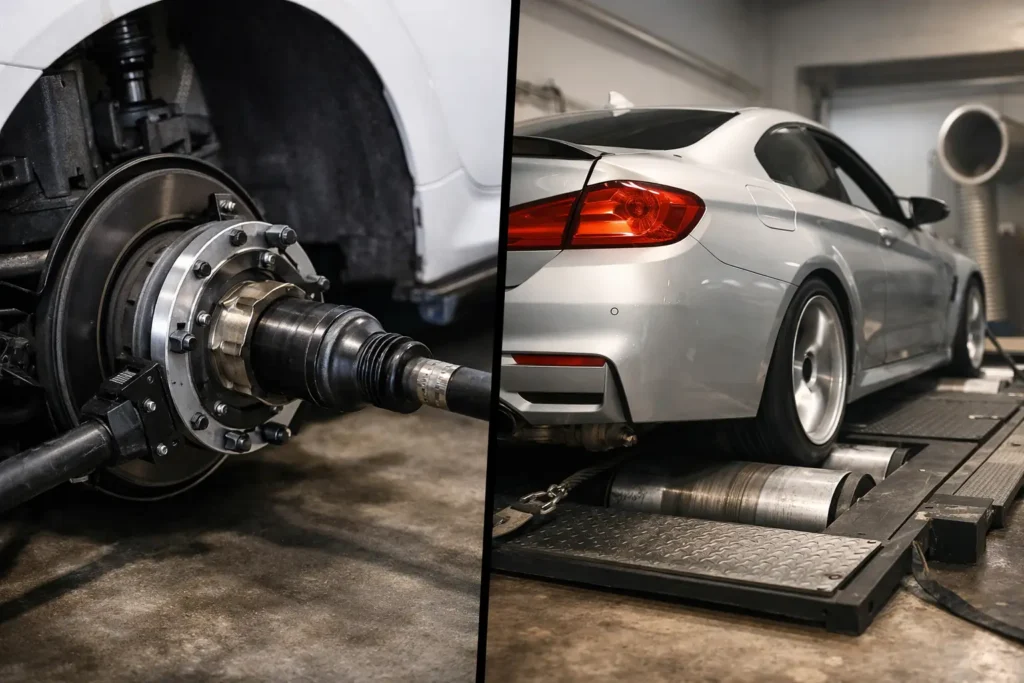
A roller dyno, also known as a chassis dyno, measures power through the driven wheels. The vehicle sits on the rollers, the wheels turn them, and the system calculates wheel power and torque from resistance and acceleration. It's the best-known form of testing for cars, light commercial vehicles, ATVs and many other vehicles.
A hub dyno doesn't rely on tyre-to-roller contact. On motorcycles, the drivetrain connects directly to the measuring unit via the hub or a custom adapter, depending on the system design. This removes several variables present with rollers: tyre pressure, slip, tyre temperature and changing resistance at the contact patch.
That doesn't mean one system automatically gives a “more real” result than the other. Both measure performance through a defined methodology and both have their own sources of deviation. The key is that the vehicle is tested on a correctly configured unit, in consistent conditions and with expert interpretation of the data.
When rollers have a clear advantage
For cars, especially AWD models, a roller dyno allows the complete drive system to be tested in operation. The engine, clutch or converter, gearbox, differentials, propshafts and tyres work together, just as they do under load on the road. This is especially useful when checking TCU calibration behaviour, gear changes, kickdown response or torque distribution on all-wheel-drive vehicles.
A quality AWD chassis dyno must precisely synchronise the front and rear axles. On modern vehicles that's not a detail that can be ignored. Electronically controlled couplings, active differentials and traction control systems monitor differences in wheel speeds. An incorrectly set test can trigger the vehicle's protection strategies or give an unrepresentative result.
Rollers are also useful because they reveal problems that direct hub measurement may not show in the same way. Clutch slip under heavy load, irregular automatic gearbox behaviour, oscillations in power transfer or traction difficulties can become visible through the charts and the vehicle's behaviour during the test.
Of course, tyres matter here. Pressure, temperature, tyre construction and strapping force affect contact with the roller. That's why serious measurement requires the same car to be compared in similar conditions: with the same tyres, a stable drivetrain temperature, correct strapping and the same test procedure.
Wheel power isn't crankshaft power
A roller dyno primarily shows the power that reaches the wheels. That's a very useful value, because it shows how much power the drivetrain actually puts down. Estimates of crankshaft power can be shown through various corrections and loss models, but they should be read with caution.
Two different dynos can show different crankshaft power estimates even when the vehicle is exactly the same. That's why, for an owner following the result of a tuning project, the most relevant comparison is often before and after on the same dyno, in comparable conditions. The trend of the curve, the gain in the mid-range and the stability of power delivery often say more than one peak number.
Why a hub dyno is especially valuable for motorcycles
On a motorcycle, rear tyre contact with the roller introduces extra variables. A small change in tyre pressure, tyre warm-up or different strapping of the bike can affect the result. A hub system reduces that effect and allows very repeatable measurements, which is especially important when fine-tuning an ECU calibration.
A motorcycle also responds quickly to changes in fuel, ignition timing, electronic throttle position and torque limits. When a comparable test can be done after every change, the calibrator can see more precisely whether a change brought a benefit in a certain rev range – without unnecessarily compromising the engine's operating safety.
Direct measurement can also be an advantage on bikes with powerful engines, where test stability is especially important. Still, the quality of preparation remains decisive. The chain, sprockets, clutch condition, service intervals, spark plugs, air filter and fuel must be checked before the result is attributed to the software.
ASF Motorsport uses a dedicated motorcycle hub dyno precisely when high repeatability and detailed analysis of motorcycle performance are needed. The goal isn't to chase an attractive peak value, but to shape linear, controlled and usable power delivery across the whole operating range.
Precision isn't the same as repeatability
These two terms are often used as if they mean the same thing, but in dyno work they're different. Precision refers to how correctly the measuring system registers a value. Repeatability tells you whether the same system, under the same conditions, will give almost the same result over several consecutive tests.
For tuning, repeatability is often decisive. If after a calibration change the torque between 2,500 and 4,000 rpm increases consistently over several runs, there's a basis for considering the change valid. If the result varies for no clear reason, the measurement conditions should be checked first before changing another parameter in the ECU.
Intake temperature, coolant temperature, intercooler condition, fuel quality and active protections in the software can change the result. On turbo engines, it's especially important to watch whether the vehicle reduces power after several runs because of high intake or exhaust temperatures. One excellent run isn't enough proof if the following tests don't confirm it.
What to choose for your vehicle and goal
For a front-, rear- or all-wheel-drive car, a roller dyno is a practical solution because it tests the vehicle as a whole. It's a good choice for measuring before and after an ECU remap, checking TCU software operation, analysing problems under load and developing a tailored calibration.
For a motorcycle, a hub dyno can have the edge when the focus is on very stable and repeatable data without the effect of tyre-to-roller contact. That's useful for custom maps, intake or exhaust changes, throttle response optimisation and checking engine operation across different modes.
If the goal is diagnostics, the choice isn't always obvious. A problem in power transfer to the wheels can be found more easily on rollers, while the behaviour of the engine itself and the ECU strategy can be analysed in a very controlled way on a hub system. An experienced operator first defines the question the test needs to answer, and only then chooses the method.
The best dyno isn't the one that shows the highest number, but the one that gives data reliable enough for the next technical decision to be the right one. When power is measured with discipline, every calibration gets a clearer direction – exactly where speed meets precision.