How long does tuning take? A precise answer
The time a vehicle spends connected to diagnostics isn't the same as the time needed for quality ECU tuning. When a driver asks how long does ECU tuning take, the shortest honest answer is: from about an hour to a full working day, depending on the vehicle, the programming method and the level of checking the calibration requires. Writing the file itself often takes little time. Professional work starts before and ends after that write.
In the ASF Motorsport approach, where Speed Meets Precision, the duration isn't determined just by the speed of the tool. It's determined by the vehicle's condition, identification of the existing software, power supply safety, the method of accessing the ECU and checking operation after programming. That's the difference between quickly loading a generic file and a calibration that has to keep reliability, response and everyday drivability.
How long does ECU tuning take in real conditions?
For a standard Stage 1 ECU remap on a technically sound vehicle, without the need for additional measurements or opening the control unit, the appointment often takes around 1.5 to 3 hours. In that time the technician reads the original software, checks the control unit identification, prepares and writes the appropriate calibration, then checks for faults and basic operating parameters.
If TCU tuning is done together with ECU calibration, extra time should be allowed. The gearbox and engine must work as a matched system: torque limits, clutch pressures, shift strategy and protection functions mustn't be looked at separately. In practice, a combination of ECU and TCU tuning usually takes 3 to 5 hours, and longer on certain platforms.
Vehicles that need bench or boot programming usually stay in the workshop longer. This can include removing the ECU, opening the housing in a controlled way when necessary, connecting to the right contact points and carefully reassembling. The procedure itself isn't something to rush. Any mistake in power supply, communication or handling of the control unit can unnecessarily drag out the process.
Why writing the software isn't the whole job
On many vehicles, reading and writing via the OBD port takes between 15 and 60 minutes. That doesn't mean the tuning is finished in the same time. Before programming, it must be confirmed that the vehicle is ready for the work, and afterwards it must be checked that communication, parameters and drivetrain behaviour are all in order.
The first step is a diagnostic check. Active faults, unstable battery voltage, sensor problems, fuel system irregularities, intake leaks or gearbox faults aren't problems software should hide. Calibration can optimise the operation of a healthy system, but it can't replace a mechanical repair.
After that, the ECU hardware and software version are identified. Two vehicles of the same model and year can have different control unit versions, previous manufacturer updates or earlier software changes. That's why professional work isn't based only on the engine name. Exact identification prevents the wrong file and reduces the risk of unexpected behaviour.
A stabilised power supply is also part of the time the customer may not see, but it's crucial. During programming the voltage must stay within a safe range. An interruption caused by a weak battery or an unsuitable charger can require additional ECU recovery procedures. A few minutes of preparation here can save hours later.
A dyno test extends the appointment, but gives context
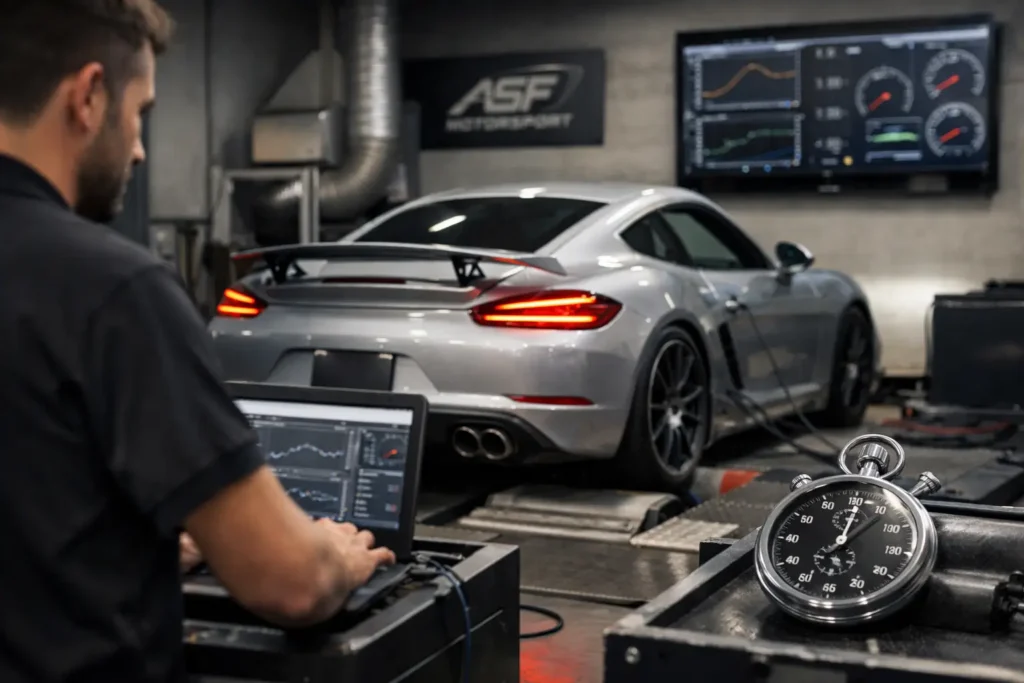
If the service includes an AWD dyno test, it's realistic to expect an extra 2 to 4 hours, depending on the vehicle and the scope of measurement. The vehicle must be set up correctly, warmed to operating temperature and measured in controlled conditions. After calibration a comparison is made and it's checked whether power delivery, torque and key operating parameters are within the expected range.
A dyno isn't just a tool for a number on a chart. Its value lies in repeatability and the ability to view the result alongside relevant data. On turbo engines, for example, boost build-up, ignition corrections, temperatures and stable torque delivery through the rev range matter. On diesel applications the focus can be on torque control, fuel pressures and the system working properly within its design limits.
What affects the duration of ECU tuning the most?
Four things make the biggest difference: the vehicle's condition, the type of ECU, the scope of the calibration and the programming method. With a tidy stock car with supported OBD access, the process is more predictable. With vehicles that already have modifications, unknown previous tuning or faults in memory, a more careful inspection is needed.
The type of drivetrain also changes the timeframe. A naturally aspirated engine, a modern turbo petrol, a diesel, a motorcycle, a commercial vehicle and a vehicle with an automatic gearbox don't use the same control strategies. Especially on vehicles with several control units, the ECU and TCU must be analysed together so that the engine's torque request stays matched to the transmission's capacity.
The scope of the work is just as important. A calibration for a stock vehicle and one for a vehicle with hardware changes aren't the same task. When a different intake, closed-course exhaust parts or other mechanical componentsare fitted, the technician must confirm how the changes affect airflow, temperature and protection strategies. It isn't responsible to assume one map suits every combination of parts.
Finally, there's also a difference between a local and a remote process. Remote tuning can be efficient when the workshop has the right equipment, stable communication and accurate vehicle data. Still, the time depends on the quality of the initial diagnostics, the availability of the original read and any questions that need resolving before the file is built or approved. Sending a file quickly isn't a substitute for accurate input information.
When can tuning take a whole day?
A whole day is a realistic timeframe when several stages are combined: an intake inspection, fixing existing faults, dyno measurement before and after, ECU and TCU programming and detailed validation. This is especially the case with more complex performance projects or when the vehicle is new to the workshop and has no reliable service history.
A longer appointment isn't automatically a sign of a problem. Sometimes it's a sign the work is being done properly. If a worn spark plug, a weak battery, an intake leak or a gearbox fault is found during the inspection, the best decision may be to stop the process until the fault is fixed. Calibration should be the final step on a healthy mechanical foundation, not an attempt to bypass the vehicle's warnings.
How to prepare for your appointment
The owner can help the process run without unnecessary delays. The vehicle should arrive with enough fuel of the right quality, a charged battery and no known unresolved faults. It's useful to list all previous software or hardware changes in advance, as well as symptoms such as irregular shifting, loss of power or an engine light.
If a dyno test is expected, the tyres should be in good condition and correctly inflated. On automatic vehicles it's worth stating the date and mileage of the last gearbox service. Such information doesn't slow tuning down – it gives the calibrator accurate technical context and helps make decisions more precise.
The best time for ECU tuning isn't the shortest possible appointment, but the appointment in which the vehicle gets the checks it needs. When the data is accurate, the power supply stable and the drivetrain healthy, the process can be efficient without compromises that cost more time later.