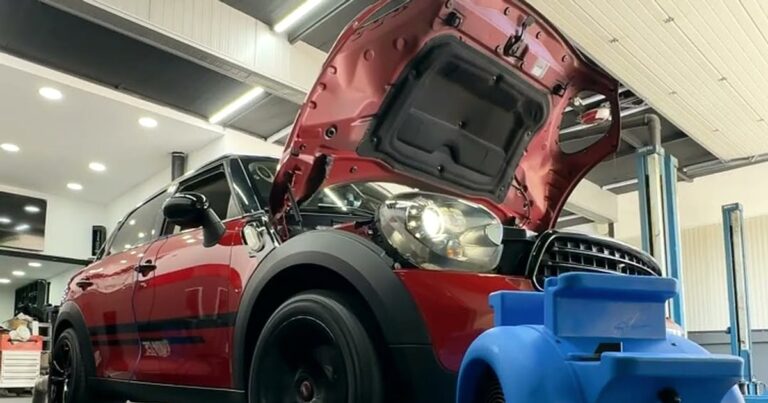
ECU tuning in Montenegro for power under control
ECU tuning in Montenegro isn't just about more horsepower. On a modern vehicle, every change in the engine software affects the balance of power, torque, throttle response, temperature, transmission and long-term reliability. That's why a quality remap doesn't start with downloading a generic file, but with diagnostics, checking the vehicle's real condition and measurement where it makes sense.
The owner of a turbo petrol car may want more decisive response out of a bend. For a diesel driver, more mid-range torque for safe overtaking or loaded driving may matter more. With vans, trucks, tractors and work machines, the priority is often usability under load, not peak power. A good calibration recognises that difference.
What does ECU tuning really change?
The ECU, or engine control unit, processes sensor data and manages the engine through a large number of maps and limiters. Depending on the drivetrain, this includes boost pressure, fuel injection quantity and timing, ignition timing, torque limits, electronic throttle position, intake temperature and protection strategies.
The factory calibration has to cover a wide range of conditions: different fuels, climate zones, manufacturing tolerances, long service intervals and drivers with completely different habits. That doesn't mean the factory software is bad. It means it was made as a compromise for global use.
Professional ECU tuning adapts that compromise to the specific vehicle and a realistic goal. On a turbo engine, the improvement is often felt as earlier and fuller torque, more linear power build-up and better throttle response. On naturally aspirated engines the room for gains is usually smaller, so the expectations are different. There, calibration more often brings more precise response and optimised operation than a dramatic change in peak power.
The number on paper isn't the whole story
Power is a useful measured value, but the way a vehicle delivers torque is often more important in everyday driving. Two calibrations can show a similar peak result and behave completely differently. One may have a sudden torque kick at low revs, while the other builds power more evenly and better suits the mechanics of the engine, clutch, gearbox and drive.
That's why a calibration isn't judged by the top of the chart alone. The power and torque curves, measurement stability, temperatures, behaviour under load and any faults logged in the control units are all looked at.
Why is diagnostics the first step?
A remap can't fix a worn turbo, a fuel supply problem, a blocked intake, faulty sensors or clutch slip. Increasing the load on an engine that already has an unresolved fault often just speeds up a problem that existed before the tuning.
Before changing the software, faults should be read, relevant live parameters reviewed and it should be checked whether actual values follow the targets. On turbo engines this can include boost, intake air temperature, fuel corrections, high-pressure system operation and deviations in turbo control. On diesels, the injection system, intake condition, sensor operation and exhaust system load are especially relevant.
Diagnostics aren't a formality that slows the process down. They determine whether the vehicle is a good candidate for tuning and what approach is sensible. Sometimes the most professional answer is to postpone calibration until the underlying mechanical or electronic problem is solved.
A dyno turns assumptions into data
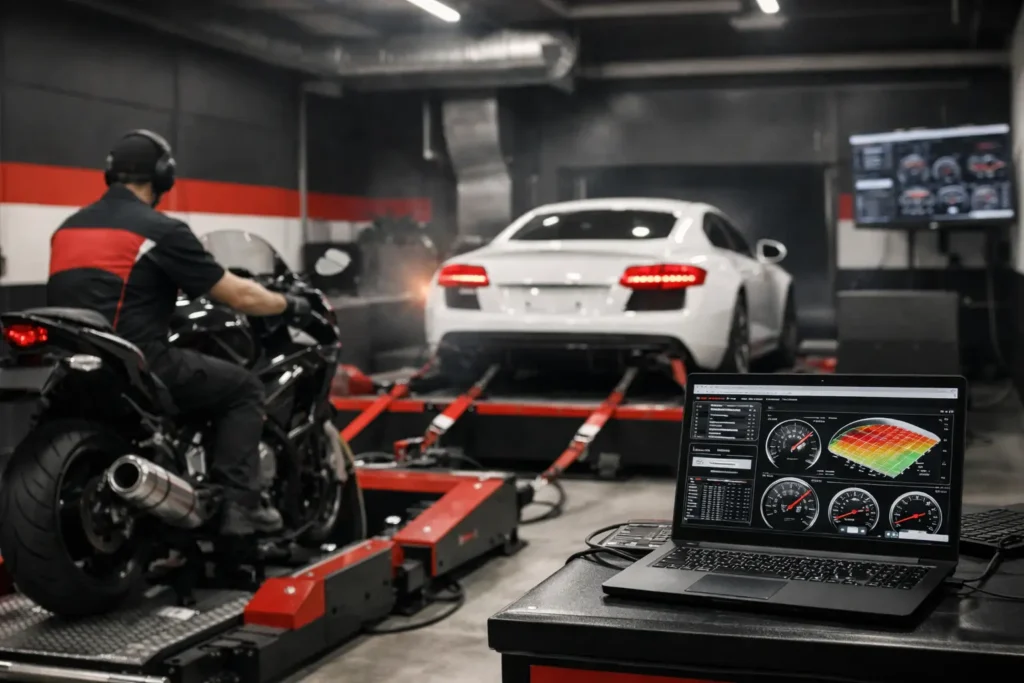
Dyno measurement gives a reference point before and after calibration. It's especially useful when the vehicle has previous modifications, unusual behaviour or when the owner wants confirmation of real results under controlled load.
An AWD chassis dyno allows all-wheel-drive vehicles to be measured without compromising how the drive works. For motorcycles, a dedicated hub dyno removes the effect of tyre slip on the roller and provides more repeatable measuring conditions. This matters because small differences in temperature, tyre pressure, how the vehicle is strapped down and cooling can affect the result.
Still, a dyno isn't a magic machine that confirms the quality of the work on its own. The value of the measurement depends on proper vehicle preparation, ventilation, procedure and expert interpretation of the data. The goal isn't to hunt for the highest number, but to understand how the engine works under load and whether the calibration achieves the planned result without unwanted deviations.
The ECU and TCU must work as a system
On vehicles with an automatic gearbox, ECU tuning sometimes also requires careful consideration of TCU calibration. The TCU controls gear changes, torque limits, gearbox pressures and shift logic. If the engine produces more torque after a remap, the factory gearbox strategy can limit the engine, shift too early or respond in a way the driver doesn't expect.
TCU tuning isn't mandatory for every vehicle, nor is it a universal solution. It depends on the gearbox type, project goal, existing limits and mechanical condition. When done properly, it can improve alignment between the engine and transmission, speed up gearbox response in the right mode and allow more consistent use of the available torque.
With manual gearboxes, the condition of the clutch and flywheel should be assessed just as realistically. Extra torque the engine easily handles won't necessarily be handled as easily by a worn transmission component. Precision means setting limits that suit the whole vehicle, not just the engine's potential.
How to recognise a responsible approach to tuning
A responsible tuner asks questions before promising a result. What fuel does the vehicle use? Is the engine stock? What's the mileage? Is there smoke, loss of power, oil consumption or faults? Is the vehicle used for everyday driving, longer trips, towing, work or the track?
Transparency about limits also matters. There's no one map that suits every example of the same model equally. Engine condition, maintenance, fuel quality, ambient temperature and modifications made have a real effect. A calibration that's excellent for a well-maintained car can be the wrong choice for a vehicle with neglected servicing.
ASF Motorsport approaches tuning through diagnostics, controlled measurements and calibration based on the vehicle's real data. That's an approach that suits both the owner of a sports car and the operator of a work machine: performance only has value when it's predictable, measurable and technically justified.
ECU tuning in Montenegro: who benefits most?
Owners of well-maintained turbo petrol and turbo diesel vehicles with a clear goal usually benefit most. That could be more flexible in-gear acceleration on open roads, a safer feeling under load, better motorcycle response or more consistent operation of a commercial vehicle.
For fleets and work machines, the focus often isn't sporty character. Well-judged torque delivery can help a vehicle do its job more efficiently in the real rev range. However, every assessment must take into account working hours, load, service history and drivetrain limits.
If the goal is just the biggest possible number, it's easy to skip the details that protect the mechanics. If the goal is a vehicle that responds better, runs cleanly and keeps a logical character, then ECU tuning becomes an engineering decision. That's where the Where Speed Meets Precision philosophy shows best: speed is worth most when it's precisely controlled.