ECU diagnostics for precise fault finding
The engine warning light isn't a diagnosis. It's a message that ECU diagnostics are needed to establish what the control unit has recognised as a deviation – and, just as importantly, why it happened. Replacing a part just because a certain fault code appeared is often the most expensive route to a repair.
On modern vehicles, the engine, gearbox, turbo, fuel system, exhaust system and numerous sensors work as a connected system. One wrong signal can change the operation of several components, limit power, increase consumption or trigger limp mode. That's why precise diagnostics isn't just reading fault codes. It's a process of checking data, operating conditions and the vehicle's real behaviour.
What ECU diagnostics actually check
The ECU is the electronic engine control unit. It constantly collects information from sensors, compares it with maps and set limits, and then controls injection, turbo boost, ignition, air intake and other functions. On diesel engines it also monitors parameters such as fuel pressure, air mass, exhaust differential pressure and the operation of the exhaust aftertreatment system.
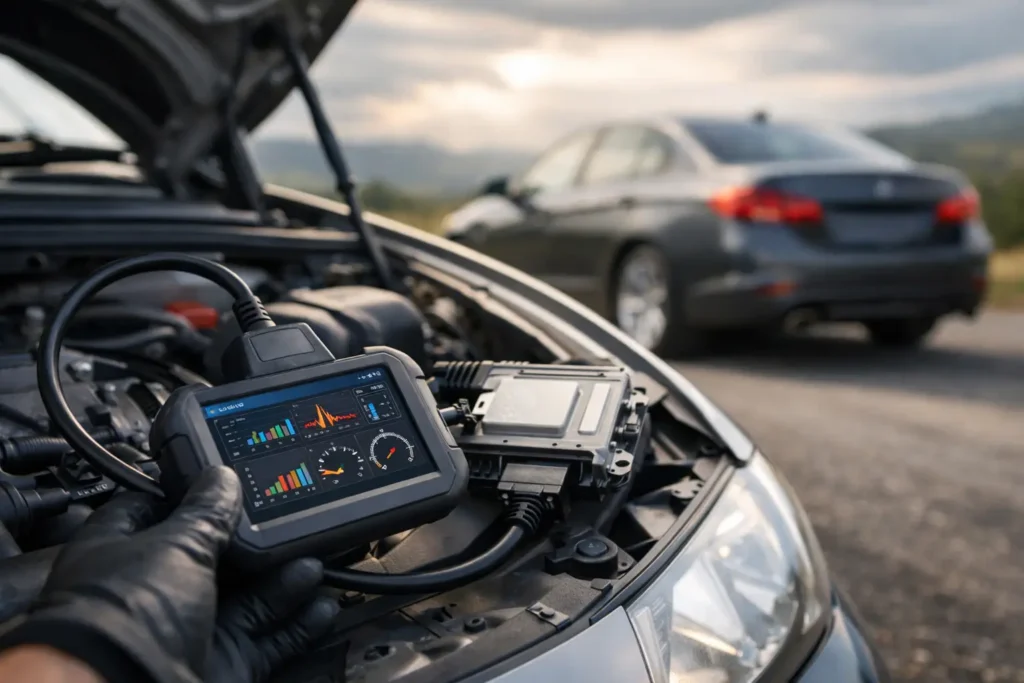
The diagnostic tool communicates with the ECU and other control units in the vehicle. It can read active, intermittent and stored fault codes, but a code is only the starting information. For example, a fault related to low turbo boost doesn't automatically mean the turbo is faulty. The cause could be a vacuum line, actuator, pressure sensor, an intake-side leak, a control problem or a deviation in air supply.
A quality check also includes so-called live data. These are the actual values the ECU sees during operation: requested and measured boost, fuel pressure, airflow, injection corrections, accelerator position, temperatures, voltage and many other parameters. Only by comparing the ECU's demands with the system's actual response do you get a clearer picture.
A fault code isn't a verdict
Misinterpreting codes is one of the most common reasons for unnecessary repairs. Codes often describe the consequence the control unit registered, not the part that needs replacing. This is especially true of faults described as signal out of range, insufficient flow, incorrect regulation or lost communication.
Another important piece of data is the so-called freeze frame – a snapshot of the operating conditions at the moment the fault occurred. Vehicle speed, revs, engine load, coolant temperature and turbo boost can show whether the problem occurs on a cold start, at full load, at constant speed or only occasionally.
An intermittent fault needs a different approach from a permanent one. If the code comes back immediately after clearing, the fault is usually present and measurable. If it only appears at a certain load or after a long drive, those conditions need to be reproduced and the relevant channels monitored live. Clearing faults without establishing the cause may temporarily switch off the light, but it doesn't solve the problem.
Why live data matters more than the scanner itself
A diagnostic device can read dozens or hundreds of parameters. Expertise shows in knowing which data is relevant and how to interpret it together. Fuel pressure, for example, isn't enough to look at as an isolated number. You need to know the requested pressure, the actual pressure, how quickly the system responds and whether the deviation occurs under load.
The same applies to airflow. A lower measured value can point to the sensor, but also to an intake blockage, an EGR system problem, a boost leak or an exhaust flow restriction. On petrol engines, mixture corrections and lambda sensor signals give extra context. On diesel engines, data on injection, boost, temperatures and systems that affect operation under load are especially useful.
On vehicles with an automatic gearbox, diagnostics must also cover the TCU – the gearbox control unit. Uneven gear changes, delayed shifts or limited torque don't always mean a mechanical gearbox fault. Adaptations, oil temperature, sensor faults, communication between the ECU and TCU and existing torque limits can all be part of the same picture.
ECU diagnostics before remapping
Before any ECU or TCU calibration, the vehicle must be technically healthy. Remapping doesn't fix a worn turbo, a faulty sensor, a fuel system problem or an intake leak. On the contrary, increased load can make an existing problem more visible and more serious.
That's why the initial check is especially important on vehicles with an unknown service history, an already active engine light, a loss of power or unstable running. The inspection should include reading all relevant units, checking faults, analysing live data and, depending on the symptoms, additional measurements. Sometimes a load test, wiring check, pressure measurement or visual inspection of mechanical components is needed.
Diagnostics before calibration protect both the owner and the tuner. The owner gets the vehicle's real condition before investing, while the calibration is developed on a stable technical foundation. That's the principle ASF Motorsport applies to optimisation: Where Speed Meets Precision isn't just a result on paper, but a controlled process in which performance is built on verified data.
When a dyno test is needed
Diagnostics on the road and in the workshop are often enough to find a fault, but there are situations where dyno testing adds value. A dyno allows controlled load and repeatable operating conditions, without relying on traffic, road gradient or changing outside conditions.
For problems that only appear at higher load, parameters can be monitored across the whole rev range. Requested and actual boost, mixture, intake temperature, fuel system behaviour and any torque limits become visible in a controlled test. This is also useful after a repair, when you need to confirm the system works stably in conditions similar to real use.
Still, a dyno isn't a substitute for basic diagnostics. If the vehicle has an obvious electrical fault, an incorrect sensor signal or a wiring problem, the cause should be fixed first. A dyno is a tool for measurement and verification, not a shortcut past a technical inspection.
Symptoms you shouldn't ignore
Loss of power, increased consumption, hard starting, jerking when accelerating and going into limp mode are clear reasons for an inspection. However, ECU diagnostics also make sense before a more serious symptom appears. An occasional warning light, an unusual change in consumption, slower throttle response or irregular automatic gearbox shifting are often early signs of a deviation.
With work machines, trucks, boats, ATVs and UTVs the approach stays the same, but the operating conditions differ. Prolonged load, dust, vibration, high temperatures and specific duty cycles affect how a fault appears. That's why diagnostics must take into account the vehicle's real purpose, not just data obtained at idle.
The best decision isn't always the quickest part replacement. Ask for the codes read, the relevant live values and an explanation of why a particular cause is suspected. When diagnostics follow the logic of how the system works, the repair becomes more precise and the vehicle more ready for reliable operation and the performance it can safely deliver.