Does TCU tuning help an automatic gearbox?
In a powerful car, the automatic gearbox often decides how the extra torque is actually felt on the road. That's why the question “Does TCU tuning help?” has no simple yes or no answer. A well-executed TCU calibration can significantly improve gearbox response, shift consistency and the way power is put down. However, the result depends on the specific gearbox, the vehicle's condition, the ECU calibration and the owner's goal.
TCU tuning isn't a trick that changes the mechanical limits of an automatic gearbox. It's a precise adjustment of the transmission control unit's software maps. When it's done on the basis of diagnostics, technical data and measurement, the goal isn't just faster shifts, but shifts that are correctly timed and repeatable. That's the difference between a feeling of aggressiveness and real, controlled performance.
What the TCU actually controls
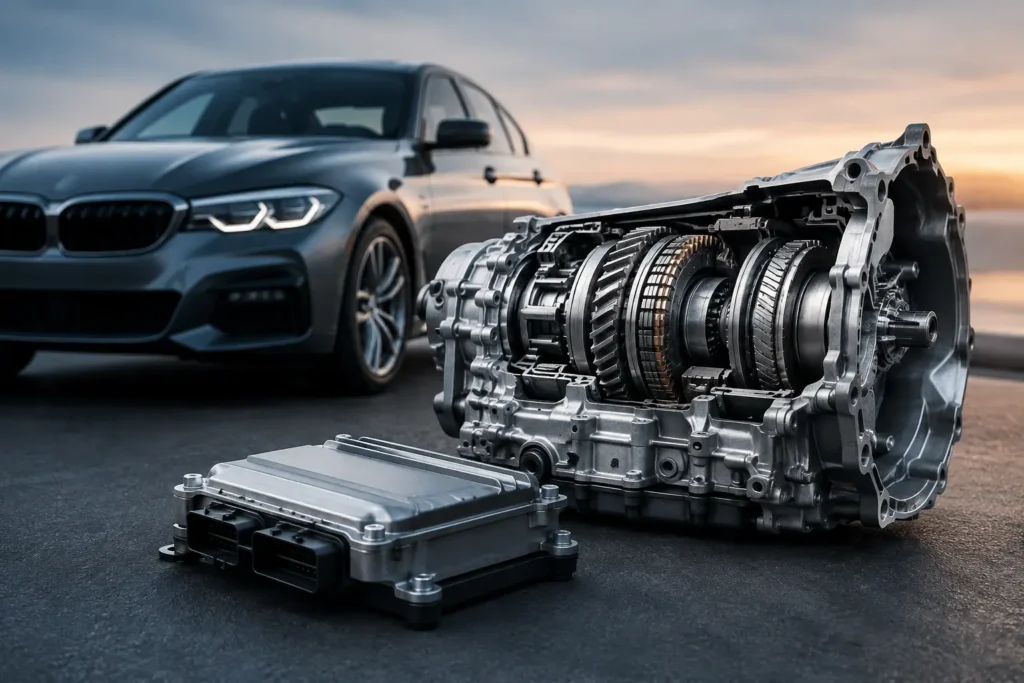
The TCU, or transmission control unit, manages a large number of parameters that determine how an automatic gearbox behaves. On modern gearboxes it doesn't just choose the moment of a gear change. It controls clutch pressure, the fill speed of hydraulic circuits, the torque converter lock-up strategy on conventional automatics, torque limits and communication with the engine ECU.
That's why a vehicle with a factory-set TCU can sometimes limit the potential of an already optimised engine. The ECU may request more torque, but the TCU may intervene through limiters or a torque reduction request during a shift. The result is that the car feels slower than its power would suggest, especially at full load.
On dual-clutch gearboxes, such as many DCT, DSG and similar designs, the calibration especially affects clutch control and shift logic. On ZF automatics the focus can be on pressures, torque limits, shift time and torque converter behaviour. There's no universal file that suits every vehicle equally – the transmission's architecture determines what is technically justified to change.
Does TCU tuning help in real driving?
The most common benefit isn't just shorter shift times. Owners usually feel it first as more direct response. The gearbox recognises the driver's demand earlier, holds the right gear more decisively under acceleration and hunts less between two adjacent gears.
On vehicles that have ECU tuning, TCU calibration is often even more valuable. The engine produces a different torque curve from the factory one, so the transmission must know how to use that torque safely and efficiently. Properly aligned ECU and TCU can reduce unnecessary interventions, improve continuity of acceleration and give the driver more predictable in-gear response.
In manual mode, full-throttle behaviour can often be adjusted. On certain platforms this means the gearbox won't automatically upshift before the driver asks it to, but only where the vehicle's design and purpose support it. Response to the steering-wheel paddles can also be improved, which is useful for dynamic driving and controlled track use.
Still, TCU tuning doesn't always make a car more comfortable. If the calibration is overly sharp, shifts at light load can become harsh and everyday driving less refined. A quality calibration therefore distinguishes between driving modes, oil temperature, load and accelerator position. Quick response shouldn't mean an unnecessary jolt every time you pull away from the lights.
When TCU calibration makes the most sense
TCU tuning has a clear purpose on vehicles that already have increased torque through ECU optimisation, on cars whose gearbox responds slowly or too conservatively from the factory, and on vehicles used for more serious sporty driving. It's also useful when diagnostics show the transmission often requests engine power reduction because of factory torque limits.
On a standard vehicle driven calmly with no engine modifications, the benefit can be subtler. The driver may get a more precise kickdown, less “thinking” from the gearbox and more logical gear selection, but not every platform will show an equally pronounced difference. That's why it's important to set a realistic goal before the work: better everyday driving, more efficient in-gear acceleration, support for an ECU tune or more consistent behaviour under load.
Vehicles that tow a trailer, work under higher load or are used commercially deserve special attention. In those cases the priority isn't aggressive shifting, but proper management of temperature, torque and shift strategy. The calibration must follow the vehicle's purpose, not just maximum performance.
The gearbox's condition matters more than the software
Software can't fix worn clutches, faulty mechatronics, problematic solenoids or oil that has lost its properties. Before TCU tuning, complete diagnostics are needed: reading faults, checking temperatures, analysing adaptation values and assessing gearbox behaviour on the road. If the transmission is already slipping, jolting or delayed because of a mechanical problem, calibration isn't the solution.
This is especially important on used vehicles with an unknown service history. Many automatic gearboxes have recommended oil and filter service intervals, even though they're often neglected in practice. Fresh oil doesn't fix every fault, but proper maintenance is the foundation before increasing load or changing the control strategy.
A professional approach also includes checking the software version, tool compatibility and the possibility of returning to the original calibration. Every intervention must be carried out carefully, with a stable power supply and a precisely defined programming procedure. Writing a file to the TCU incorrectly can cause a serious problem that has nothing to do with the quality of the gearbox itself.
Dyno measurement and driving give a fuller picture
Power on paper isn't enough to explain how an automatic vehicle behaves. AWD dyno measurement can show how the engine and transmission behave under load, but a road check remains just as important. Shifts at part and full throttle, temperature, torque reduction requests and consistency over several consecutive accelerations need to be monitored.
In the ASF Motorsport approach, where speed meets precision – Where Speed Meets Precision – TCU calibration is seen as part of the complete drivetrain. The goal isn't to produce the most dramatic feeling on the first drive, but to align the engine, transmission and protection strategies in a technically justified way.
On some vehicles the result will be very noticeable: faster, firmer shifts, better gear control and fewer interruptions in acceleration. On others the improvement will be more measured, but still worthwhile through better operating logic and fewer factory limits. An honest assessment always starts with what the vehicle does today, not what the owner expects the software to magically change.
TCU tuning isn't a substitute for driver responsibility
A more precise gearbox can make a vehicle more capable, but it doesn't change road conditions, tyre quality or the limits of grip. More torque and more decisive gear changes are especially noticeable on wet or uneven surfaces, where the electronics and the driver need enough margin. Calibration should support control, not encourage unnecessary risk.
The best result comes when TCU tuning is chosen as a technical decision, not as an isolated modification. If the gearbox is healthy, maintenance is up to date and the calibration is adapted to the engine and how the vehicle is used, the benefit can be very real. Before any work, the smartest move is to ask for diagnostics and a conversation about your specific vehicle – because a good answer isn't universal, but precisely tuned to your drivetrain.