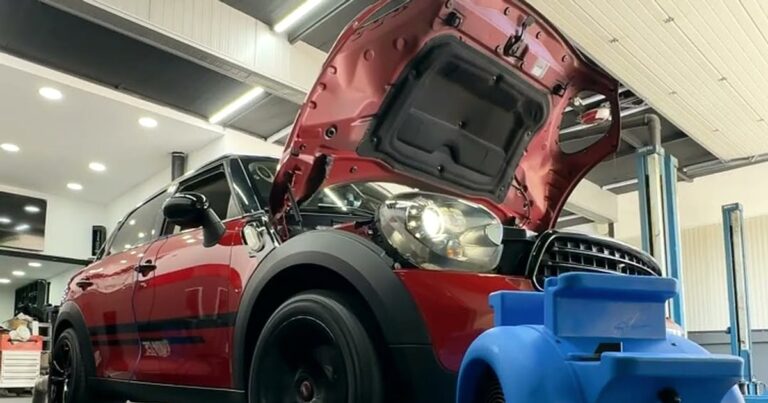
Four reasons to dyno test your vehicle

A number on paper isn't a goal in itself. When an engine under real, controlled load shows how it develops power, torque and temperature, tuning decisions become based on data, not assumptions. These are four reasons for dyno testing before and after any serious work on the ECU, TCU or the vehicle's mechanical configuration.
A dyno test isn't reserved for project cars and maximum performance. It's just as useful for the owner of an everyday car, a motorcyclist, an ATV or UTV enthusiast, a boat owner, or a company monitoring its commercial vehicles or work machines. The difference is in the goal of the measurement: one wants safe confirmation of performance after a remap, another more stable response under load, and another wants to find a problem that can't be clearly reproduced on a short test drive.
Why dyno testing is the foundation of precise tuning
A dyno simulates the load a vehicle or engine sees in real use, but under controlled conditions. On an AWD chassis dyno, front-, rear- or all-wheel-drive vehicles can be monitored, while a motorcycle hub dyno allows very direct and repeatable measurement at the drivetrain. During the test, it's not just peak power and maximum torque that are looked at.
Expert analysis follows the power and torque curves across the whole rev range, the air-fuel ratio, intake temperatures, boost on turbo engines, ignition behaviour, coolant temperature and other parameters available through diagnostics. On vehicles with an automatic gearbox, gear selection, shift logic, torque limits and TCU calibration behaviour also matter.
The result is a clearer picture of what the engine is really doing. Still, a dyno result should always be read in context. Different dynos, atmospheric conditions, tyres, fuel, how the vehicle is strapped down and the selected gear can affect the absolute number. That's why a before-and-after comparison on the same equipment, in similar conditions and with the same procedure, is often more valuable than comparing with a figure published somewhere else.
1. Measure real power and torque
The first reason is simple: a dyno removes guesswork. The manufacturer's claimed power refers to the engine under defined factory conditions, while a chassis dyno measures the power available at the driven wheels. Between the engine and the wheels there are drivetrain losses, which depend on the vehicle's design, gearbox, drive type, oil, tyres and operating temperature.
More importantly, the driver doesn't feel only the peak value. A good calibration is recognised by a clean, stable torque curve. If the engine builds useful torque earlier, but without a sudden spike that stresses the clutch, gearbox or driveshafts, the vehicle can be more pleasant and faster in real driving without chasing a spectacular peak number.
This is especially relevant for diesel vehicles, because tuning is often judged by the torque gain. The dyno shows where that torque appears and how long it stays available. On naturally aspirated petrol engines the changes may be less pronounced at the top, but can be seen in response and in the mid-range. On turbo engines the analysis also reveals how quickly boost builds and how stable power delivery is at higher revs.
2. Diagnostics under load reveal problems that otherwise stay hidden
Many vehicles idle smoothly and show no clear symptom on a short drive around town. The problem only appears when the engine has to deliver power for a longer time. A dyno allows exactly that kind of check in a safe, supervised environment, while the relevant parameters are read at the same time.
A drop in boost, a mixture deviation, excessive intake temperature, power limiting due to protection strategies or unstable fuel system operation can go unnoticed without measurement under load. The same goes for clutch slip, uneven automatic gearbox behaviour and torque limits the ECU or TCU activates in a certain rev range.
A dyno isn't a substitute for complete mechanical diagnostics, but it significantly shortens the path to the cause of a problem. Instead of replacing parts blindly, the technician can link the power curve to diagnostic data and pinpoint more precisely what needs checking. Sometimes the solution is calibration, sometimes servicing the turbo, sensors, fuel system or drivetrain. Transparency means acknowledging that difference before any software change.
3. ECU and TCU calibration can be confirmed, not just promised
A remap without measurement may give a subjective feeling of better response, but a feeling isn't complete verification. After every change to the ECU calibration, you need to check how the engine responds under full load and whether the goals were reached without leaving the components' safe operating limits.
This is especially important with custom calibrations. A vehicle may have a modified intake, exhaust system, different intercooler, turbo, fuel or mechanical modifications that affect how the engine behaves. A generic file can't always take every detail of the specific vehicle into account. Dyno data allows the calibration to be judged by real behaviour, not by an assumed configuration.
With TCU tuning, measurement can confirm that gear changes, torque management and transmission logic work together with the engine's characteristics. The goal isn't just faster shifts. Properly aligning ECU and TCU strategies can give more predictable response and reduce unnecessary power interruptions, while respecting the limits of the specific gearbox.
In the ASF Motorsport approach, the dyno is therefore part of a controlled process: baseline measurement and condition check, data analysis, calibration, then validation of the results. Where Speed Meets Precision isn't a phrase about the highest number, but the principle that every change can be technically explained and verified.
4. You get a measurable starting point for future decisions
A dyno chart is a record of the vehicle's condition at a given moment. A saved baseline test can be very useful months later, especially if the engine's behaviour changes, a new component is fitted or you want to assess the result of a further modification. Without a starting point, it's hard to know whether a change is real or just the result of different driving conditions.
This is also valuable for professional workshops, fleets and owners of work machines. For vehicles that carry loads, tow trailers or work under prolonged load, available torque in the useful rev range often means more than peak power. Measurement helps determine whether it makes sense to optimise a particular operating mode and whether the drivetrain keeps stable performance.
For motorcycles, jet skis and other specialised vehicles, the advantage is repeatability. Small changes to the intake, fuel, gearing or electronic maps can have different effects depending on the configuration. Instead of conclusions based on engine sound or a brief feeling of acceleration, the owner gets data that can be compared before and after the work.
How to prepare your vehicle for a meaningful test
A reliable result starts with preparation. The vehicle should be in good technical condition, with the right oil and coolant levels, no active faults that could compromise the test and tyres in good condition. For cars it's useful to arrive with the fuel you normally use, because fuel quality and octane rating can affect engine behaviour and ignition corrections.
The goal should also be clearly defined. Are you checking the factory condition, solving a specific problem, validating an ECU remap or comparing two mechanical configurations? A clearly set goal determines which parameters should be monitored and how to interpret the chart. On vehicles with complex electronic systems, driving modes, temperature, gearbox adaptations and factory protections need to be taken into account.
The most useful dyno test isn't the one with the highest printed number, but the one after which you know the condition of your vehicle, where it makes its power and what the technically justified next step is. When performance is measured, diagnosed and confirmed under controlled load, every following decision becomes more precise.