Bike dyno: what really measures a motorcycle's power
A motorcycle can feel noticeably stronger after a service, an exhaust change or an ECU calibration, but the feel on the road isn't a measuring instrument. A bike dyno turns impressions into data: it shows how the engine delivers power and torque across the whole rev range, where response is clean and where there's room for correction. For serious optimisation it isn't an add-on to the process, but its checkpoint.
With a motorcycle it's especially important to understand that the peak figure isn't the whole story. Two engines can have similar peak power but a completely different character on the road or track. One may pull evenly from mid revs, while the other only delivers at the very top. The dyno chart clearly reveals that difference.
What is a bike dyno and how does it work?
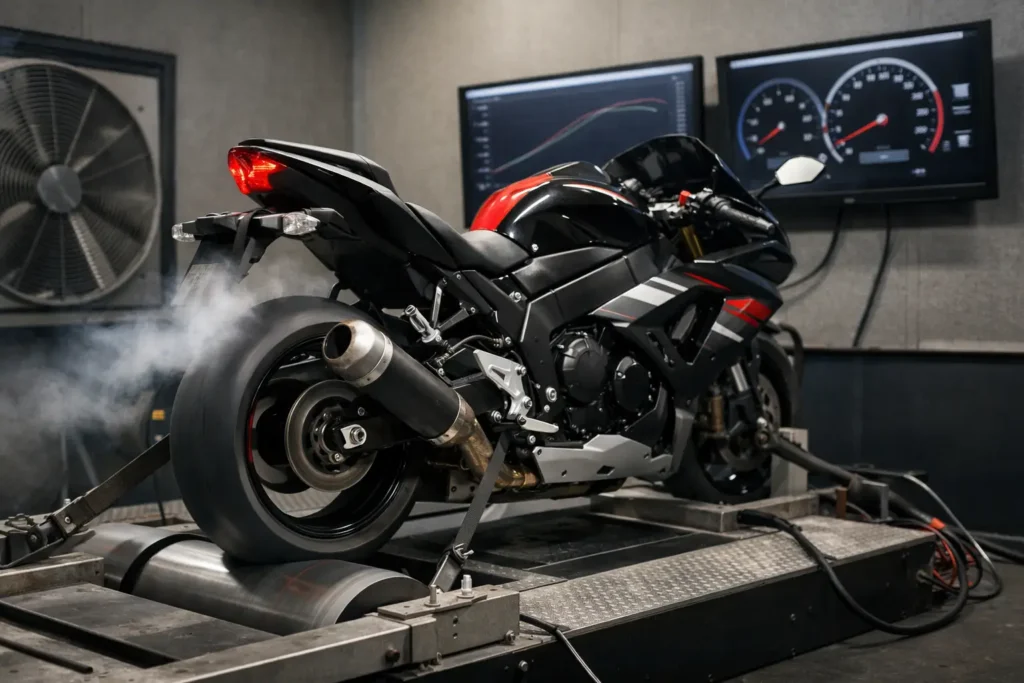
A bike dyno is a dynamometer designed to measure motorcycle performance under controlled load. During the test the system records speed, engine revs, roller acceleration or brake load, and from these parameters calculates power and torque. The result is shown as a chart that shows the drivetrain's behaviour across the rev range.
Two designs are most common. A roller dyno measures the motorcycle through the driven wheel, while a hub dyno connects directly to the rear drive after the wheel is removed. Both systems can give useful, precise data when set up correctly, but they don't measure in exactly the same way.
A roller system includes part of the losses through the tyre and roller contact, so it better represents the complete bike in the configuration it's ridden in. A hub dyno removes variable factors such as rear tyre pressure and deformation or slip on the roller. That's why it's especially useful for repeatable measurements and detailed calibration work. The most important thing isn't to look for a universally “better” type, but to use the same professionally set-up system when comparing results before and after work.
Wheel power isn't catalogue power
Motorcycle manufacturers usually publish power measured at the crankshaft, in laboratory conditions and according to their own methodology. A motorcycle dyno, especially a roller one, generally shows power at the rear wheel. Between the crankshaft and the ground are the clutch, gearbox, chain or shaft drive, tyre and other parts that consume some energy.
That's why directly comparing a dyno sheet number with the factory catalogue often leads to the wrong conclusion. The right question isn't “Why is the number lower?” The real question is: was the measurement done consistently, is the curve healthy and has calibration produced a clear, repeatable change in the range the rider uses?
Why a chart is worth more than one number
Peak power attracts attention, but the power and torque curves give real diagnostic value. A torque dip in the mid-range can point to a limit in the factory calibration, a mismatched air-fuel ratio, or a problem with ignition, intake, exhaust or the bike's mechanical condition. An uneven curve doesn't automatically mean a fault, but it deserves expert interpretation.
On naturally aspirated bikes, the focus is often on precise throttle response, a stable mixture and more linear power delivery. On turbo bikes, boost control, intake air temperature, the ECU's protection strategies and component limits need extra attention. With both engine types, the goal of a quality calibration isn't an aggressive number on paper, but safe and predictable drivetrain behaviour.
The chart also shows how useful a change really is. A gain of a few kilowatts at revs the bike rarely uses may matter less than a fuller mid-range. On a road naked, a touring model or an ATV, it's exactly that middle part that most affects the everyday feel of acceleration and easier overtaking.
What professional dyno measurement of a motorcycle looks like
A good result starts before the first run. The bike must be in good technical condition: chain properly adjusted, tyres undamaged, oil and coolant at the right level and the engine warmed up to operating temperature. On chain-driven bikes its condition is also checked, because a chain that's too loose, too tight or worn can introduce variations and put unnecessary load on the drive.
The bike is then properly secured. That isn't just a safety step. A stable position affects consistent tyre-to-roller contact and the repeatability of runs. Fans must provide enough airflow to the radiator and intake, especially on modern bikes whose electronics monitor coolant and intake air temperature.
During measurement, the specialist selects the right gear, usually the one closest to a 1:1 ratio, when the gearbox design and manufacturer's procedure allow. The bike's electronics are also taken into account. Traction control, speed limiters, different riding modes and the ECU's adaptive strategies can change the result if not correctly interpreted.
After the baseline run, the map shouldn't be changed straight away. First you check whether the data is stable. Repeatable runs confirm that a deviation wasn't caused by warming up, the bike's position, the tyre or another external factor. Only then does the dyno become a reliable basis for diagnostics or a tailored ECU calibration.
What affects the measurement result
A dyno number isn't an absolute value separate from operating conditions. Air temperature, atmospheric pressure and humidity affect air density, and therefore the amount of oxygen available to the engine. The software can apply correction factors according to a defined standard, but correction doesn't remove the need for a disciplined procedure.
The bike's temperature is just as important. An engine that has just warmed up and one that is heat-soaked after several runs won't necessarily give the same result. On bikes with a modern ECU, protection functions can reduce power when the system detects excessive temperature or unfavourable operating conditions. That isn't a flaw of the dyno test – it's data about the vehicle's real behaviour.
On a roller system, rear tyre pressure, tyre type and roller contact condition are relevant. A change of chain, gearing, fuel or even the selected riding mode can change the chart. That's why serious comparisons are made with the same bike, on the same dyno system and in conditions as similar as possible.
When is a dyno test especially justified?
Measurement is useful before and after an ECU remap, but its value goes beyond confirming the result. It makes sense after fitting a homologated exhaust, changing the intake, an engine repair, fixing irregular throttle response or suspecting the bike isn't delivering the performance it should.
It's also a sensible step before bigger modifications. A baseline chart shows the starting condition and can prevent a later problem being blamed on the wrong work. If the bike already has a power loss, an incorrect air-fuel ratio or a mechanical defect, a good workshop will record that first instead of masking the symptom with calibration.
ASF Motorsport uses a dedicated motorcycle hub dyno for precise, repeatable motorcycle testing. Combined with diagnostics and an individual approach to ECU calibration, measurement serves the same purpose as any good engineering decision: confirm what the engine is really doing before deciding what to change.
How to read a dyno sheet without drawing the wrong conclusions
First look at the shape of the curve, then the numbers. A steady rise in power, stable torque and a clean transition through the mid-range often say more than an isolated peak. If the chart shows a sudden break, you need to establish whether it's an exhaust valve change, an electronics intervention, a limiter or a real problem.
Second, compare like with like. A result from one dyno system shouldn't be used as a direct judgement of a result from another, especially if the conditions, correction standard and measurement procedure aren't known. A dyno is the strongest tool for tracking change on the same vehicle, not for a numbers contest between different workshops.
Third, ask for an explanation. A professional report links the chart to the bike's technical condition, the work done and how the change will feel on the road. That's the approach that fits the Where Speed Meets Precision philosophy: performance isn't an assumption, but a measured and controlled value.
Next time your bike feels faster or slower than you expect, don't rely only on a subjective feeling. Precise measurement can show whether servicing, diagnostics or a carefully tailored calibration is needed – and give you a clear reason for every next step.