The best fuel for tuned cars: which octane to choose?
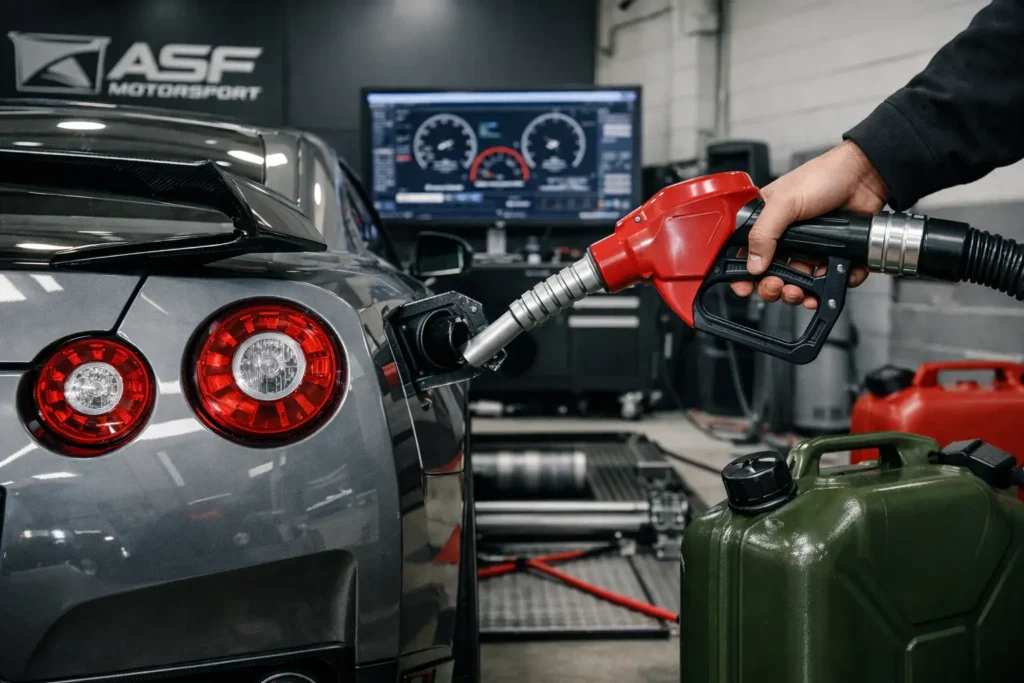
After a quality ECU remap, fuel becomes part of the calibration, not just a liquid you pour in at the pump. The phrase best octane for tuned cars sounds as if there's one simple answer, but professional practice is more precise: the best octane is the one the specific map was developed and tested for, and that you can consistently put in the tank.
The engine doesn't know what's written on the fuel cap. It responds to the fuel's actual knock resistance, intake air temperature, load, turbo boost, ignition and the quality of the fuel in the tank. That's why the difference between 95, 98 and 100 RON isn't just a number. On a tuned engine it can decide how long the engine keeps optimal ignition timing at full load.
What the octane rating really tells you
The octane rating, usually expressed as RON in Europe, shows petrol's resistance to uncontrolled combustion under pressure and temperature. Higher octane doesn't mean the fuel automatically produces more power on its own. Its advantage is that it allows the calibration to use more advanced ignition timing, higher boost or both, without approaching the knock limit.
Knock isn't the same as normal combustion. In proper combustion, the flame spreads in a controlled way from the spark plug. In knock, part of the mixture ignites uncontrollably, creating a sudden pressure spike. Modern engines have knock sensors and an ECU that can pull ignition timing for protection, but that's a corrective measure, not a substitute for the right fuel.
When the ECU constantly detects knock or unstable combustion conditions, it reduces performance. The driver then often says the car has “got used to it” or that the weather is bad, when the real reason is fuel that doesn't meet the map's requirement.
The best octane for tuned cars depends on the map
The first rule is simple: follow the calibration specification. If the ECU map was made for 98 RON, 98 RON isn't a recommendation to interpret flexibly – it's the operating condition under which the ignition, boost targets and protection strategies were defined.
A map for 95 RON can be a very good calibration when it's properly developed for that fuel. It will usually have more conservative targets where needed, so the engine has a safety margin on hot days, under long loads and with normal variations in fuel quality. A map for 98 or 100 RON can use the potential of more knock-resistant fuel, but it assumes that fuel is really used.
That's why one number can't be the answer for every car. A stock naturally aspirated engine, a turbo petrol with a moderate Stage 1 remap and a vehicle with a bigger turbo don't have the same requirement. Compression ratio, intake temperature, intercooler efficiency, fuel flow, combustion chamber design and knock control strategy all differ.
For vehicles that ASF Motorsport calibrates, the choice of fuel must be matched to the vehicle's specific specification and purpose. A reliable dyno result is only worth something if the fuel conditions in real driving are equally controlled.
Why 100 RON isn't always the better choice
If a car has a stock map or a map optimised for 95 RON, switching to 100 RON usually won't bring a measurable power gain on its own. The ECU may have adaptive strategies that can make use of better fuel to some extent, but you shouldn't expect the fuel to change the limits set by the calibration.
Conversely, a car mapped for 100 RON shouldn't regularly run on 95 RON just because the engine has knock sensors. Protection systems can reduce the risk in individual situations, but constantly pulling timing increases thermal load and takes away part of the performance the map was designed for.
Availability also matters. If 100 RON is only available occasionally, while the vehicle is used every day in areas where 95 or 98 RON is reliably available, it's more realistic to choose a map that suits the fuel you'll put in every time. Consistency is often worth more than the occasional tank of higher-octane fuel.
RON, AKI and pump labels
In Bosnia and Herzegovina and most of Europe the RON rating is used. In some other markets, especially North America, fuel is labelled with the AKI value, the average of the RON and MON methods. That's why the number on a foreign pump shouldn't be compared directly with a European RON number.
Roughly, European 95 RON corresponds to fuel labelled 91 AKI, while 98 RON is roughly 93 AKI. These are useful guides, but they're no substitute for the tuner's recommendation, especially for vehicles imported from another market or cars with modified software.
Don't assume a “premium” label means an identical composition at every pump and in every country. Standards set minimum requirements, while additives, ethanol content, storage and fuel turnover can affect how the engine behaves.
Ethanol changes the rules, but requires preparation
Blends with a higher ethanol content can have high knock resistance and performance potential. However, ethanol has a different stoichiometric ratio from petrol, so the engine needs more fuel for the same amount of air. That directly affects the capacity of the high-pressure pump, the injectors and the overall fuel strategy.
That's why E20, E30 or E85 aren't fuels you add without changing the calibration. The fuel system's compatibility, the actual ethanol content and the available flow need to be checked. Especially on direct-injection vehicles, the limit is often not octane but the amount of fuel the system can deliver at high load.
Mixing fuels without measurement and without a suitable map introduces too many variables. Professional calibration needs data, not assumptions. If the vehicle uses a flex-fuel map for ethanol, you need to know how the system detects ethanol content and which protections are active when the fuel composition varies.
Temperature, load and real driving conditions
Fuel that's good enough for a short burst of acceleration on a cool night may not give the same margin on a summer day, after several consecutive accelerations or on a long climb. As intake air temperature rises, so does the likelihood of knock. The intercooler, airflow and cooling efficiency then become as important as octane.
That's why a serious ECU calibration isn't judged only by peak power. Ignition behaviour, knock corrections, exhaust gas temperature where available, the air-fuel ratio, boost and stability of results over several repetitions are all looked at. A fast car must stay predictable when conditions aren't ideal.
If you notice that the vehicle occasionally loses power on the same fuel, accelerates irregularly under load or shows engine faults, don't look for the solution only in higher octane. Diagnostics are needed. Spark plugs, coils, intake leaks, the fuel pump condition and sensors can create symptoms similar to a fuel problem.
A practical choice of fuel after tuning
For everyday tuning, the most sensible approach is to choose one trusted petrol station or chain, use fuel of at least the octane stated for the map and not mix different specifications unnecessarily. If the map is for 98 RON, use 98 RON consistently. If you're travelling somewhere such fuel isn't available, plan a more conservative map in advance or a suitable operating mode if the vehicle supports it.
On cars with map switch options, each mode must have a clearly defined fuel requirement. Label them and don't rely on memory. The difference between a 95 RON map and a more aggressive 98 or 100 RON map isn't a cosmetic setting – they're different engine operating limits.
The best choice isn't the fuel with the highest number on the pump, but the fuel that suits your calibration, is available without interruption and lets the engine run without constant corrections. That's where the Where Speed Meets Precision principle is confirmed: performance isn't just a peak figure, but a repeatable, controlled result every time you go full throttle.