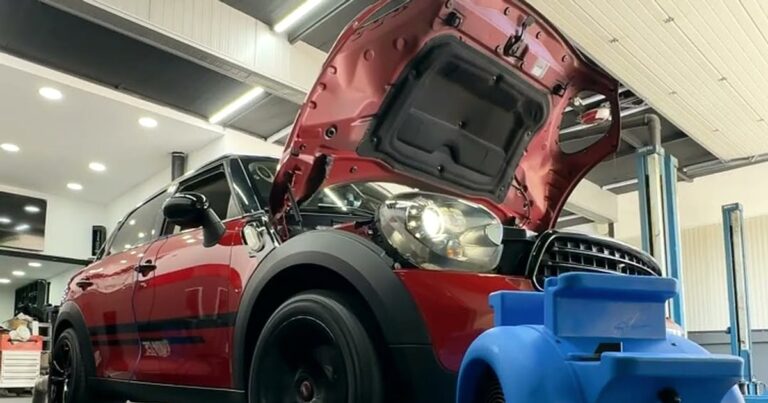
AWD dyno for precise power measurement
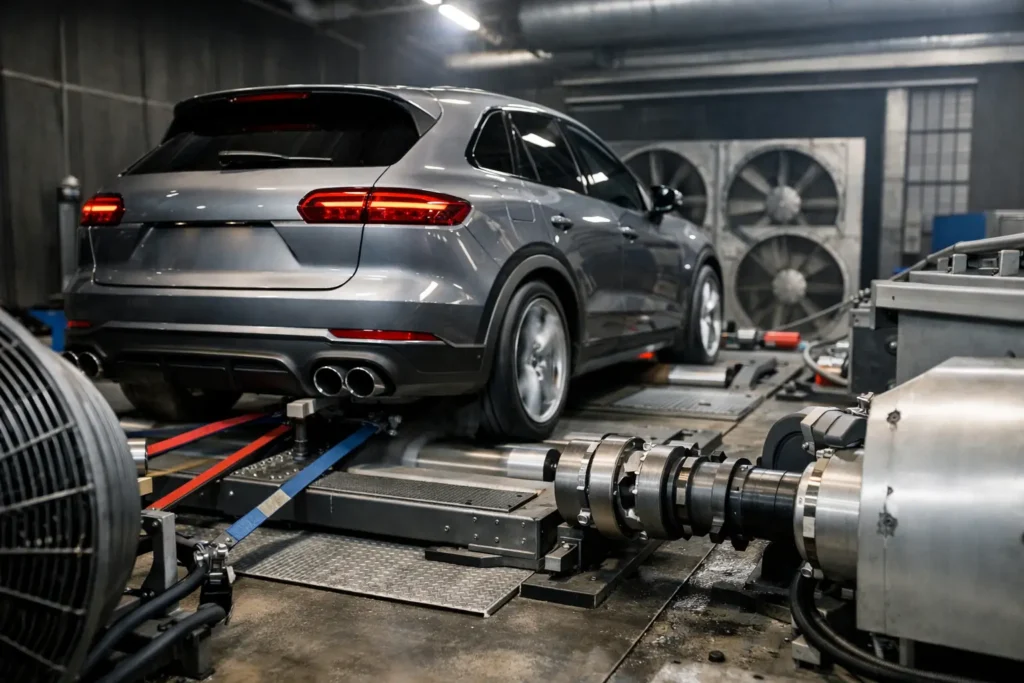
For all-wheel-drive vehicles, an AWD dyno isn't just a tool for showing peak power. It's a controlled measuring environment in which the operation of the engine, gearbox, drive system and electronics can be analysed under real load. That's the key difference between assuming a vehicle works well and having data that can confirm it.
For ECU or TCU calibration, quality measurement before and after a change gives a basis for a technically sound decision. Power matters, but the torque curve, turbo boost stability, intake air temperature, gearbox behaviour and drivetrain response often say much more about the vehicle's real condition.
What an AWD dyno measures and why it's different
An AWD dyno, a dynamometer for vehicles driven on both axles, uses rollers for the front and rear wheels that run in sync. This allows testing of vehicles whose drive force is split between the front and rear axle, without unnecessary load on the centre differential, coupling or transfer case.
A conventional single-axle dyno can be suitable for front- or rear-wheel-drive vehicles. However, with 4×4, AWD and some hybrid configurations, that approach can give unreliable results or trigger the vehicle's protection strategies. Modern drive systems constantly compare wheel speeds. If the electronics register a difference they interpret as slip, they can reduce power, change torque distribution or log a fault.
The synchronised rollers of an AWD system keep the front and rear axle speed ratio within the limits the vehicle expects. As a result, the engine, drive and transmission work in conditions closer to driving on the road, with the advantage of a repeatable and safe test environment.
The test result usually shows power and torque at the wheels. Depending on the measurement methodology, estimated engine power can also be shown. These two values shouldn't be confused. Wheel power is a directly measured value, while estimated engine power depends on the calculation of transmission losses and the procedure used. For before-and-after calibration comparisons, what matters most is that the tests are done under the same conditions.
Precision doesn't start with pressing the throttle
A reliable dyno result depends on vehicle preparation as much as on the unit itself. Tyres must be in good condition, correctly inflated and reasonably warmed up. Tyre pressure affects contact with the rollers, and therefore measurement stability. The vehicle must be secured correctly, without stressing the suspension and with no possibility of moving at full load.
Cooling also plays an important role. Under higher load, the engine and intercooler get far less natural airflow than when driving. A professionally directed ventilation system simulates airflow to the radiator, intake and intercooler to reduce the effect of heat soak. Still, you have to be realistic: a long series of full loads always raises operating temperatures. That's why enough time is left between measurements for stabilisation.
Fuel is another factor that mustn't be ignored. Quality, the octane rating on petrol engines, fuel temperature and the condition of the supply system can change how the engine behaves. On diesels, fuel pressure, exhaust gas temperature where available and boost system operation should be monitored. A dyno doesn't replace diagnostics – it makes them more concrete.
From a number to diagnostics
The greatest value of the test isn't one peak figure on the chart. A good reading shows where the engine makes its torque, how power rises through the revs and whether there's a deviation that needs checking. A flat or unstable curve can point to a limit in fuel delivery, turbo control, intake, exhaust, ignition or gearbox management.
On turbo engines, target and actual boost, ignition corrections, lambda values, intake air temperature and any intervention by protection maps are especially monitored. If the ECU closes the throttle, reduces torque or limits boost, the final power figure alone won't explain why. A data log during the measurement can.
On vehicles with an automatic gearbox and TCU control, the dyno also shows the quality of torque transfer. Uneven shifting, clutch slip, torque limits in a certain gear or an early gear change can hide the engine's potential. That's why ECU and TCU calibration often need to be seen as a connected whole, especially on vehicles with high factory torque.
AWD adds another dimension to the analysis. The behaviour of the rear axle coupling, centre differential or electronically controlled torque distribution system can be followed through the stability of the test and diagnostic data. If the drive system triggers protection, or if tyres differ in size or wear, the result can be compromised. That's why inspecting the vehicle before the test is part of a professional procedure, not an unnecessary formality.
When an AWD dyno is especially useful
Testing has clear value before any tuning, after ECU or TCU calibration, when checking a suspected loss of power and after fitting hardware parts. For vehicles arriving with an unknown previous map, a baseline measurement can reveal whether the engine even achieves the factory-expected behaviour before calibration parameters are changed.
After calibration, the chart should be interpreted in the context of the driving feel and the components' safety limits. A well-tuned car doesn't need an aggressive torque jump at low revs. With some gearboxes, turbos and drivetrains, more progressive torque delivery is the smarter choice because it preserves traction and reduces transmission load. The peak value isn't always the best calibration.
For workshops and professional tuners, repeatable AWD measurement allows quality control across many vehicles and configurations. For the owner, it gives transparent proof of the car's condition and the change after the work. This is especially useful on premium SUVs, sports saloons, dual-clutch vehicles and powerful diesel platforms, where torque distribution matters as much as power itself.
What a responsible test looks like
Before measurement, diagnostic faults, fluids, tyre condition, vehicle securing and operating temperature are checked. Then the right gear is selected, usually the one whose ratio is closest to 1:1, where the gearbox and vehicle logic allows. On automatic gearboxes, the procedure is adapted to how the transmission works, without forcing shifts that could trigger protection.
Measurements aren't done at random. Enough runs are needed to confirm repeatability, but not so many that the vehicle is unnecessarily heat-loaded. If the results differ, the technician must determine whether the cause is temperature, tyre slip, a change in boost, an electronics intervention or a mechanical problem.
U ASF Motorsport, AWD testing is part of a process in which calibration is based on data, not on universal promises. The Where Speed Meets Precision philosophy has a practical meaning here: performance should be measurable, controlled and matched to the real capabilities of the engine and drivetrain.
A result worth reading
A dyno chart should be kept together with information about the fuel, temperature, vehicle configuration and changes made. Only then does it become a useful technical record, not just a photo of peak power. If you're planning tuning or looking for the cause of a change in how your vehicle runs, start with a stable measurement and complete diagnostics – precise data is the best foundation for every next decision.