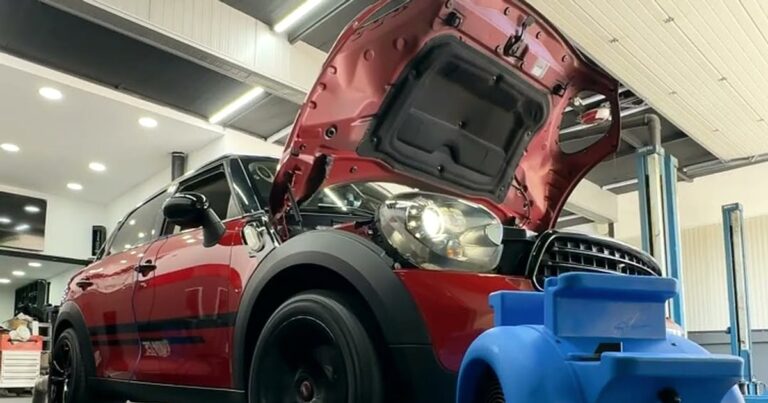
ASF Tuning chiptuning without guesswork

Power you can feel when overtaking, more precise throttle response or more stable automatic gearbox behaviour don't come from random software changes. ASF Tuning chiptuning is based on measurement, diagnostics and calibration of the parameters the vehicle manufacturer already uses to manage the engine and transmission. The goal isn't to promise unrealistic figures, but to adapt the specific vehicle's potential to its condition, purpose and mechanical limits.
On a turbo petrol or diesel engine, the difference after a well-made ECU calibration is often most visible in the mid-range. On naturally aspirated engines the gain is usually more moderate, but response and power delivery can be made more linear. For vehicles with an automatic gearbox, TCU calibration can be as important as the ECU work, because the engine and gearbox must work as one system.
What does chiptuning actually mean?
The name chiptuning dates back to when memory chips in control units were physically replaced. On modern vehicles the work is mainly done by reading and programming the original ECU software. The ECU, the electronic engine control unit, doesn't just control fuel quantity. At the same time it manages boost pressure, ignition timing, torque limits, throttle operation, temperature, protection functions and many other parameters.
That's why professional calibration isn't just raising one value. A change requires understanding the relationship between air, fuel, temperature, pressure and torque. If one limit is raised without aligning the other maps and protections, the result can be uneven running, overheating, clutch slip or faults being triggered.
On diesel vehicles there's special focus on torque control and thermal load. On turbo petrol engines, fuel quality, knock corrections, intake air temperature and cooling system capacity matter. With motorcycles, ATVs, UTVs, boats and work machines the approach differs further, because load, ventilation and duty cycle are completely different from a passenger car.
ASF Tuning chiptuning starts with diagnostics
Before any programming, you need to know the condition of the vehicle. A pressure sensor fault, poor airflow, a worn turbo, a fuel system problem or a gearbox irregularity aren't solved by remapping. On the contrary, extra load can make an existing problem more visible and more expensive.
Diagnostics therefore include checking stored and active faults, relevant live data, adaptations and the real behaviour of the drivetrain under load. On vehicles where it applies, requested and achieved values of pressure, airflow, fuel, temperature and torque are analysed. Only when the data shows a healthy basis does calibration make sense.
This step is especially important on used vehicles. An engine can run smoothly in light driving and yet not reach the requested turbo boost at full load or show excessive corrections. Good tuning doesn't hide such signals. It recognises them before a decision on further work is made.
Dyno measurement gives the numbers context
A power figure without the measurement conditions says little. Ambient temperature, fuel quality, tyre condition, drivetrain losses, slip and how the vehicle is strapped to the rollers can all affect the result. That's why a dyno test isn't just a final photo with a chart, but a tool for comparing behaviour before and after calibration in controlled conditions.
An AWD chassis dyno is especially valuable for all-wheel-drive vehicles, because it allows measurement without compromising how the drive system works. For motorcycles, a dedicated hub dyno measures at the hub and avoids the effect of tyre slip on a roller. This makes it easier to read changes precisely, especially when adjusting throttle response, fuel maps or running after intake and exhaust changes.
The most useful chart isn't necessarily the one with the highest peak. For an everyday car or work vehicle it's often more important that the torque curve is clean, predictable and available in the rev range actually used. For a track bike the priorities may differ. For a truck, tractor or industrial engine the emphasis may be on torque delivery under load and managing consumption in a clearly defined operating mode.
The ECU and TCU must be aligned
Modern automatic gearboxes constantly exchange data with the ECU. The gearbox uses information on requested and available torque to determine clutch pressure, shift timing and protective limits. If after calibration the ECU produces a different torque profile and the TCU stays completely stock, the gearbox can limit power or shift in a way that doesn't use the drivetrain's full potential.
TCU calibration can adjust shift logic, torque limits, clutch pressure and response to manual commands, always within limits appropriate to the specific transmission. That doesn't mean every car needs a TCU remap. A vehicle with a manual gearbox, a factory well-matched automatic or a car whose goal is only mild optimisation can have different needs.
On more powerful projects the mechanical side must also be considered. The clutch, flywheel, clutches in the automatic gearbox, differential and driveshafts have their own limits. A calibration that respects those limits often gives a better long-term result than an aggressive map built just for one peak run on the dyno.
One map isn't the answer for every vehicle
Two vehicles of the same model and year won't necessarily respond identically. Different fuel quality, altitude, climate, service history, factory software versions and fitted components change the starting point. A vehicle used every day in town doesn't have the same requirements as a car for occasional track days, a jet ski working in high temperatures or an agricultural machine under constant load.
That's why a good process doesn't come down to a generic file. The original software is identified and safely saved, the control unit's compatibility is checked, and changes are chosen according to real data and the owner's goal. After programming comes validation through diagnostics, a test drive or a dyno measurement, depending on the vehicle and type of project.
Vehicles with hardware modifications need special attention. A larger intercooler, different intake, modified exhaust, upgraded turbo or changed fuel system may need a completely different calibration strategy. Software should follow the hardware, not try to make up for its shortcomings.
How to recognise a professional approach
A quality service provider asks questions before talking about results. What's the vehicle, what condition is it in, what gearbox does it have, what fuel is used and what does the owner really want to achieve? The answers determine the direction of the work.
Transparency also means saying clearly when tuning isn't the next step. If diagnostics show a mechanical problem, the problem is fixed first. If the transmission shows signs of wear, increasing torque isn't a responsible solution. If the vehicle is intended for public roads, all relevant regulations and emissions systems must stay in line with local requirements.
ASF Motorsport builds this discipline through ECU and TCU calibration, diagnostics and measurable results on an advanced AWD chassis dyno and a motorcycle hub dyno. The Where Speed Meets Precision philosophy isn't about the highest number at any cost, but about controlled, verifiable performance development.
The real value of chiptuning shows when the vehicle responds naturally: the engine pulls decisively, the gearbox understands the requested torque and the data confirms the system is working within reasonable limits. Before deciding on a remap, ask about the vehicle's condition, the project goal and the validation process – that's where the precision begins that still matters after the first acceleration.