ASF file service for 950+ dealers worldwide
When a workshop takes in a vehicle with specific hardware, a known file service history (tuning since 2000) or a request for measurably better response, the quality of the file decides more than the reading tool itself. The ASF Motorsport (ASF Tuning) file service for a network of more than 950 dealers worldwide is based on calibrations that take into account the vehicle's real configuration, purpose and the technical limits of the drivetrain. That's the difference between a generic change and a professionally prepared solution.
For a workshop, a file service isn't just sending the original ECU or TCU read and waiting for the file to come back. It's a technical process in which the quality of input data, communication and software version checks directly affect the result. For the vehicle owner, it means performance isn't separated from reliability, diagnostics and everyday usability.
What a professional file service must solve
ECU calibration controls far more parameters than peak power. On a modern petrol or diesel engine, operating strategies include torque request, per-gear limits, boost, injection, ignition timing, intake air temperature, component protection and numerous corrections that kick in under different conditions. On vehicles with an automatic gearbox, the TCU calibration also determines shift logic, torque limits and clutch behaviour.
That's why a good file doesn't start with the question “How much power do you want?” It starts with questions about the engine, gearbox, mileage, fuel, vehicle modifications, active faults and the vehicle's purpose. A family SUV, a delivery van, a weekend motorcycle and a race project don't use the same compromise, even when they share the same basic engine.
A professional calibration must respect factory protection strategies when they protect the engine, turbo, fuel system or transmission. Increasing performance without controlling thermal load, fuel quality and torque limits may seem impressive in the short term, but it isn't an approach that builds a workshop's trust or long-term value for the owner.
The ASF Tuning file service and working through a dealer network
A network of over 950 professional dealers worldwide needs a standardised process, but not identical files for every vehicle. Vehicles differ by market, factory software, ECU hardware, standards, fuel and maintenance condition. Even two seemingly identical cars can have different control unit identifications, software versions or factory calibration strategies.
That's why the original file is first correctly identified. Data about the vehicle, the ECU or TCU, the read method and all relevant modifications matter. If there's an active fault or a symptom such as irregular running under load, regeneration, clutch slip or unstable boost, that problem must be understood first. A remap isn't a substitute for basic diagnostics and mechanical servicing.
ASF Motorsport approaches file service work from a calibration perspective, not mass file processing. Every request should have a clear technical basis: what the vehicle is, what its current condition is, what result is realistic and which system limits must be kept. This approach lets the dealer explain to the customer what's being done and why, instead of relying on unverified figures.
Precision starts with the original read
The original file is the reference point. A faulty read, the wrong protocol or a file previously modified without documentation can significantly complicate the job. That's why the workshop should save the original, record the identification data and check the checksum when the tool and ECU require it.
With certain units, extra precautions are needed because of tuning protection, virtual reads, bench procedures or boot mode work. There's no universal rule that suits every ECU. The right choice of procedure depends on the specific control unit and supported tools, and the goal is always the same: a safe read and reliable programming.
The calibration is checked in real conditions
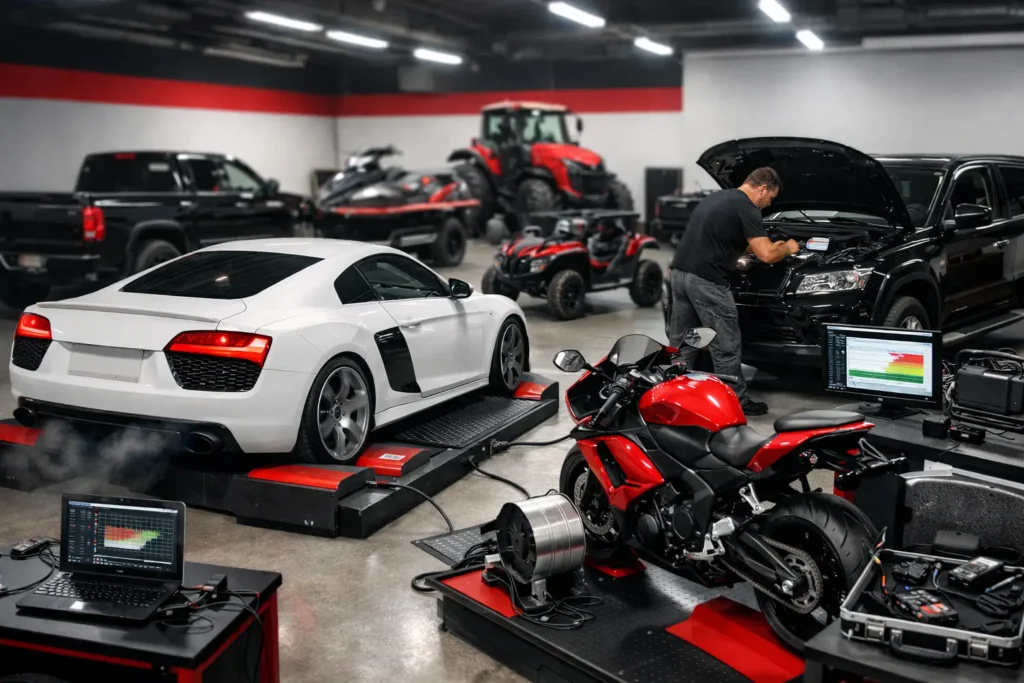
Dyno testing is a valuable tool because it gives controlled, repeatable data on power, torque and engine behaviour under load. Still, the dyno isn't the only check. Data logs while driving can show requested and actual boost, temperatures, ignition corrections, fuel quantity, turbo position, torque limiters and gearbox behaviour through real operating modes.
The best method depends on the vehicle. For a powerful car with a complex drivetrain, an AWD chassis dyno can provide valuable control. For a motorcycle, a hub dyno allows precise measurement without the variations of tyre-to-roller contact. With work machines, trucks and agricultural equipment the priority often isn't peak power, but more stable torque, better response under load and predictable behaviour over long work cycles.
Dealer support isn't just delivering a file
The dealer is the person who sees the vehicle, talks to the owner and takes responsibility for a proper installation. That's why a file service must provide more than a technically modified file. Clear requirements before programming, an understanding of the project goal and support when there's a mismatch between the expected and actual behaviour of the vehicle are all needed.
Good communication is especially important for vehicles that already have a modified intake, exhaust, turbo, intercooler, clutch or fuel system. Every change can alter how the engine responds. Modified hardware doesn't automatically mean a more aggressive calibration should be applied. First it should be confirmed that the hardware works as intended and that the supporting systems can handle the desired load.
With TCU tuning requests, the workshop should pay attention to gearbox oil condition, adaptations, slip and existing faults. Faster gear changes and different torque limits can improve response, but only when aligned with the transmission's capabilities and the ECU strategy. The ECU and TCU shouldn't be treated as separate projects if together they manage the same flow of torque.
Where extra caution is needed
Not every request is equally simple. Vehicles working under constant load, using fuel of varying quality or with high mileage need a more conservative approach. This applies to commercial vehicles, tractors, construction equipment, boats and many ATV or UTV applications, where downtime can cost more than a small performance gain.
Before calibration, mechanical defects should be fixed: air leaks, faulty sensors, worn spark plugs, fuel problems, a weak battery, gearbox faults or overheating. A file can optimise a healthy system, but it can't repair a fault. Also, every intervention must comply with local regulations, homologation and road emissions requirements.
Why the scale of the network has value
More than 950 dealers doesn't mean every project is routine. The value of the network is that professional workshops in different markets can get structured support for a wide range of vehicles – from passenger cars and motorcycles to trucks, boats and industrial engines. Broad coverage only makes sense if it's backed by a consistent working standard.
For the vehicle owner, the local dealer provides direct inspection, diagnostics and communication. For the workshop, a centralised file service brings a technical database and calibration experience. That combination reduces room for assumptions, especially on complex platforms where one wrong piece of data can change the whole course of a project.
When the original read, vehicle condition, calibration goal and post-programming check are all at the same level, tuning becomes a controlled engineering procedure. That's exactly where the phrase Where Speed Meets Precision takes on real meaning: not in promising unrealistic results, but in a careful decision for every vehicle that leaves the workshop.